Mozartkugel: What It Is and Where to Buy It in Austria
A Mozartkugel is pistachio marzipan and nougat in chocolate. Learn how it is made, why Fürst calls its version original, and where to buy it in Salzburg.
On this page
A Mozartkugel is a round chocolate covered in a thin shell, filled with pistachio marzipan and hazelnut nougat. It has no real connection to Mozart beyond the name, which Salzburg confectioners attached to the candy in the nineteenth century. This guide covers what is inside, the quarrel over who invented it, how to read the wrapper, and where to buy a box in Salzburg.
Buy them in Salzburg rather than a supermarket if you want the handmade version, and expect the price to scale with box size and with how much of the work is done by hand. The famous blue-and-silver foil is a clue rather than proof, and the label rules matter more than the color.
What a Mozartkugel is and how it tastes
The classic construction is a core of pistachio marzipan, a layer of hazelnut nougat around it, and a dark chocolate coating. The combination is sweet and nutty rather than bitter, and the pistachio reads as a faint green note inside the nougat. Salzburg walking-tour operators describe the ball the same way, as marzipan, nougat and pistachio wrapped in chocolate.
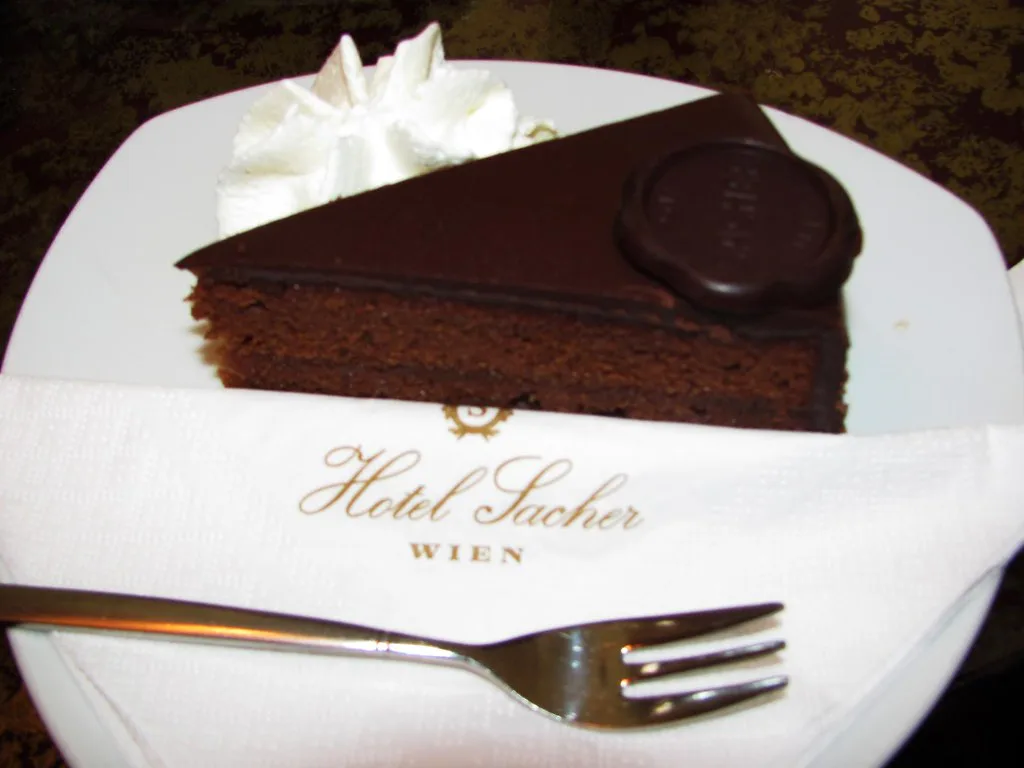
If you have eaten a Sachertorte, which pairs dense chocolate cake with apricot jam under a chocolate glaze, the Mozartkugel is the opposite experience: small, layered and built around nut pastes rather than cake. It belongs with the other sweets in this survey of Austrian desserts.
Austrian confectioners also sell variations on the theme. Braunpunkt, a Salzburg chocolate shop, offers its house Mozartkugel with marzipan or without it, loose or boxed, and also sells praline assortments, single-origin style tablets and gift vouchers.
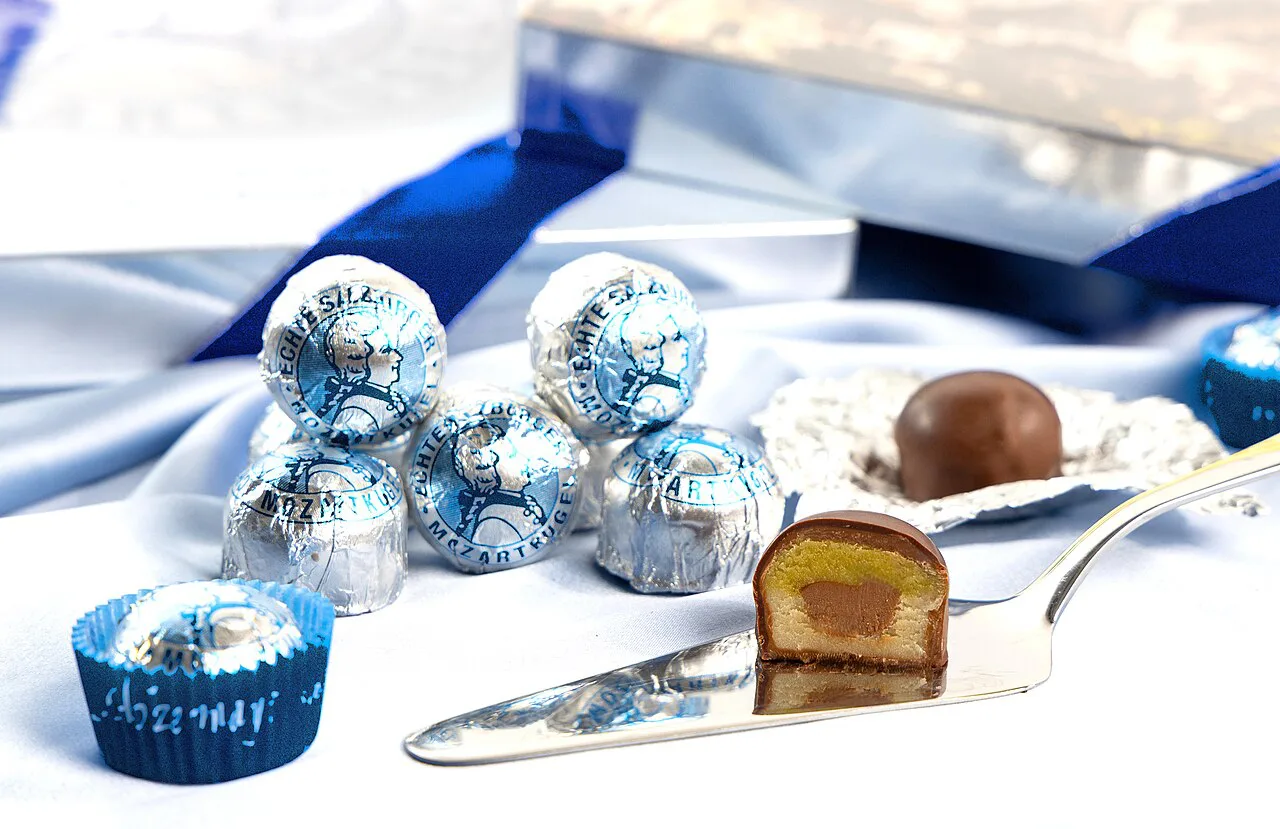
Why it is called a Mozartkugel
Salzburg rediscovered Mozart in the middle of the nineteenth century, roughly fifty years after his death, and a Mozart cult followed: the statue went up in 1842 and products began carrying his name. The chocolate ball was invented about a hundred years after Mozart died and named for him.
Are Mozartkugeln still made? Yes. Fürst still hand-makes its Original Salzburger Mozartkugel in Salzburg, Braunpunkt makes a house version, and the mass producers Mirabell and Reber turn out the candy for supermarkets across Austria.
Do Mozartkugeln contain alcohol? The classic Mozartkugel is built from pistachio marzipan, hazelnut nougat and chocolate, with no alcohol involved. Pralines and praline assortments are a different matter: Braunpunkt sells both alcohol-free and with-alcohol praline boxes, so check the label on mixed boxes.
Can I buy Mozartkugeln outside Salzburg? Supermarket brands such as Mirabell and Reber are sold across Austria. Fürst sells only through its own Salzburg shops, with no branches in other Austrian cities, so a Fürst box has to be bought in person in Salzburg.
The candy was first called a Mozartbonbon and only later became the Mozartkugel.
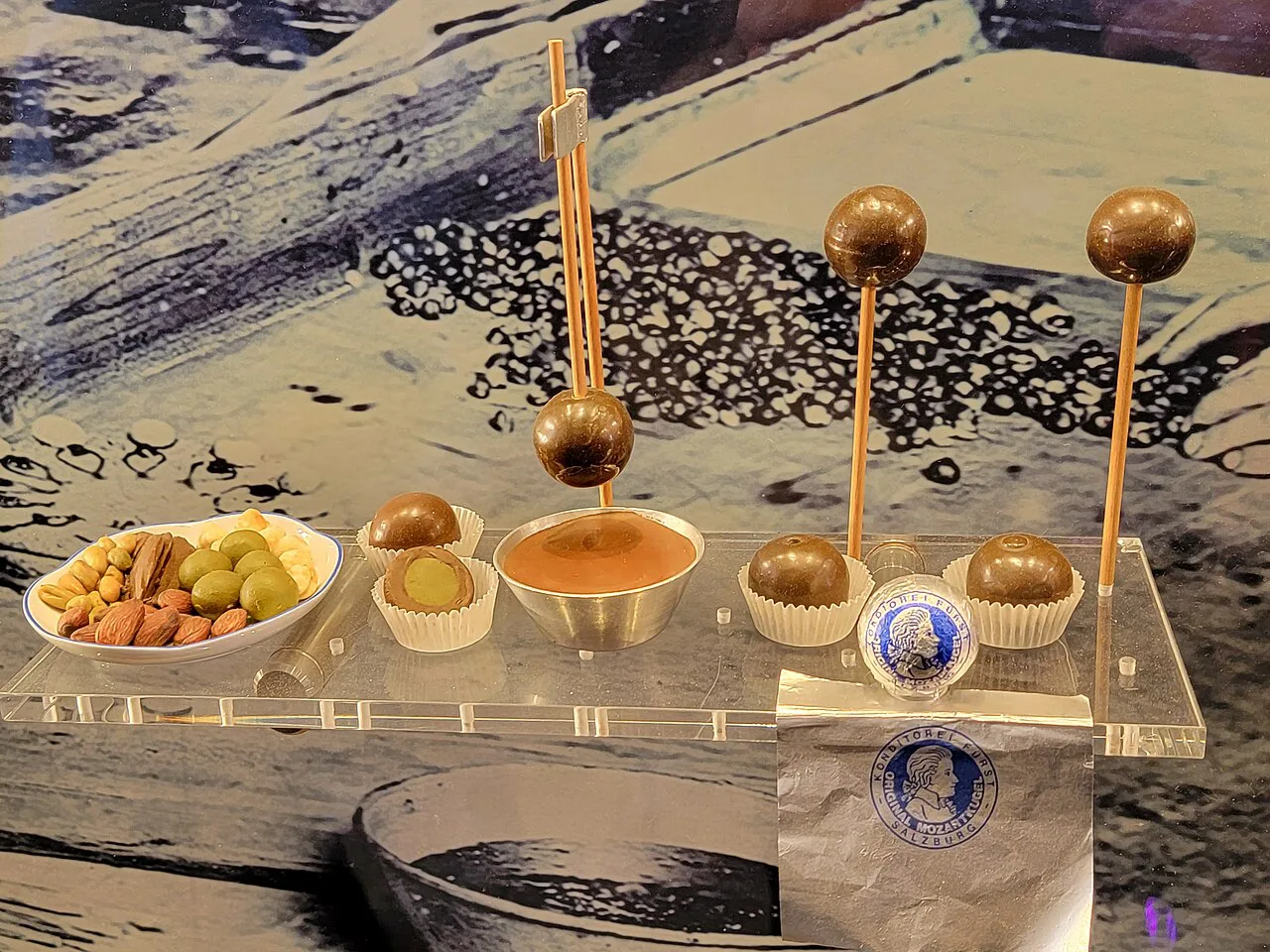
Fürst and the 'Original Salzburger Mozartkugel'
Konditorei Fürst credits Paul Fürst, a master confectioner, with creating the candy around 1890, as the hundredth anniversary of Mozart's death approached. The firm says he presented it in Paris and won a gold medal, and that he failed to patent it, which is why other confectioners copied it almost immediately.
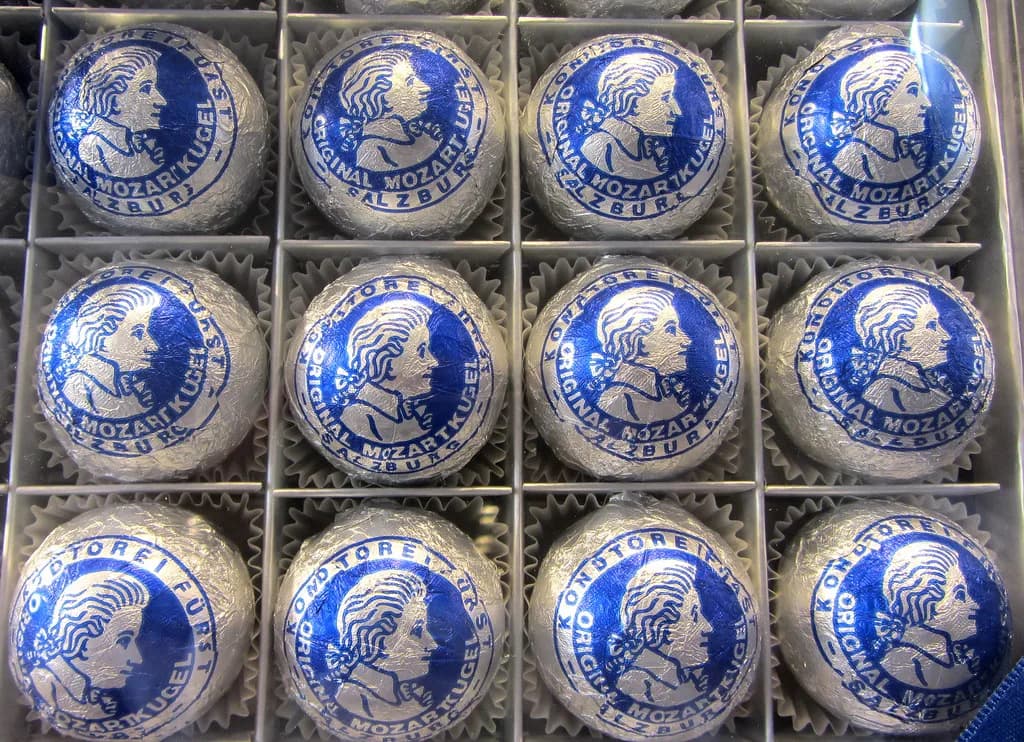
The Fürst version is still made by hand and wrapped in blue-and-silver foil. The company has held the right to call its product Original Salzburger Mozartkugel since 1996, after court cases against other makers.
The house where the firm began stands in the Brodgasse in Salzburg's old town.
The rival claim: an 1881 advertisement
The origin story is contested. Historian Gerhard Ammerer, working on a book about the Mozartkugel, found an advertisement in the daily Die Presse dated 3 February 1881 for a Salzburger Spezialität Mozartkugeln, hand-made by the confectioner R. Baumann in Salzburg, and the notice even advertised shipping the candy.
Baumann's business was the predecessor of today's Confiserie Holzermayr on the Alter Markt, and Alexander Truschner, a great-grandson of the firm's founder Josef Holzermayr, has said the history of the Mozartkugel must be rewritten. Ammerer considers a reassessment of the legend unavoidable; Martin Fürst, who runs the firm today, maintains that Paul Fürst invented the Original Salzburger Mozartkugel.
Treat the question as two competing claims rather than a settled fact, and judge the candy in the shop rather than the marketing on the tin. The same mix of legend and pastry clings to Kaiserschmarrn.
Original versus supermarket versions
The labels carry distinct words. Only Fürst may call its product Original Salzburger Mozartkugeln; the Austrian mass producer Mirabell sells Echte Salzburger Mozartkugeln, and the German firm Reber, which makes roughly half a million of the candies a day, must label its product Echte Reber Mozartkugel and may not use the word Salzburg at all.
The difference is not only legal. Fürst candies are hand-made and sold only through the company's own shops in Salzburg and not through other retailers, while the supermarket brands turn up across Austria in red-and-gold foil.
How to read the wrapper
Fürst wraps its candies in blue-and-silver foil, while Mirabell, Reber and other supermarket brands use red and gold. The catch is that plenty of other confectioners and souvenir shops make their own Mozartkugeln and wrap them in blue and silver to suggest they are Fürst's product.
The packaging has been litigated, too: in 2017 the Oberster Gerichtshof barred the manufacturer Braunpunkt from selling its Mozartkugeln in silver-blue packaging too close to Fürst's. Read the brand name first, then the foil.
Where to buy Mozartkugeln in Salzburg
Fürst sells through its cafés on the Alter Markt, where the candy was invented and is still made, and on the Mirabellplatz, plus two small shops on the Getreidegasse and at the Ritzerbogen; the firm has no branches in other Austrian cities.
Braunpunkt has shops on the Judengasse and the Getreidegasse, and sells its own Mozartkugeln and chocolates from European makers; it ships orders in cooled packaging during warm weather.
What a Mozartkugel costs
Prices vary by maker and by box size, so treat any single figure as one shop's offer rather than a national standard. At Braunpunkt, the house Mozartkugeln run from a six-piece box at 16,90 € through nine pieces at 25,90 € and twelve pieces in a tin at 34,90 € to a sixteen-piece mixed box at 42,90 €, with loose ten-piece bags at 24,00 €.
That works out to roughly 3 € to 3,50 € per piece in the smaller boxes and less per piece as the box grows, which makes the larger boxes the better value if you are buying for several people. The praline assortments cost 21,90 € for nine pieces and 38,90 € for sixteen, and the tablets are 9,90 € each.
If you want to buy from Fürst, compare the sizes it sells at the counter; a small box is the sensible choice if the candy has to survive a flight home.
Buying and carrying them home
Chocolate does not enjoy a hot car or a summer suitcase, so buy your boxes close to departure rather than at the start of a tour. Braunpunkt ships orders in cooled packaging during summer, which matters if you are ordering rather than carrying.
Weight is the other constraint: pralines and tablets fill a bag quickly and the larger tins add bulk, so a couple of small boxes usually make more sense than one big one.
Where the Mozartkugel fits in Austrian sweets
Think of the Mozartkugel as Salzburg's contribution to a long Austrian dessert habit that also produced the Sachertorte in Vienna and the Linzer Torte, the latticed jam tart named for the city of Linz.
Salzburg has its own dessert, the Salzburger Nockerl, a sweet soufflé-like dish.
The strudel tradition belongs here too, from the Apfelstrudel recorded in the collections of the Wienbibliothek im Rathaus to the older Habsburg Empire kitchens that shaped it.
Eat your chocolate with coffee, as Austrians do, and use the coffee house ritual as the frame: an espresso at the bar, a melange at a table, and no rush. For the ritual itself, see this guide to Austrian Coffee House Culture.
Which Mozartkugel to buy
Choose Fürst if you want the handmade Salzburg candy in its blue-and-silver foil, sold only in the firm's own Salzburg shops. Choose Braunpunkt if you want a box with a clear price on it and a mix of house-made and other European chocolates.
For supermarket versions, the wrapper tells you what you are getting: Mirabell is Echte Salzburger Mozartkugeln and Reber is Echte Reber Mozartkugel, both honest labels for an industrially made candy.
Explore more Austria guides
Frequently Asked Questions
Are Mozartkugeln still made?
Yes. Fürst still hand-makes its Original Salzburger Mozartkugel in Salzburg, Braunpunkt makes a house version, and the mass producers Mirabell and Reber turn out the candy for supermarkets across Austria.
Do Mozartkugeln contain alcohol?
The classic Mozartkugel is built from pistachio marzipan, hazelnut nougat and chocolate, with no alcohol involved. Pralines and praline assortments are a different matter: Braunpunkt sells both alcohol-free and with-alcohol praline boxes, so check the label on mixed boxes.
Can I buy Mozartkugeln outside Salzburg?
Supermarket brands such as Mirabell and Reber are sold across Austria. Fürst sells only through its own Salzburg shops, with no branches in other Austrian cities, so a Fürst box has to be bought in person in Salzburg.
Sources
Notes for your next Austrian town break
Optional updates when we add or revise town guides.
You might also like
Continue reading
More guides you'll find useful