Weissenkirchen in der Wachau: Fortified Church, Square and Danube
Weissenkirchen in der Wachau pairs a fortified Gothic church with the Teisenhoferhof and a Danube ferry. See what to visit and how the town fits a route.
On this page
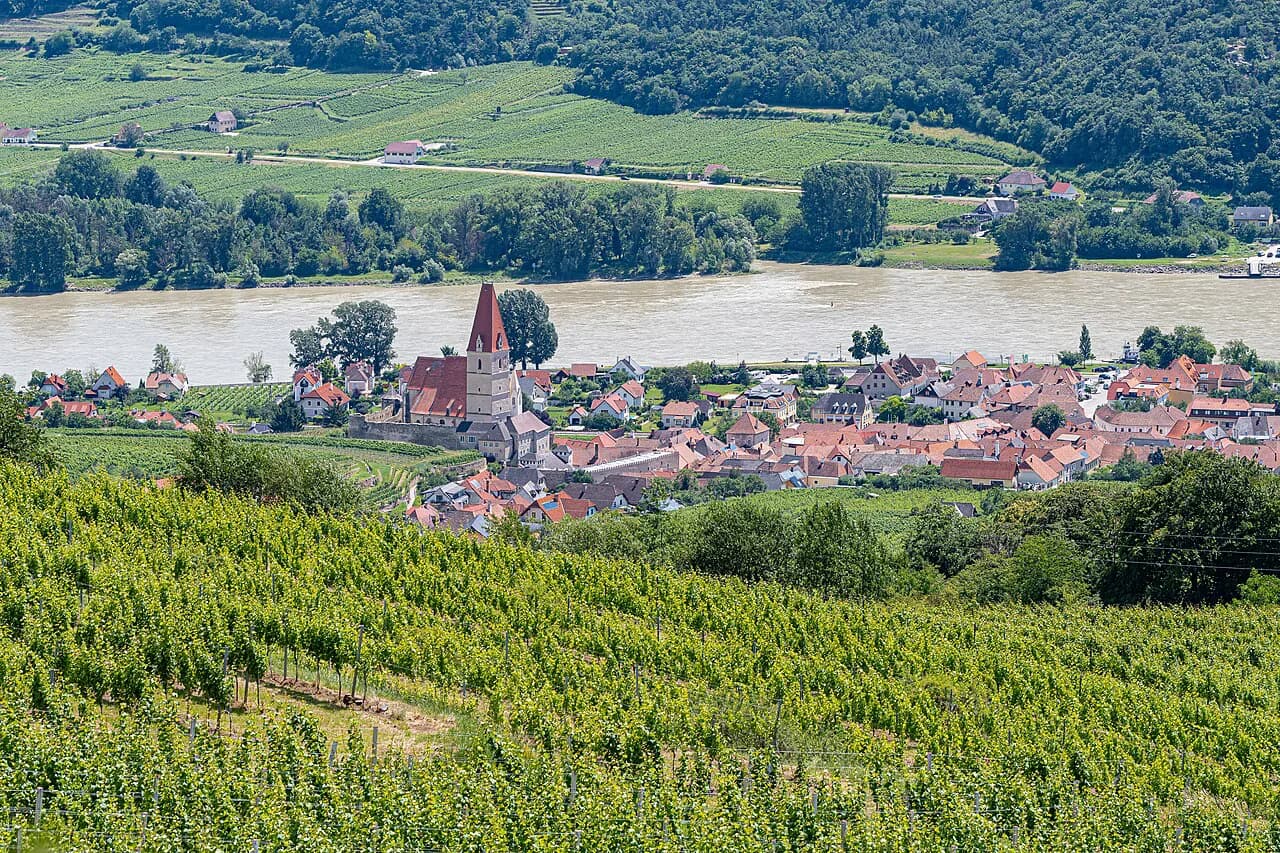
Weissenkirchen in der Wachau is a small wine village on the Danube between Krems and Melk, and its historic core fits into roughly an hour on foot. The village climbs a short slope from the river to a fortified white Gothic church, and the market square, the Teisenhoferhof and a small local museum sit within a couple of minutes of it. This guide covers the church and its defenses, the square, the museum, the ferry and train links, and how the village slots into a Krems–Melk day.
Treat Weissenkirchen as one stop on a Danube route rather than a destination of its own: it is the largest wine-growing community in the Wachau and the center of a municipality that also takes in the smaller villages of Joching, Wösendorf and St. Michael. It sits mid-valley, so it works equally well approached from Krems in the east or Melk in the west.
Where Weissenkirchen sits between Krems and Melk
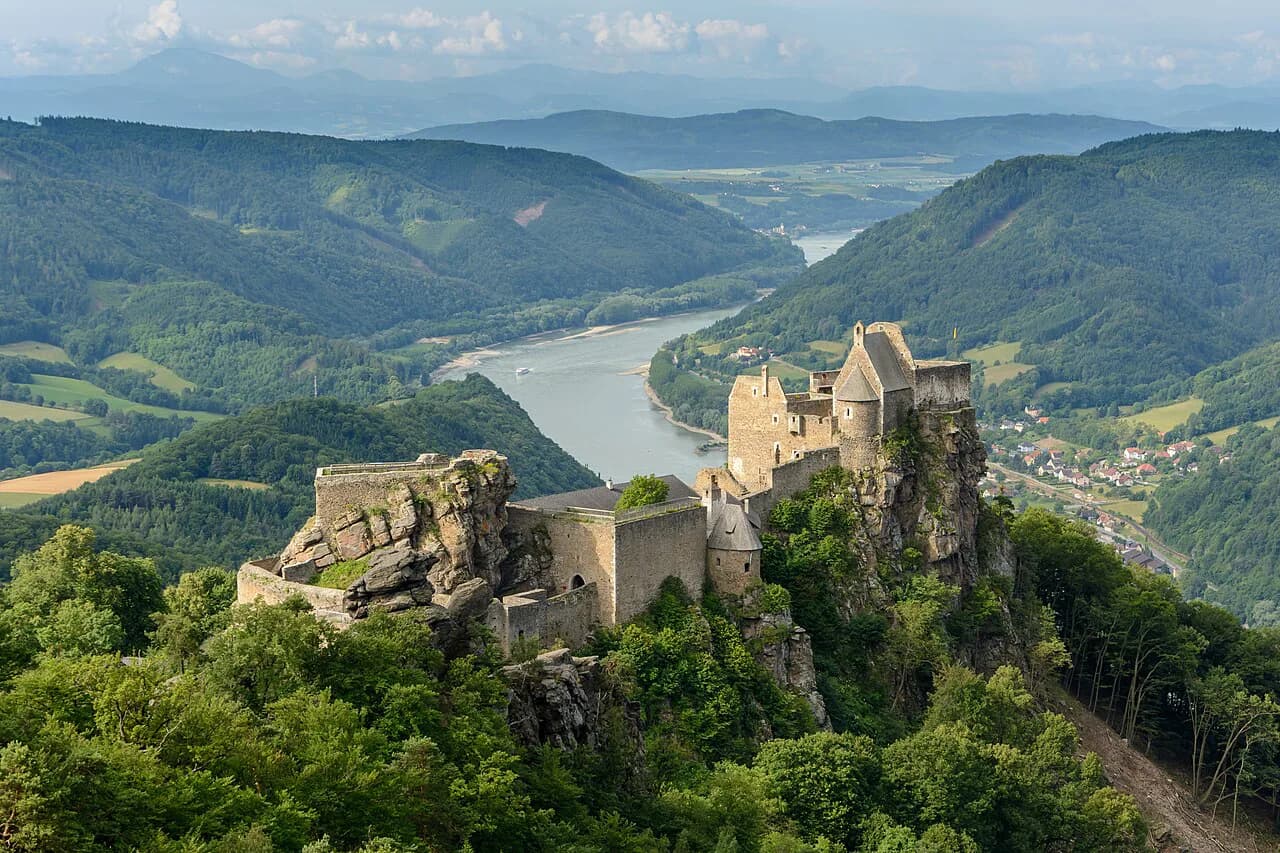
The Wachau is an 18-mile stretch of the Danube valley in Lower Austria running between Krems and Melk, and it holds UNESCO World Heritage status. Weissenkirchen lies in the middle of that run, on the north bank, which makes it a natural halfway halt rather than an add-on at either end.
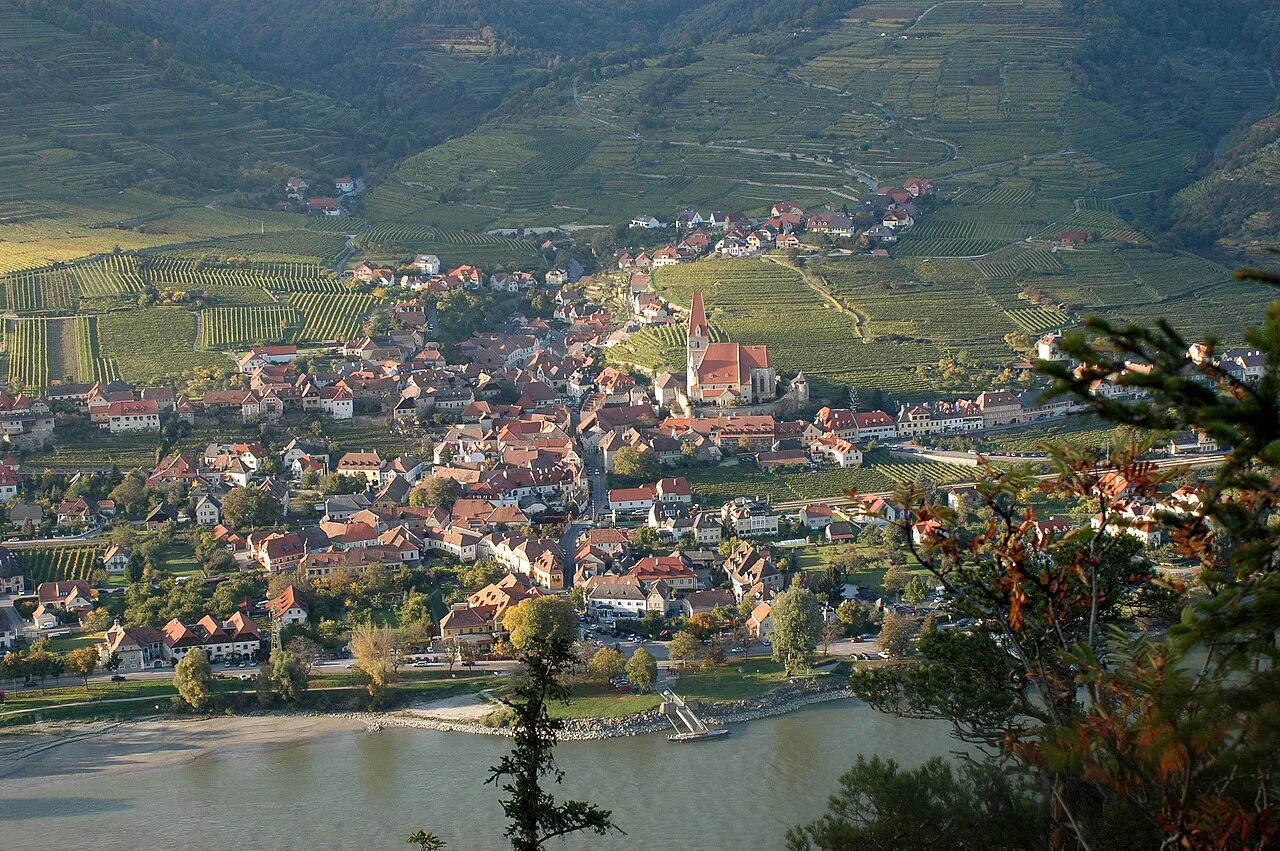
The municipality spreads beyond the riverside core: Joching, Wösendorf and St. Michael are separate hamlets in the same community, so the name on a train sign covers more ground than the compact center. The valley's terraced vineyards and apricot orchards fill the slopes on both sides, and the village is accordingly a wine community first and a sightseeing village second.
Read the village in this order: church and fortifications at the top, the Teisenhoferhof closing the market square just below it, then the riverside road, ferry landing and train halt. That sequence saves you from walking the slope twice, and it keeps the historic core as one compact loop.
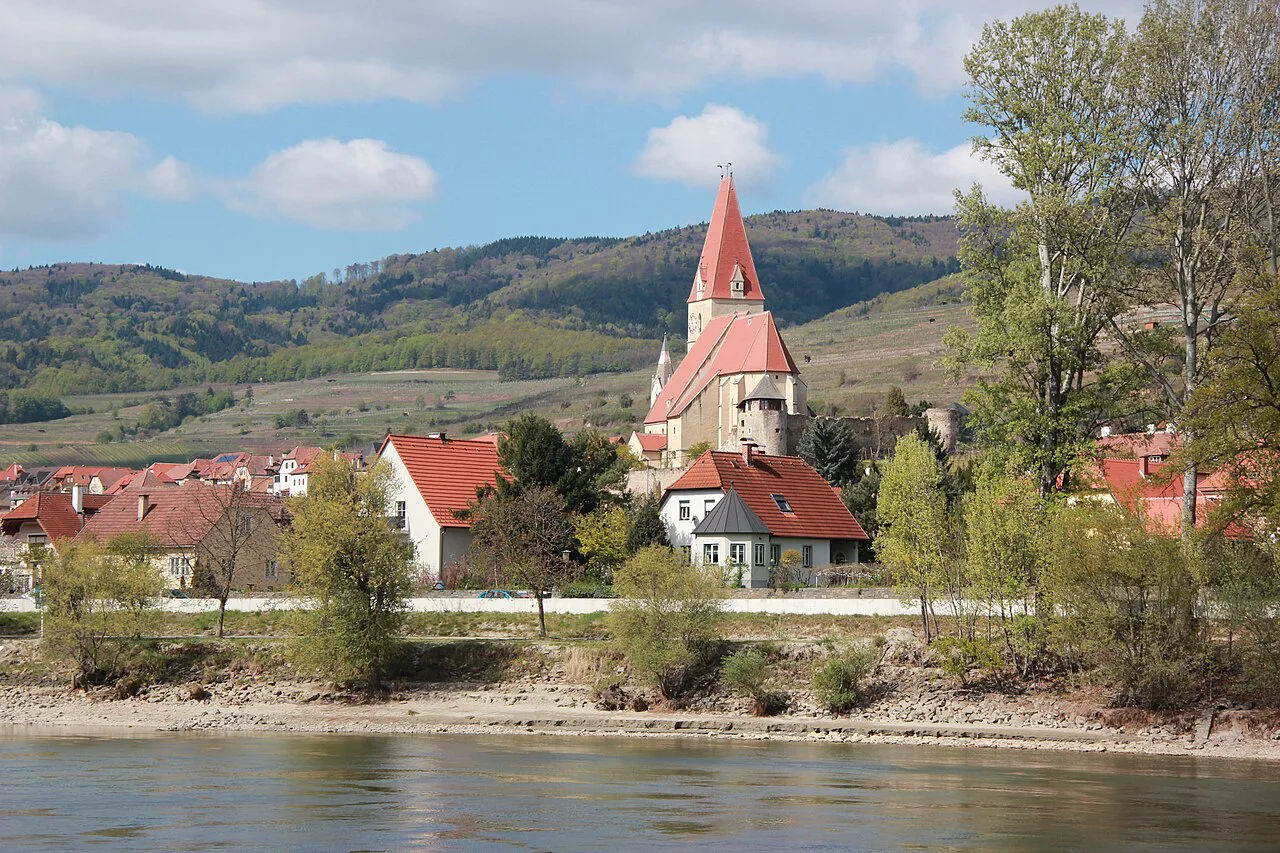
Why the village is called Weissenkirchen: the white fortified church
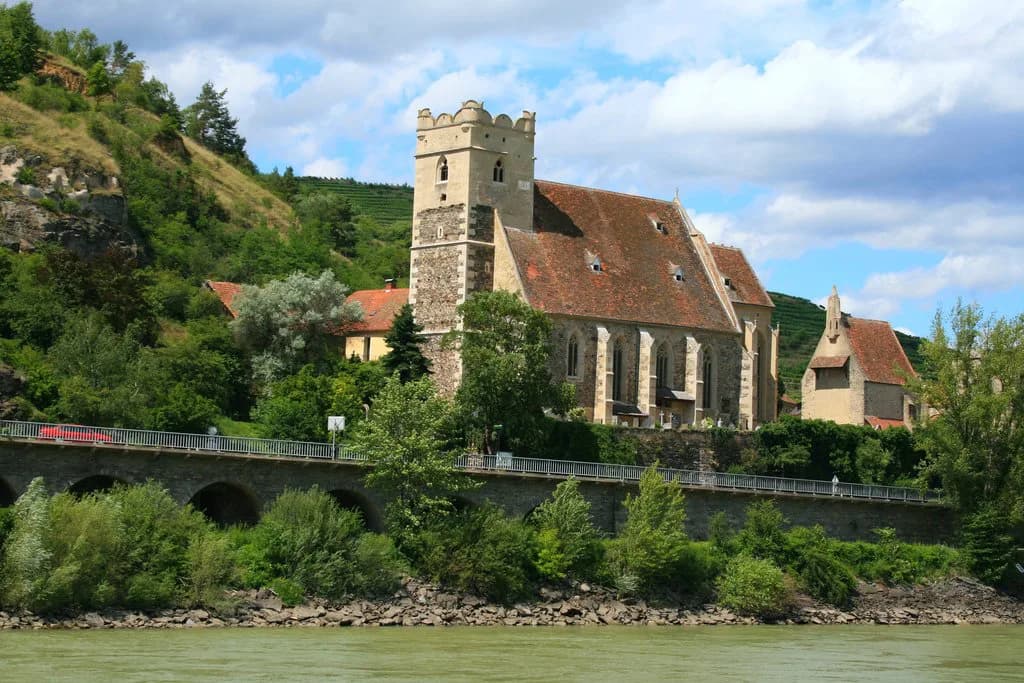
The landmark that dominates the rooftops is a large white stone Gothic church, built with defensive walls and originally as a defense against the Turks rather than only as a place of worship. Its appearance from the river and from the vineyard terraces above is the village's signature view.
The fortifications are part of the visit, not decoration: the churchyard walls and towers formed the village's refuge in times of danger. Walk the outside of the church first to read the walls and the gate, then go inside if the doors are open.
The church is an active parish, so treat the interior as a working church rather than a monument on a schedule. Published service times and any visitor restrictions are posted at the church itself and through the parish; check those before planning an interior visit.
The Teisenhoferhof and the top of the market square
At the upper end of the market square, the Teisenhoferhof forms a deliberate defensive close to the square, joining the church's fortification line. It was built in 1335 as a Gothic structure to form a defensive end to the market square, later reworked in Renaissance style, and it is counted among the finest Renaissance farm buildings in the Wachau.
For a visitor, this is the most photogenic assembly in the village: square, farm building and church wall stand within a few steps of one another. Allow time to stand back at the lower end of the square to see how the buildings close the view.
The building is a heritage structure, and access to its courtyard depends on what is open on the day. Look for signs at the entrance rather than assuming the interior is walkable.
The 1385 school next to the church
Beside the church stands a school whose origins are dated to 1385, and it is described as the oldest elementary school in Austria still in operation. It is a working school, so the interest is in the building and its setting next to the fortifications, not in a tour.
Pass it on the way between the church and the square, usually a minute or two of your walk. On school days, keep noise down and stay outside the entrance.
Wachau Museum and the market square on foot
The market square is small and enclosed, ringed by wine-growers' houses, and it reads clearly in a single sweep. The Wachau Museum sits in the village center and gives context on the valley's wine growing and rural life.
Seasonal opening is the deciding factor: small valley museums commonly close outside the warmer months, so confirm the museum is open for your dates before you build the visit around it.
The walking route is short: ferry landing to church and square is a climb of a few minutes, and the whole center can be seen in about an hour at an unhurried pace. Add time for the museum if it is open.
The riverside, the Danube ferry and the local train stop
The riverside road carries the everyday life of the village, and the Danube bank here is a working transport corridor as much as a viewpoint. The local train stops in Weissenkirchen, and Danube river boats call at the village during the season.
A car ferry crosses the Danube at Weissenkirchen and takes foot passengers, bicycles, motorcycles and cars. That makes the south bank reachable directly, without driving back to Krems or Melk to find a bridge.
Ferry operating times and boat schedules change with the season, so confirm them on the operator's own timetable for your travel date rather than relying on a posted board from another year.
Getting there and onward: train, boat, ferry and road
The simplest spine for a Wachau day is the Danube's left bank: local trains link the villages between Krems and Melk, and the river boats offer a one-way alternative along the same stretch. Use the train for speed and certainty, the boat for the river view.
If you drive, the valley road runs close to the river through the villages, and the car ferry adds a crossing point mid-valley. The trade-off is that parking in the small centers is limited, while the train and ferry drop you directly in the village.
Cyclists have a dedicated route along the bank and can use the ferry to switch sides, then continue by train with a bike if the day runs long. Train timetables and boat schedules are the two things to check before setting out.
How Weissenkirchen fits a Krems–Melk route
On a westbound day from Krems, Weissenkirchen makes a good middle stop: see the church and square, then continue toward Spitz or Melk in the afternoon. Approached from Melk, it works as the last valley stop before returning east.
The pairing with Melk is the obvious one on the western end: the abbey, rebuilt by Jakob Prandtauer, is a large, formal baroque complex, while Weissenkirchen is small, defensive and Gothic. Seeing both in one day gives you the two poles of Wachau architecture.
Dürnstein, east of the village, adds a ruined castle and a blue church tower on the same bank, so a chain of Krems, Dürnstein, Weissenkirchen and Melk is realistic if you keep each stop short.
Joching, Wösendorf and St. Michael: the wider municipality
Joching, Wösendorf and St. Michael are the small wine villages that belong to Weissenkirchen, each a cluster of houses and cellars among the vineyards. They are not separate stops so much as extensions of the same community, and they explain why the municipality is the valley's largest wine-growing one.
If you arrive by car or bicycle, a loop through these hamlets shows the vineyard landscape behind the riverside village; on foot from the center it means a longer walk without much in the way of sights.
Is Weissenkirchen worth a stop on your Danube day?
Yes, if you want a compact, real wine village with one strong architectural set piece: the fortified white church, the Teisenhoferhof closing the square, and a school that has been in use since the 14th century. Budget about an hour for the center, more if the Wachau Museum is open.
Skip it as a standalone trip and use it instead to break the Krems–Melk run, riding the train or boat one way and the ferry across if you want the far bank. Confirm seasonal boat and ferry times before you commit to a one-way boat plan.
Explore more Krems guides
Frequently Asked Questions
What country is Weissenkirchen in?
It is in Austria, in the state of Lower Austria, in the district of Krems-Land. The village lies on the north bank of the Danube in the Wachau valley between Krems and Melk.
What is the Wachau Valley famous for?
The Wachau is known for its terraced vineyards and apricot orchards along the Danube, for wine villages such as Weissenkirchen, Dürnstein and Spitz, and for baroque monasteries including Melk Abbey. The valley is a UNESCO World Heritage Site on an 18-mile stretch of the river.
How do I get to Weissenkirchen without a car?
Use the local train along the Danube between Krems and Melk, which stops in Weissenkirchen, or take a river boat during the season. A car ferry also crosses the Danube here and carries foot passengers and bicycles, so you can arrive from the south bank. Check the current timetable for your date.
Sources
Notes for your next Austrian town break
Optional updates when we add or revise town guides.
You might also like
Continue reading
More guides you'll find useful