Korneuburg, Austria: Old Town, Town Hall and Kreuzenstein
Korneuburg pairs a neo-Gothic town hall on the Hauptplatz with the medieval Stadtturm and Burg Kreuzenstein, an easy stop on the Danube north of Vienna.
On this page
Korneuburg works as a half-day stop, not a destination in itself: the old center is compact, and Burg Kreuzenstein above the town is what justifies the detour. The town sits on the Danube just north of Vienna, at the southern edge of the Weinviertel, which makes it a natural first or last stop on a Lower Austria loop. This guide covers the Hauptplatz and its town hall, the medieval tower, the castle and its falconry, and how to reach each part without wasting a day.
Where Korneuburg sits and what it is
Korneuburg lies on the left bank of the Danube, north of Vienna and south of the rolling farmland of the Weinviertel. The town's own history pages trace its origins to a small trading and market settlement first mentioned in the twelfth century, which explains why the center is small and functional rather than monumental. Treat it as a stop on the way somewhere else, not a place you build a trip around.
What you get is one tight old center around the Hauptplatz, a riverside park area, and two outlying sights: the castle hill above town and the fossil reef site at Stetten. That split matters for planning, because only the center is genuinely walkable from the station. Pair Korneuburg with a Danube route or a Weinviertel loop rather than expecting a full day of urban sightseeing.
The Hauptplatz and the neo-Gothic Rathaus
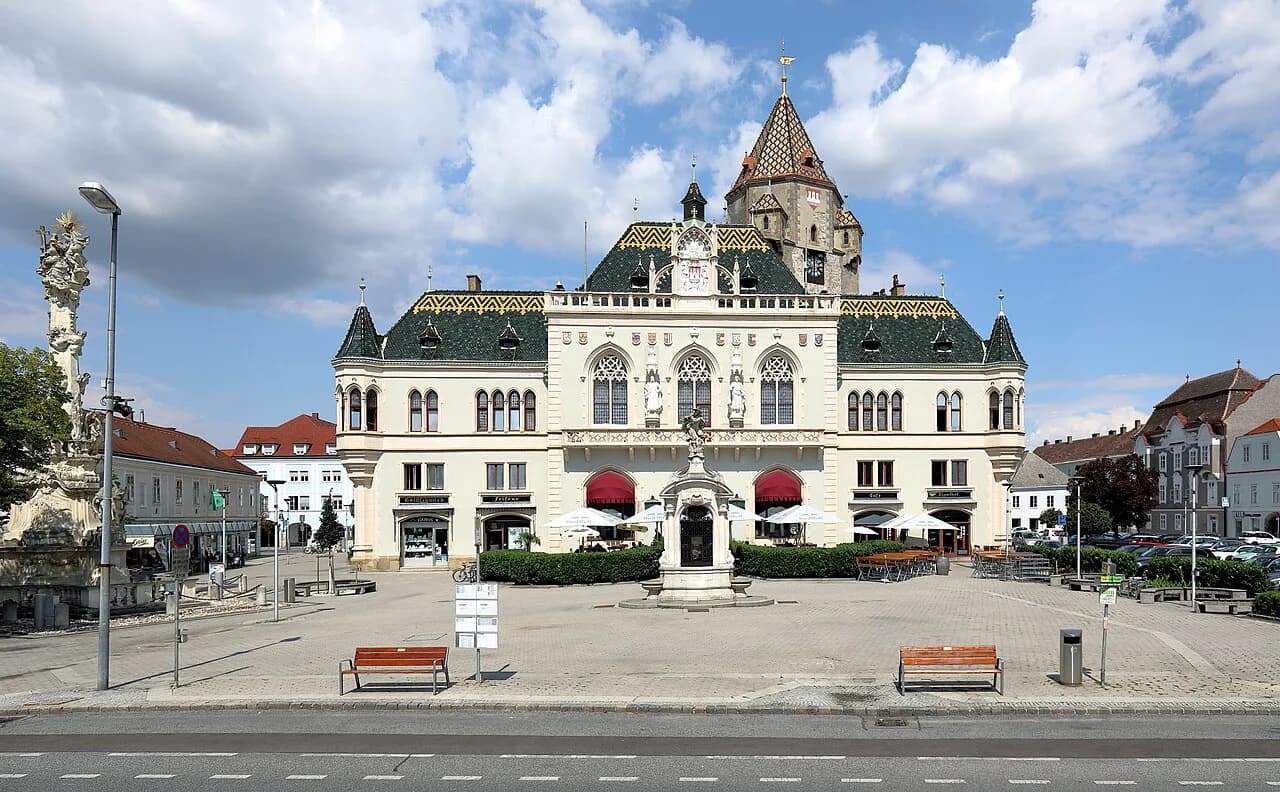
The Rathaus Korneuburg stands in the middle of the Hauptplatz, a large, irregular four-winged neo-Gothic building crowned by a hefty tower. The town's history page dates the town hall to 1894/95, so what you see is a late-nineteenth-century statement piece rather than a medieval hall. It is the most prominent building in the center and the natural place to start a walk.
The Hauptplatz is the address of the municipal offices at number 39, which is a useful orientation point on a map. Read the square as a place to circle rather than a sight to enter: the town hall is an administrative building, and the town's own pages treat the Rathaus and the Stadtturm as landmarks described from the outside. Expect a short look at the facade, a walk around the square and its surrounding streets, and then move on.
A short walk through the old center
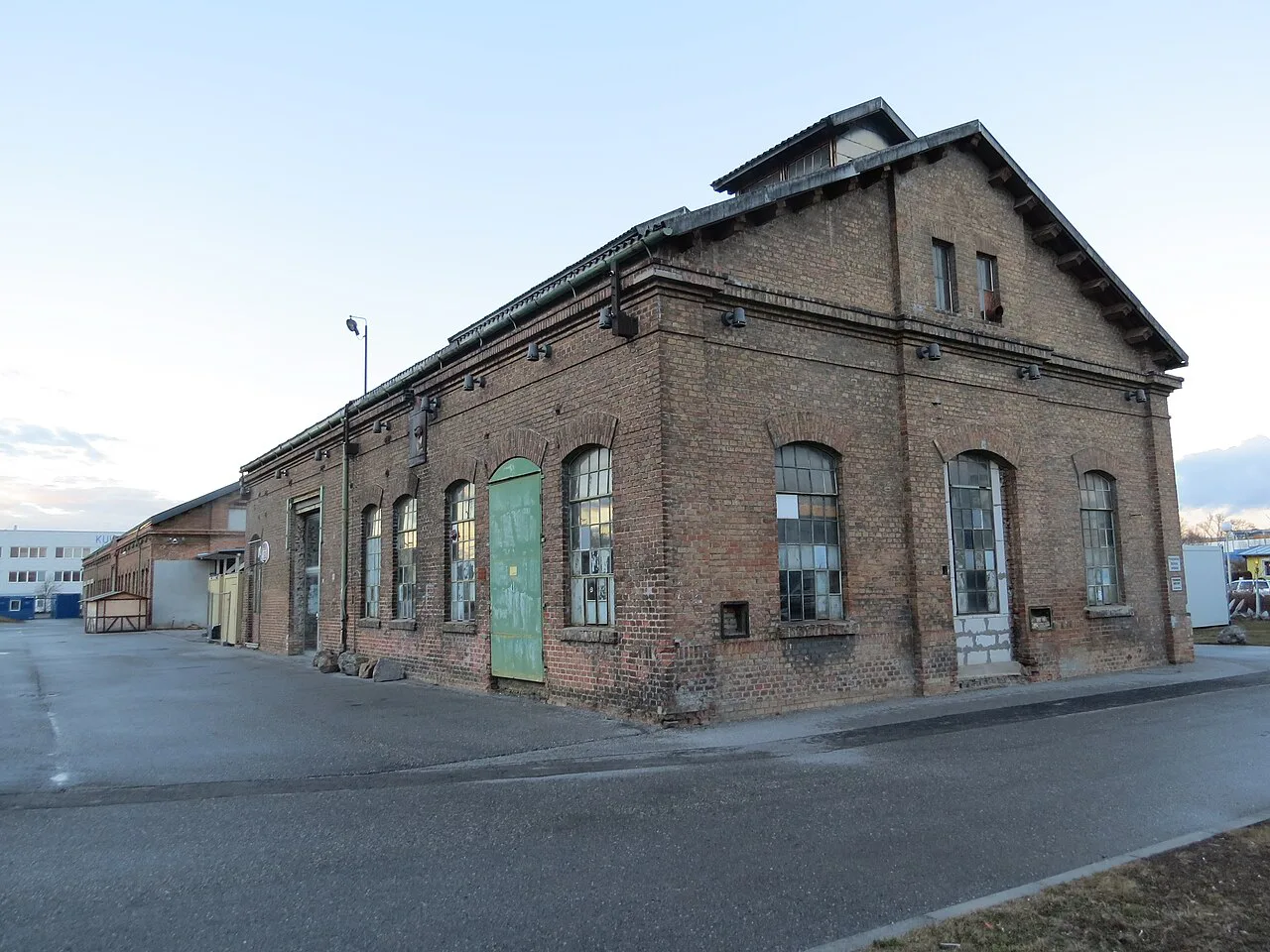
The second anchor of the walk is the Stadtturm, the medieval town tower built during the expansion of the town fortifications. The town dates the tower to the fifteenth century and describes it as a defensive structure, which gives the center its picture: a Gothic brick tower behind a neo-Gothic hall.
A sensible route is short: start at the Hauptplatz by the Rathaus, take in the square and its facades, find the Stadtturm, then drift into the surrounding lanes before heading toward the river. Nothing here demands heavy navigation, and you should not plan on tower climbs or interior access without confirming it locally first. Budget roughly an hour for the center itself, which is honest for a town this size.
Burg Kreuzenstein and the falconry
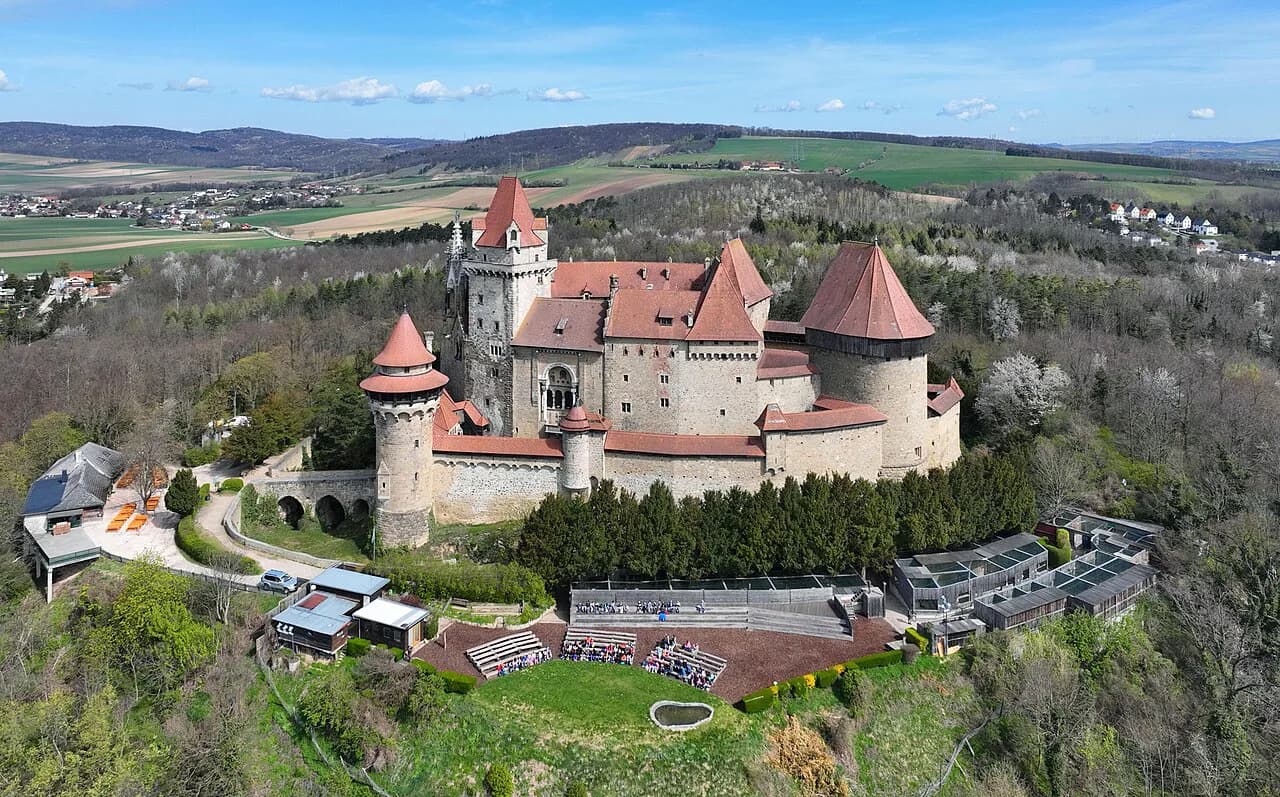
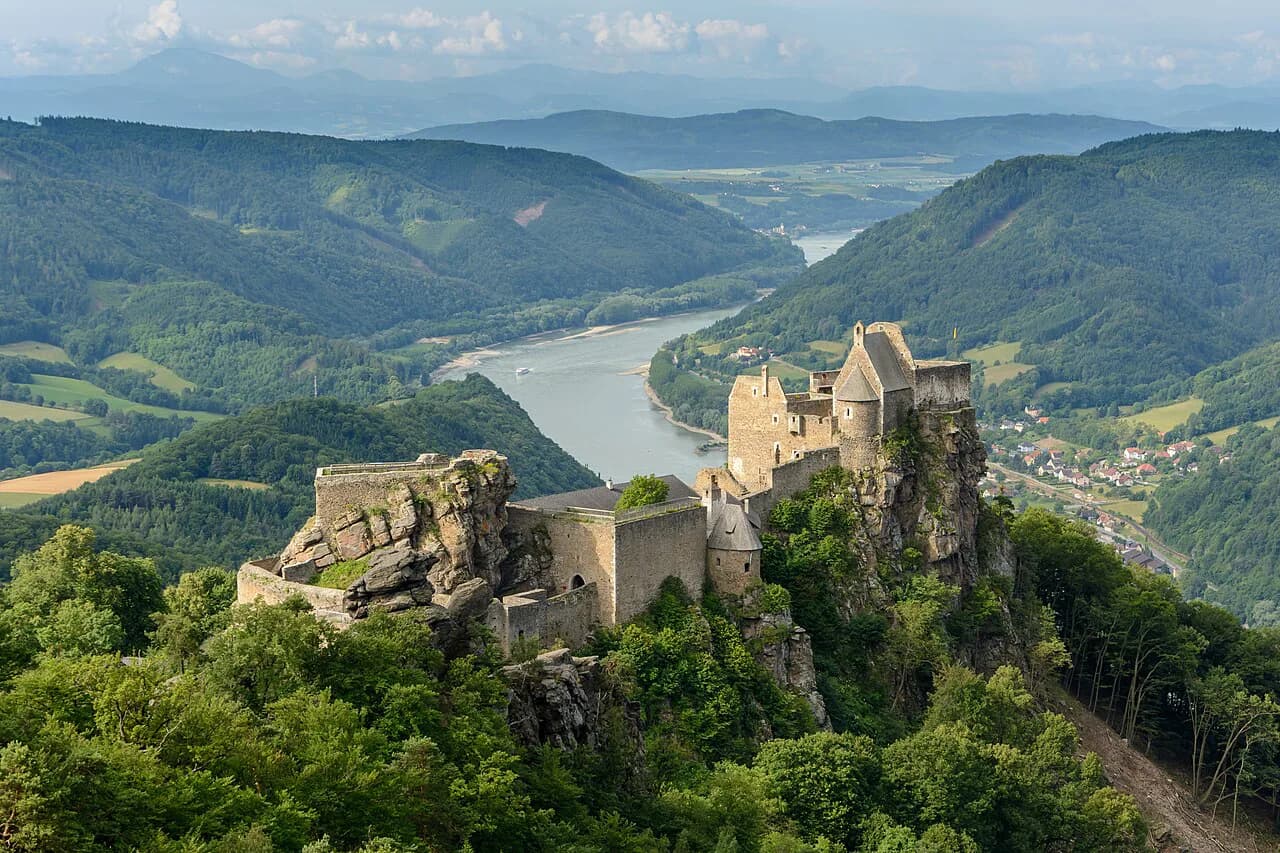
Burg Kreuzenstein is the reason to give Korneuburg more than a station stop. The castle rises on its hill above the town and is associated with an Adlerwarte Kreuzenstein, a falconry that keeps and breeds birds of prey and offers regular visiting times and flight demonstrations. Treat the castle and the bird-of-prey shows as a single outing, and confirm the show dates on the falconry's own website.
The flight shows are not continuous; exact dates and slots are published on the operator's website, so confirm the schedule before you commit to a day, because missing a show turns a two-part visit into a single castle tour. The castle sits on its hill above town and is not part of the Hauptplatz walk, so treat it as a separate leg with its own transport.
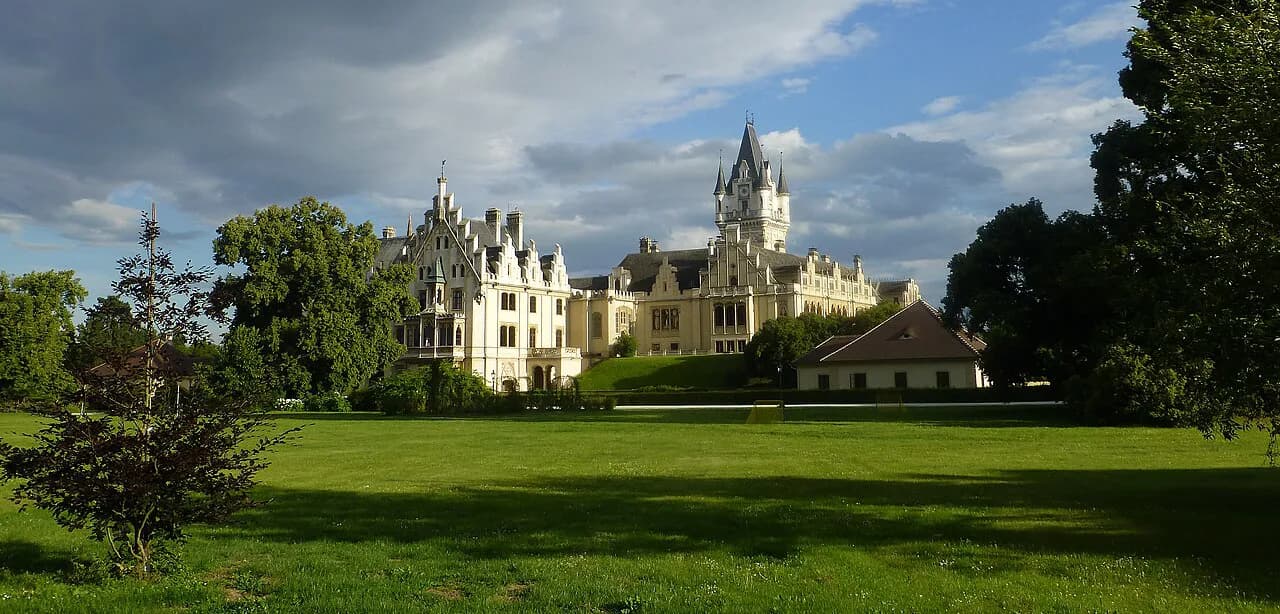
If castle interiors and Wilczek collections interest you, our guide to Burg Kreuzenstein covers the family behind the reconstruction and how the building came together. Read it before booking, since it clarifies what the visit actually consists of beyond the falconry.
Fossilienwelt Weinviertel at Stetten
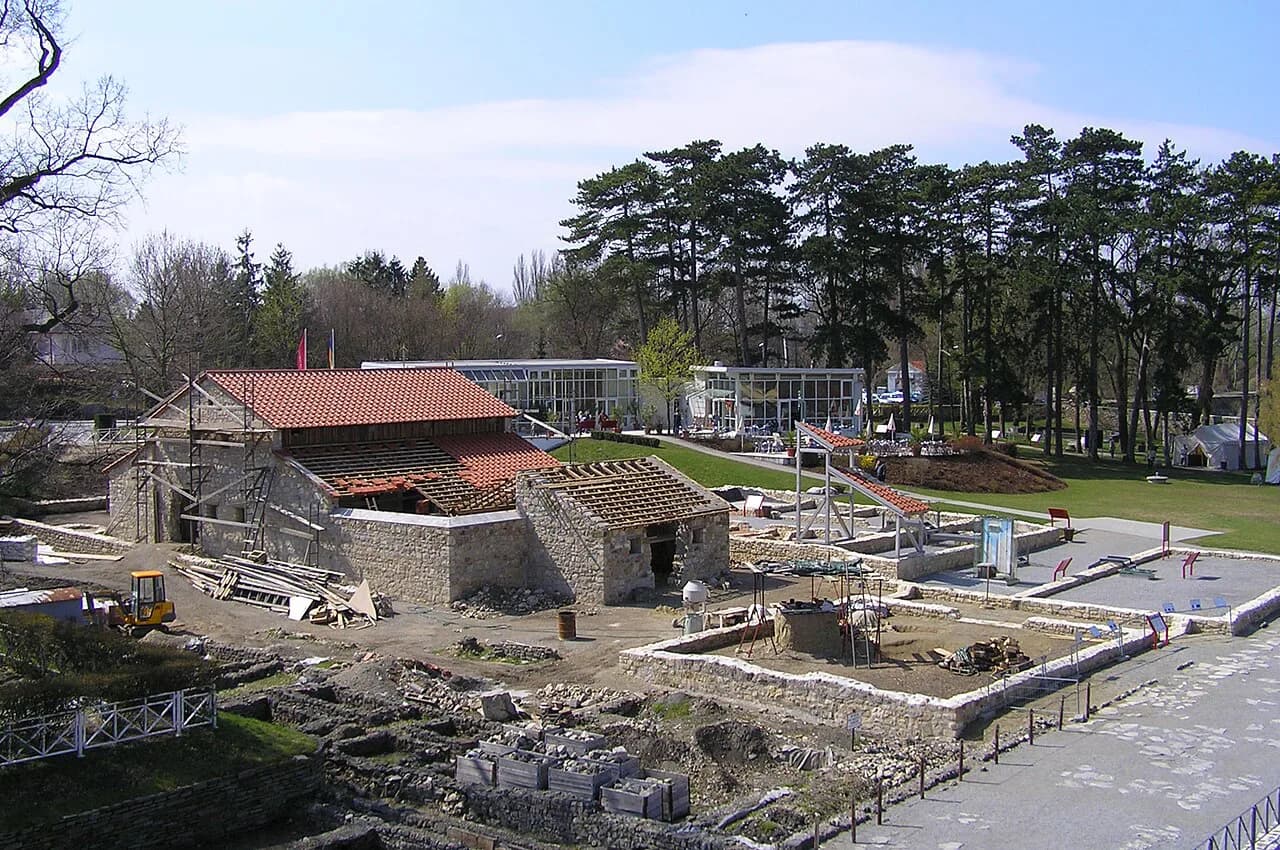
The Fossilienwelt Weinviertel in Stetten, listed under Korneuburg's attractions, presents what it describes as the world's largest accessible fossil oyster reef, roughly 17 million years old. The reef has been tilted about 24 degrees by tectonic movement since it formed, and the site explains the tropical sea and estuary that once covered the Korneuburg basin. It is a geology stop rather than a town sight, and it needs its own transport to Stetten.
Choose between the castle and the reef if your day is tight: they pull in opposite directions from the center, and doing both plus the Hauptplatz in one afternoon leaves no room for slow wandering. The reef suits travelers who want natural history and indoor or guided interpretation, while Kreuzenstein suits those after architecture and the birds of prey. Neither is a substitute for the old center, which stays the base of the visit.
Parks and the Danube riverside
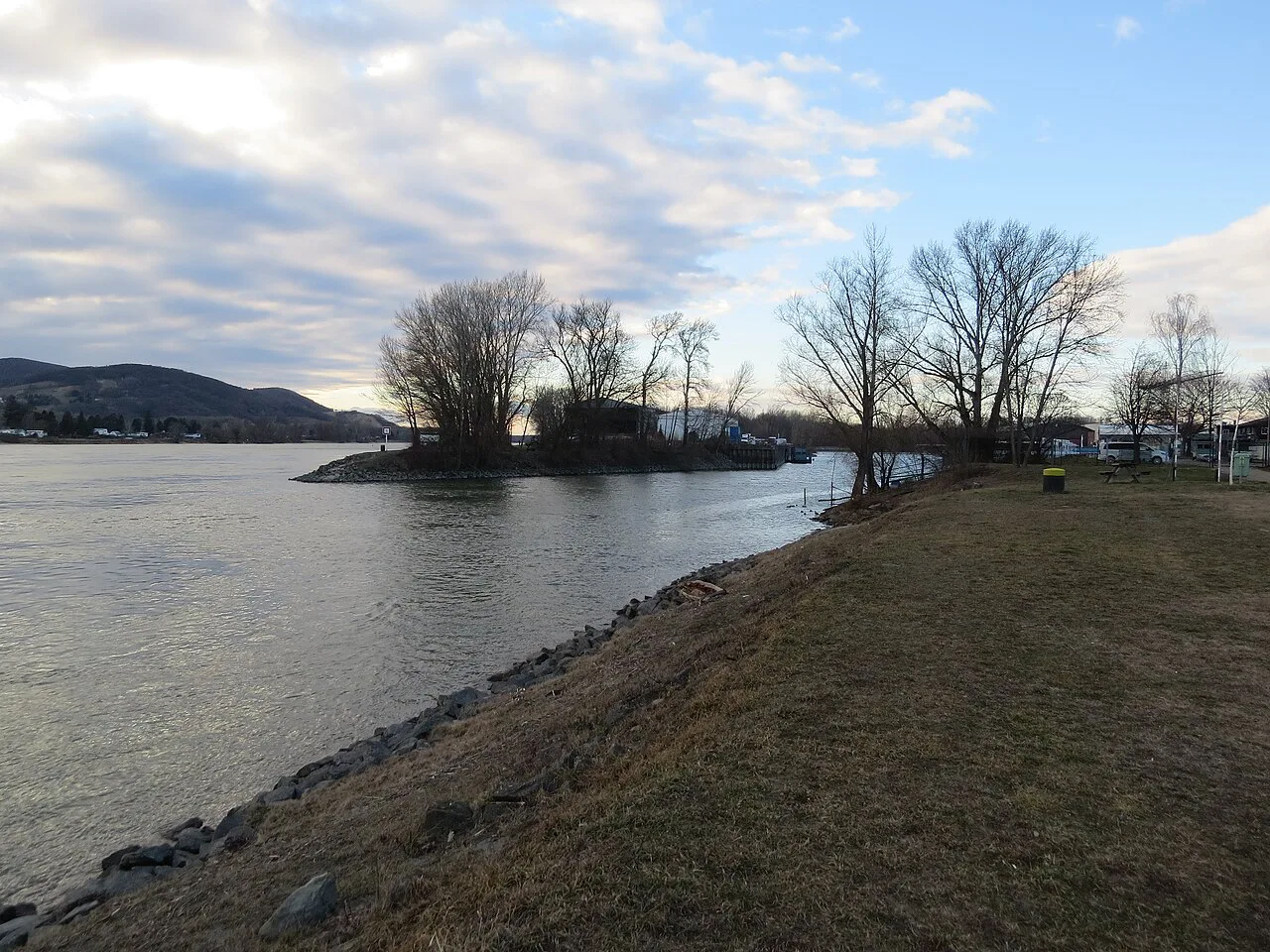
Korneuburg's green space is generous for its size, and the Donaupark is the largest of the town's parks at about 9.9 hectares, running along the Danube side of town. Smaller parks sit closer to the center and the station, among them the Jubiläumspark, the Dabschpark and the Schwedenpark. Use them as a rest between the center and the river rather than as a sight in their own right.
The riverside gives the town its setting and a place to sit before you move on by train or car. A picnic spot and a skatepark near the Danube end of town round out the outdoor options for a few spare hours. If the weather is poor, the center walk shortens considerably, so build the castle into the plan instead of relying on the riverbank.
How long to stay and how to arrive
Two to four hours covers the Hauptplatz, the Stadtturm and the surrounding lanes at an unhurried pace. Add most of a half day if you include Burg Kreuzenstein, and add another separate block for Stetten. That arithmetic is why Korneuburg suits a route stop rather than a base: the center is quick, and the outlying sights are the center's time cost.
Korneuburg appears in rail-accessible family excursion listings for the town and its surroundings, which confirms the station as a practical arrival point for the area. For actual departure times and journey lengths, use the ÖBB timetable rather than estimating. By car, the town sits close to the Danube crossings north of Vienna, which makes it easy to combine with a Weinviertel drive.
Practical constraints to plan around
The real planning constraint is scheduling, not distance. The Adlerwarte Kreuzenstein offers flight demonstrations at published times, so a castle visit has to be built around those slots, and the castle and the fossil reef both sit outside the center. Decide which one anchors your day and let the other go if the timing does not fit.
Treat the town hall as a landmark, not an interior sight, and do not expect tower access: the square and the Stadtturm are what you see from outside. Any opening details for the castle, the falconry or the Fossilienwelt should come from each operator's own site before you travel. Build a flexible hour into your plan for the transfer between center and castle.
Where to go next along the Danube and into the Weinviertel
Korneuburg sits between Vienna and the Weinviertel, so the natural continuation runs north into the wine country. Retz is the obvious next stop for a historic town center and its windmill, and our guide to Retz, Austria covers what to see there. From there a castle loop takes in Rosenburg Castle in the Kamptal, a Renaissance palace with a falconry of its own, so bird-of-prey fans can compare the two.
Along the Danube, Krems an der Donau is the bigger hub for the Wachau and the gateway to towns like Dürnstein. Closer to Vienna, Klosterneuburg Monastery makes an easy cultural stop on the same rail corridor. Both work as additions to a Korneuburg day rather than replacements for it.
Is Korneuburg worth the detour?
Yes, if you treat it as a Danube-side stop with a castle attached rather than a town to explore for days. The Hauptplatz, the neo-Gothic Rathaus and the Stadtturm give you an hour of genuine interest, and Burg Kreuzenstein with its falconry is the piece that makes the stop memorable. Skip the castle and you have a pleasant pause between Vienna and the Weinviertel, nothing more.
Build the day around the fixed timing of the castle's flight shows, confirm current opening details with each operator, and leave the Fossilienwelt for a trip when geology is the point. That order keeps Korneuburg honest and keeps your schedule workable.
Explore more Krems guides
Frequently Asked Questions
How do you pronounce Korneuburg?
Say it as KOR-noy-burk, with the stress on the first syllable and the final -burg clipped short. The German 'eu' sounds like 'oy,' so it does not rhyme with 'new.'
Can you walk from Korneuburg town center to Burg Kreuzenstein?
Treat them as separate legs. The castle stands on its hill above town and is listed as an outlying attraction rather than part of the Hauptplatz walk, so plan on a bus, taxi or car rather than a stroll from the square.
Sources
Notes for your next Austrian town break
Optional updates when we add or revise town guides.
You might also like
Continue reading
More guides you'll find useful