Austrian Baroque: Where to See It Beyond Vienna
Austrian baroque explained for travelers: the architects behind it and the abbeys, churches and palaces worth a detour outside Vienna and Salzburg.
On this page
Austrian baroque rewards travelers who leave the big cities: the style's grandest work sits in abbey churches along the Danube, in pilgrimage churches on hilltops and in palaces on the edge of town. This guide explains what the style is, names the architects who built it, and picks the buildings worth planning a route around.
Expect a short list rather than a survey. Each stop comes with what to look at inside so a forty-minute visit is not just a photo of a facade, plus the route logic: which stops sit on the Danube line, which need a bus or car, and where set tour times shape your day.
What Austrian baroque is, in plain terms
Baroque architecture of the seventeenth and eighteenth centuries worked with complex plan shapes, dynamic spaces and a heightened feeling of motion and drama, as the long arc of Austrian building history shows. Where a Gothic church pulls your eye up a narrow shaft, a baroque church pulls it around a curve, toward a dome, an oval nave or a high altar framed in marble and gold.
In Austria the style arrived through architects trained in Rome and adapted to local needs and traditions, most famously by Johann Bernhard Fischer von Erlach, who was born in Graz, studied in Rome and returned home to teach architecture to the future Emperor Joseph I. That Italian training explains the domes, colonnades and classical detailing you see repeated from Vienna to Salzburg.
The style also reached small parish churches, not just imperial commissions: baroque altars survive in village churches across Austria, so a stop in an ordinary town can still deliver a gilded retable and a painted ceiling.
The architects who shaped it: Fischer von Erlach, Hildebrandt, Prandtauer
Three names let you trace the style across the map. Johann Bernhard Fischer von Erlach is the imperial classicist, credited with the design of Schönbrunn Palace from 1696 and the Karlskirche in Vienna, begun in 1715 and finished under his son Joseph Emanuel.
Do I need a car to see Austrian baroque outside Vienna? No for the Danube abbeys, which sit on the rail line through the Wachau and can be paired with river boats in season. A car helps for village pilgrimage churches and hilltop abbeys away from the main line, where bus connections are thinner; check current ÖBB and Postbus timetables before you commit.
Are baroque abbey interiors self-guided? Large foundations generally run guided tours at set times rather than open access, and the schedule changes by season. Confirm the day's tour times at the abbey's own website or ticket desk before you travel to the site.
When were the main Austrian baroque buildings constructed? Schönbrunn's design dates from 1696, the Karlskirche was begun in 1715, and Salzburg's Collegiate Church was begun in 1694 and dedicated in 1707. That places the core of the style between the late seventeenth century and the early eighteenth.
Lucas von Hildebrandt, Fischer von Erlach's rival, worked on the Hofburg and built the Palais Schwarzenberg in Vienna, which was finished by his rival's office in 1728. His work is described as more personal, mixing Italian and French elements, and it set the tone for baroque building well beyond the capital.
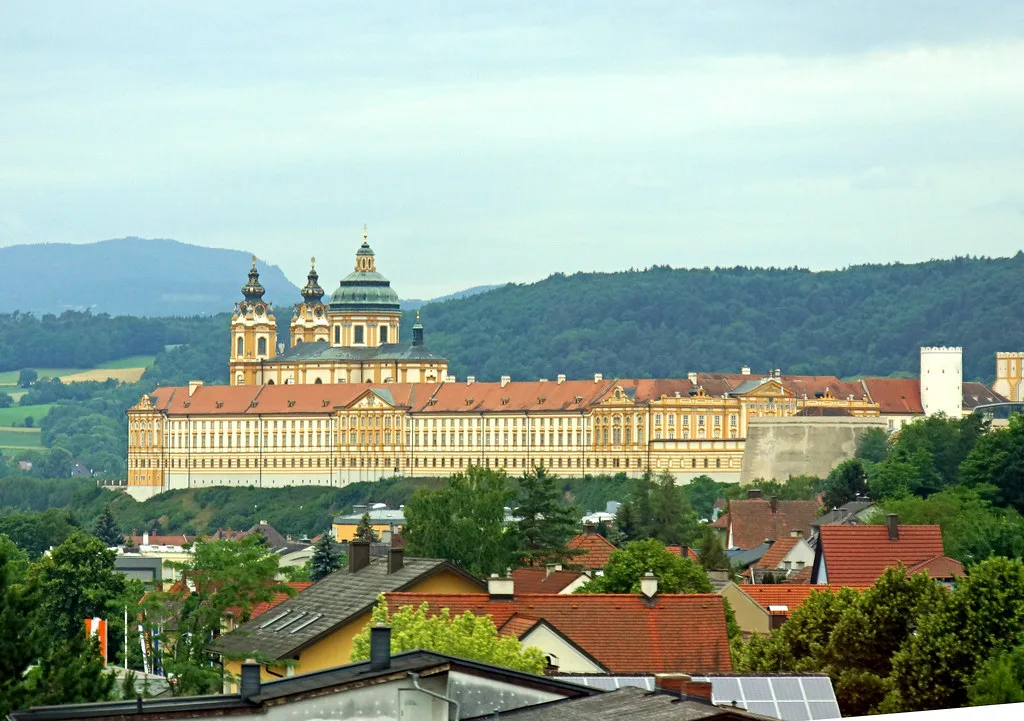
Jakob Prandtauer is the name to know for the Danube abbeys, above all Stift Melk. Where the Viennese masters worked in stone and stucco inside the city, Prandtauer's generation built the great monastery complexes that still dominate the river valley. Our guide to Austrian abbeys charts those foundations town by town.
What distinguishes a baroque church interior from a Gothic or rococo one
A Gothic interior is skeletal: stone ribs, tall windows, and a clear structural logic you can read from the floor. A baroque interior hides the structure on purpose, wrapping walls in stucco marble, breaking the straight nave line with side chapels, and finishing in a high altar that acts as a stage set.
Rococo takes the same ingredients and thins them: lighter colors, asymmetry, and ornament that spills across every surface. The test on site is simple. If the eye is carried smoothly from the entrance to the altar by one continuous curve, you are looking at mature baroque; if the decoration feels like lace applied over the architecture, you are closer to rococo.
The single most useful thing to look at is the altar itself, since baroque altars in Austria use columns, broken pediments and gilded figures to frame a painting or a statue like a theater backdrop.
Baroque abbeys: Stift Melk and the monastery churches of the Danube
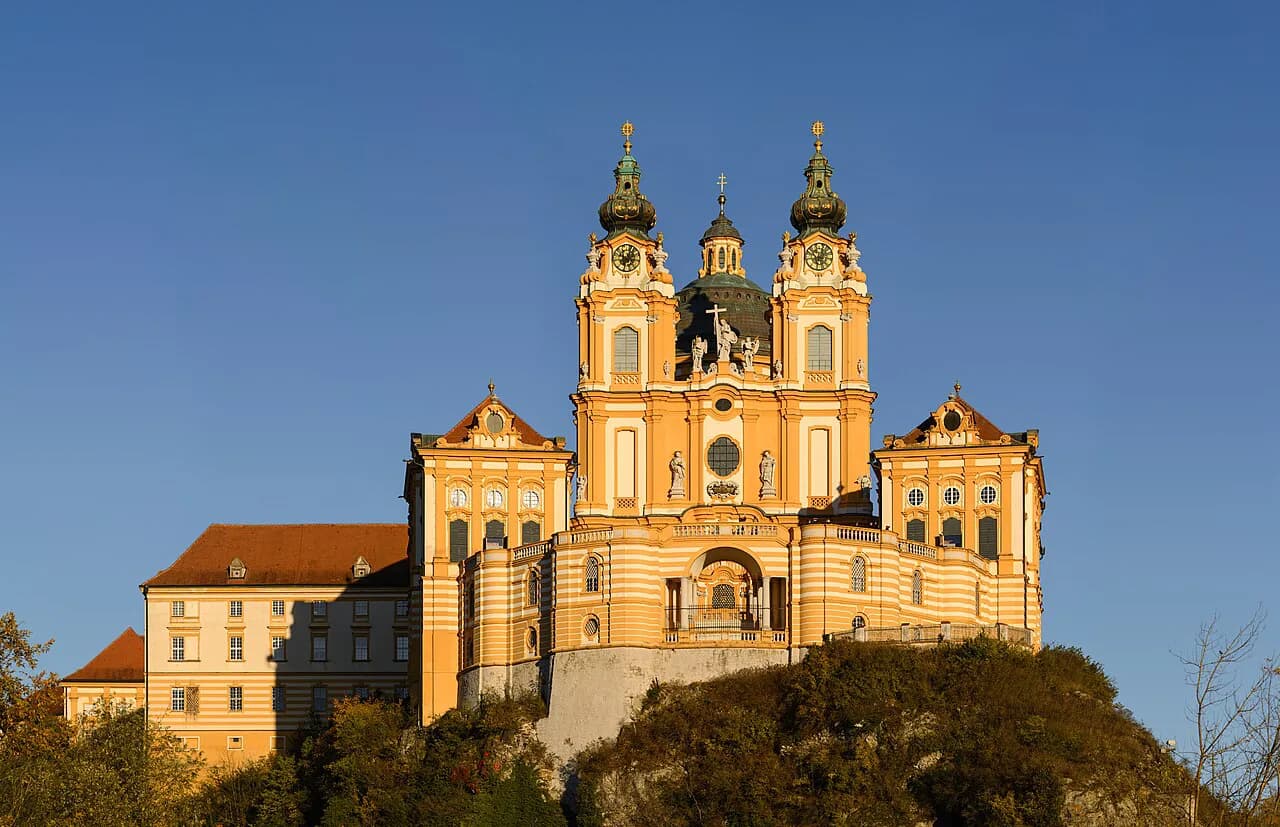
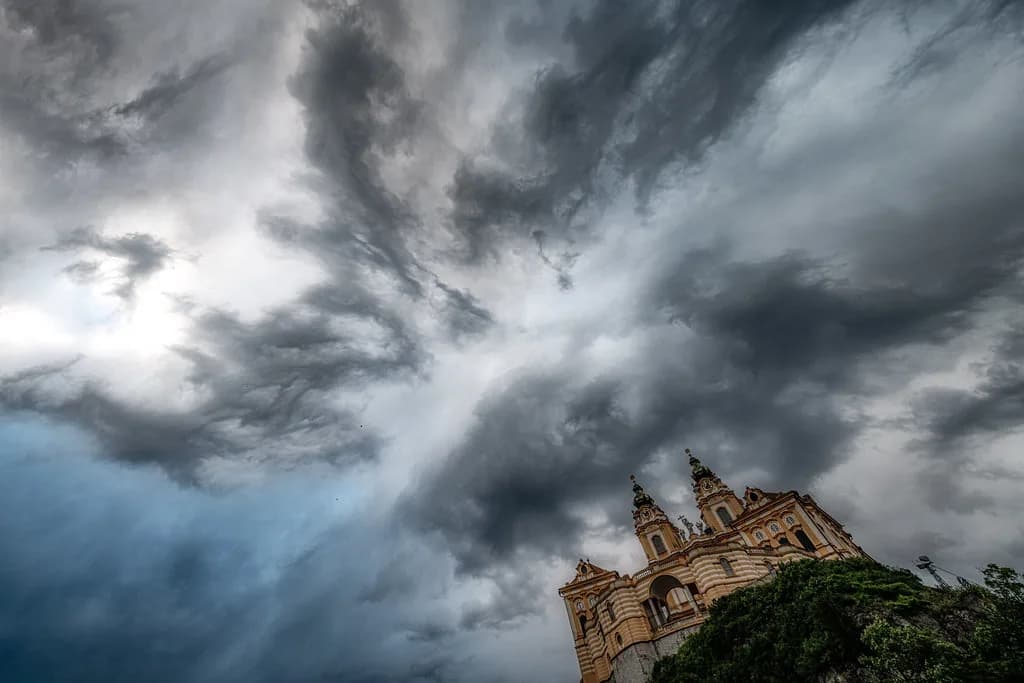
Stift Melk (Melk Abbey) is the anchor of any baroque route along the Wachau: a monastery complex on a bluff above the Danube, with a church interior that is the textbook example of the style in Austria. It sits on the river line between Vienna and Linz, which makes it the easiest great baroque building to reach without a car. Melk Abbey is covered in detail in our guide to Austrian abbeys.
Upstream along the same stretch, Stift Göttweig occupies a hill above the valley and rewards the climb with a view back over the river. Treat both as half-day stops rather than a quick look, because the churches, libraries and stair halls each take time.
The practical constraint on the Danube abbeys is touring style: the big foundations generally admit visitors on guided tours at set times rather than letting you wander freely, and those times change with the season. Confirm the day's tour schedule at the abbey's own ticket desk or website before you commit to a train.
Pilgrimage churches and the theatrical facade
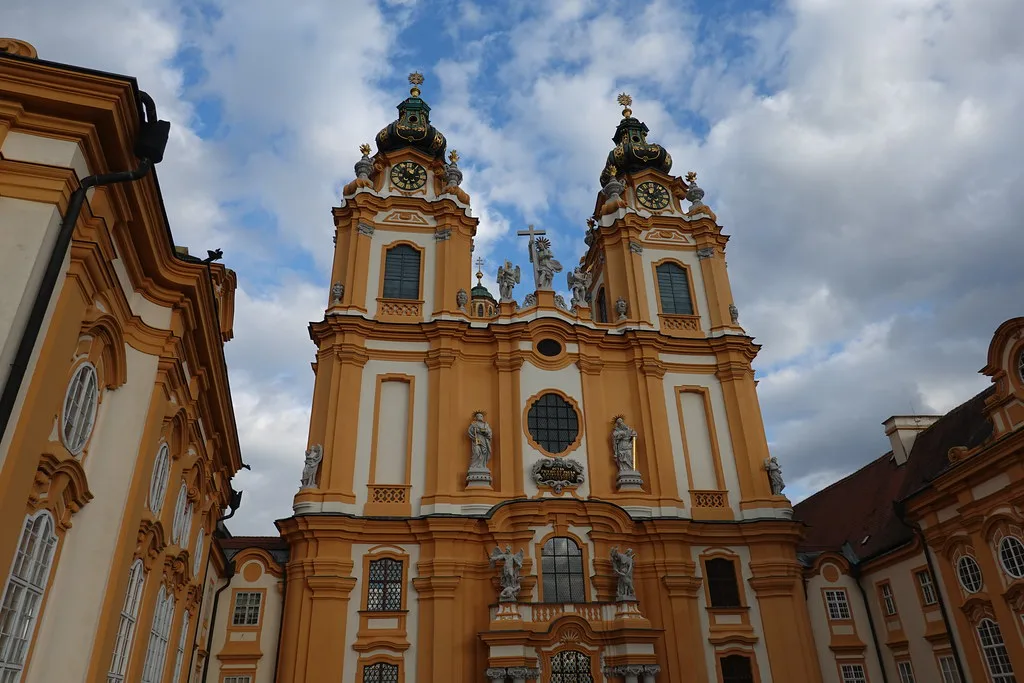
The pilgrimage church is where Austrian baroque gets theatrical. The facade is built to be seen from a distance along the approach road, and the interior is arranged so the visitor's movement from door to altar is part of the design.
Smaller pilgrimage churches are everywhere in the countryside and often sit on a ridge or at the end of a village street, which means the building does as much work from outside as in. Check the parish notice board or the diocese's listing for opening times, since village churches are frequently locked outside service hours.
If you are already touring castles, these churches fit neatly into the same drives: many sit on the same roads as the fortresses and palaces covered in our guide to Austrian castles.
Palaces and secular baroque: Schönbrunn, the Hofburg, the Belvedere
Vienna holds the secular set pieces. Schönbrunn Palace was designed from 1696 as an imperial residence meant to overshadow Versailles, and the Hofburg grew as a medieval palace that baroque architects, including Hildebrandt and both Fischer von Erlachs, rebuilt and extended. The Belvedere rounds out the trio as a garden palace rather than a fortress.
Outside the capital, secular baroque turns up in episcopal and aristocratic residences rather than royal palaces, and those are best visited as part of a wider castle itinerary. For country-house and garden-palace stops within easy reach of the city, see our picks of castles near Vienna.
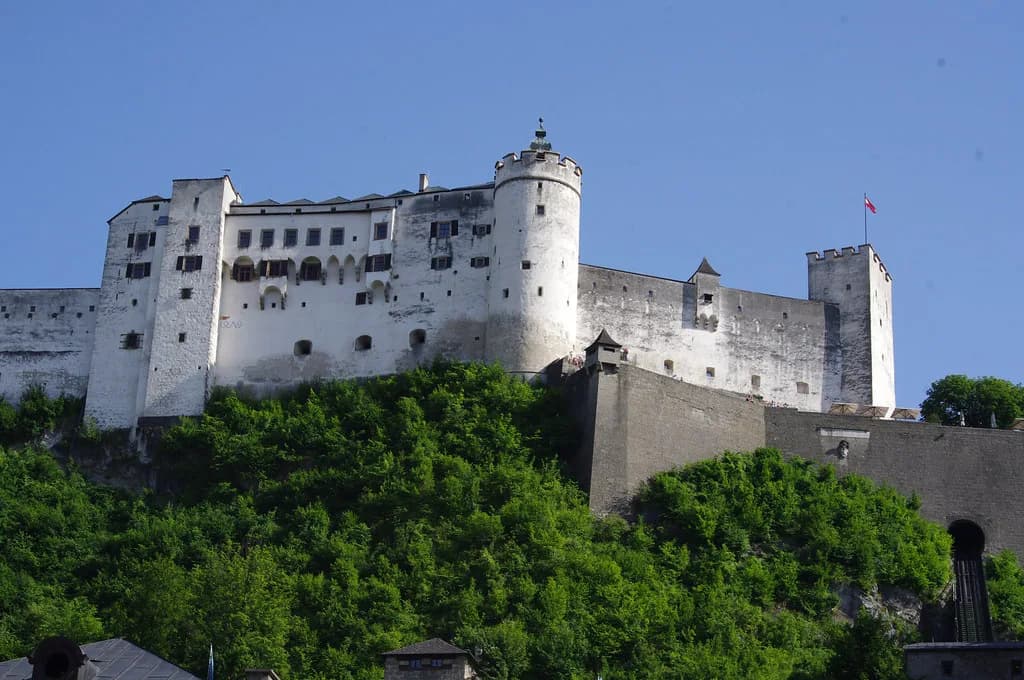
Near Salzburg the same period produced palace interiors and fortress works rather than great monastery churches, and our guide to castles near Salzburg covers Hohensalzburg Fortress and Hohenwerfen Fortress alongside the palaces.
Baroque town squares and streets you walk through, not just look at
The town square is where Austrian baroque becomes everyday architecture: a Trinity column in the middle, facades with curved gables around the edges, and a church facade closing one side. The point is to walk the square slowly rather than photograph it from the entrance.
Danube towns such as Dürnstein and Krems in the Wachau pack this into a few streets between the abbey and the river landing, so they work well as a walking hour between boat or train legs.
In the Alps the same vocabulary appears in smaller doses, in the squares of towns like Schärding on the Inn or Mödling south of Vienna, where a baroque facade sits in a medieval street plan. These are the cheapest baroque stops on the trip because there is no ticket and no tour time to meet.
Vienna's Karlskirche and the baroque set pieces in the city
Vienna's Karlskirche was begun in 1715 to a design by Fischer von Erlach and completed under his son, consecrated to Saint Charles Borromeo, the patron saint of the Habsburg emperor. Its dome and paired columns make it the city's most concentrated dose of the style outside the palaces.
Vienna also shows the style's afterlife: the Wotruba Church, the Kirche Zur Heiligsten Dreifaltigkeit, was built from 1974 to 1976 on a model by the sculptor Fritz Wotruba, its intersecting concrete blocks a stark counterpoint to the domed churches of the baroque.
The concept behind that idea, the gesamtkunstwerk or total work of art in which the architect controls everything from pews to roof, is usually traced to Wagner's operas; architectural writers argue its origins sit firmly in the baroque.
Modern building in the same city keeps looking back to the baroque: the Pfarre am Schöpfwerk Kirche, built in 1974 to a design by Victor Hufnagl, borrows the gridded detailing of Otto Wagner and Josef Hoffmann while its decoration refers further back.
Salzburg's Collegiate Church and the Fischer von Erlach connection
In Salzburg, Fischer von Erlach built the Collegiate Church, begun in 1694 and dedicated in 1707, which began as the university church on University Square. It remains a concert and art venue as well as a church, which matters when you plan a visit around a performance day.
The same architect is credited with the Church of the Holy Trinity in Salzburg, begun before his move into imperial service. Seeing both in one afternoon is the best way to watch a single designer's baroque develop.
Fischer von Erlach moved to Salzburg in 1693 to serve the Prince Archbishop, and became Imperial Court Architect and Engineer in 1694, so the Salzburg churches and the Viennese palaces belong to the same short career.
How to fit a baroque stop into a route by train, bus or car
The easy route is the Danube: the rail line along the Wachau puts Melk, Dürnstein and Krems on one sequence, with boats covering the river stretch in season. Check current timings on the ÖBB and Postbus sites rather than relying on last year's timetable, since river and valley services change by season.
Salzburg and the Alps are the second cluster, best done by car or by bus if you want the smaller pilgrimage churches, where the village location is the whole point and train stations are a walk away.
Tirol and Innsbruck add another cluster, where the secular side dominates; for those palace interiors, including the Spanish Hall, and the castles on the same roads, see castles near Innsbruck and Tratzberg Castle.
Lower Austria, west of Vienna, adds Artstetten Castle, which links a baroque palace to the family of Archduke Franz Ferdinand of Austria and includes the Family Crypt. It works as a half-day by car from the city.
What to look for inside: altars, frescoes, pews and light
Start at the high altar and read it like a stage: columns, gilded figures and a central painting are arranged to carry the eye upward. Baroque altars in Austrian churches follow this pattern from village chapels to abbey churches.
Then look at the light. Baroque architects cut windows and dome lanterns to throw a single shaft onto the altar or the crossing, so timing your visit to morning or late afternoon changes what you see.
Finally look down and around: pews, choir stalls and pulpits were often designed with the building as a total work of art, a gesamtkunstwerk, so the carving on a bench belongs to the same program as the ceiling fresco.
Practical notes: abbey tour times, Monday closures and seasonal openings
The single most common mistake is arriving at a great abbey without checking how visits work. Melk and the other large Danube foundations usually run guided tours at fixed times, so a late arrival can mean waiting an hour or missing the interior entirely.
Many museums and palace interiors keep a weekly closing day, often Monday, and some churches restrict sightseeing during services. Build your day so the ticketed interior comes first and the town square and river walk fill the rest.
Some alpine roads and smaller sights open only in the warmer months; before you plan a drive, confirm the current season on the operator's site rather than assuming last summer's dates still apply.
Which baroque stop should you build your route around?
If you have one day, take the Danube line to Stift Melk and walk the Wachau towns on the same ticket; if you have a car, add Stift Göttweig and one village pilgrimage church for the interior that tourists skip.
If you want the architects instead, do Vienna's Karlskirche and Schönbrunn in one day, then Salzburg's Collegiate Church and Trinity Church in another, and you will have seen Fischer von Erlach's career from start to finish.
Frequently Asked Questions
Do I need a car to see Austrian baroque outside Vienna?
No for the Danube abbeys, which sit on the rail line through the Wachau and can be paired with river boats in season. A car helps for village pilgrimage churches and hilltop abbeys away from the main line, where bus connections are thinner; check current ÖBB and Postbus timetables before you commit.
Are baroque abbey interiors self-guided?
Large foundations generally run guided tours at set times rather than open access, and the schedule changes by season. Confirm the day's tour times at the abbey's own website or ticket desk before you travel to the site.
When were the main Austrian baroque buildings constructed?
Schönbrunn's design dates from 1696, the Karlskirche was begun in 1715, and Salzburg's Collegiate Church was begun in 1694 and dedicated in 1707. That places the core of the style between the late seventeenth century and the early eighteenth.
Sources
Notes for your next Austrian town break
Optional updates when we add or revise town guides.
You might also like
Continue reading
More guides you'll find useful