
Hofkirche Innsbruck: Maximilian's Court Church and the Black Men
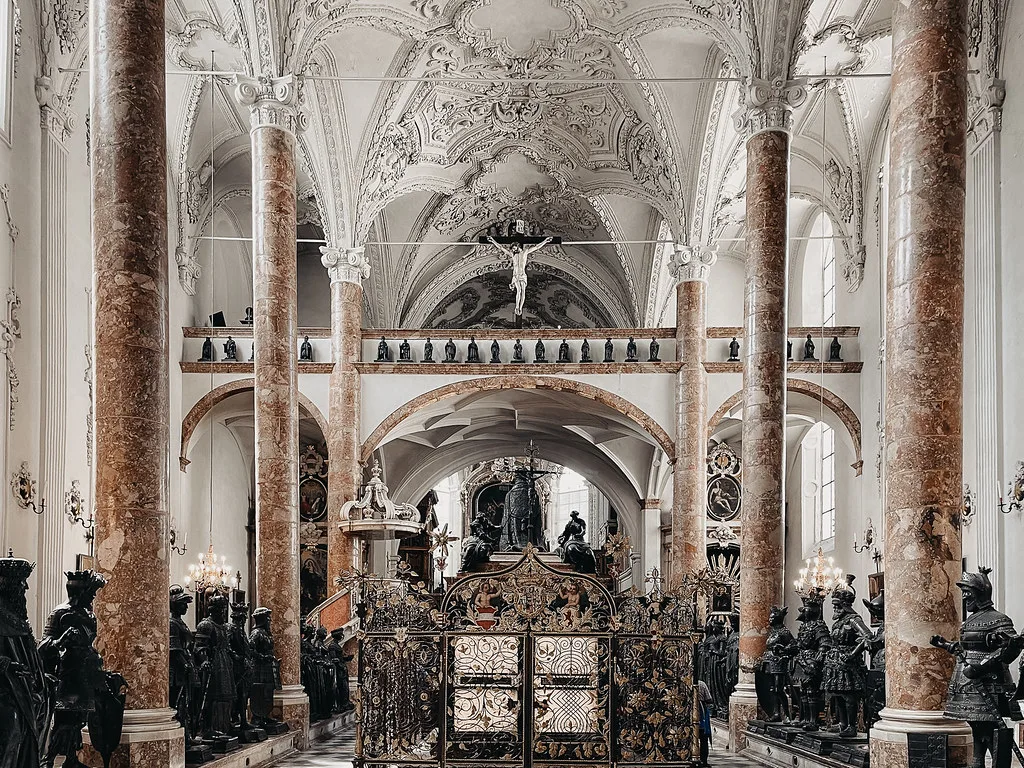
The Hofkirche (Court Church) is the one Innsbruck monument worth rearranging a morning for: a 16th-century burial church holding Emperor Maximilian I's empty tomb, flanked by 28 larger-than-life bronze figures known as the Black Men. Allow 60 to 90 minutes inside, then walk straight into the Hofburg next door and the Altstadt beyond. This guide covers what the church is, where it sits, what to look for inside, and the practical details that decide your timing.
Plan the visit around one quirk: on Sundays and public holidays the church opens in the early afternoon rather than at 9:00, so a Sunday morning stop will find the doors shut. Weekday visits are the simpler choice, and the church sits close enough to the old town that you can slot it between other sights without a bus or taxi.
What the Hofkirche actually is
Ferdinand I built the church between 1553 and 1563 as a memorial to his grandfather Maximilian I, who died in 1519. Maximilian had asked to be buried in the St. Georgs-Kapelle of Wiener Neustadt's castle, and that wish was honored, so the elaborate monument in Innsbruck is a kenotaph, an empty tomb. Knowing this in advance spares you the puzzle of peering into a grave that was never occupied.
The scheme was ambitious even by Habsburg standards: Maximilian commissioned around 40 bronze figures for the tomb, but they proved too heavy for the Wiener Neustadt chapel, and the project moved to Innsbruck under Ferdinand. Only 28 figures were ever finished. The result is counted among Europe's grandest imperial tombs and Tyrol's most significant art monument, built with work by artists such as Albrecht Dürer and Peter Vischer the Elder.

Where it is on the edge of the Altstadt
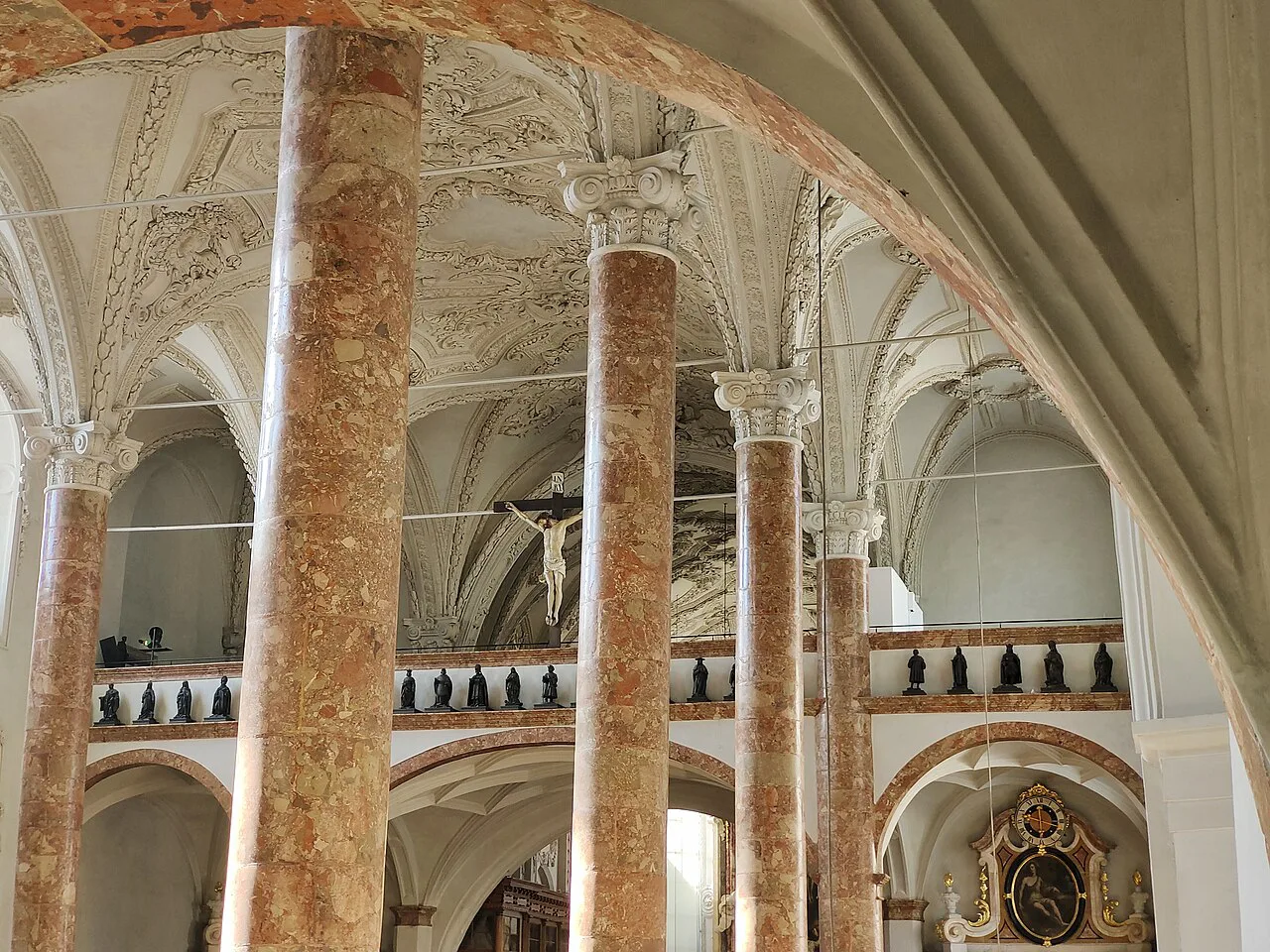
The address is Universitätsstraße 2, at the edge of the Altstadt, with the Volkskunstmuseum on one side and the Kaiserliche Hofburg on the other. That position makes it a natural hinge between the old town lanes and the Hofburg quarter, so you can walk in from the Golden Roof area in a few minutes without any transport at all.
Coming from Innsbruck's main station, the church is a straightforward walk into the center; the old town itself is compact and pedestrian, so once you are in the Altstadt everything on this page sits within a short stroll. If you are building a wider sightseeing plan, the Innsbruck Attractions: 17 Visitor Guides collection maps the other churches, palaces and museums in the same district.
The 28 bronze figures and the Black Men nickname
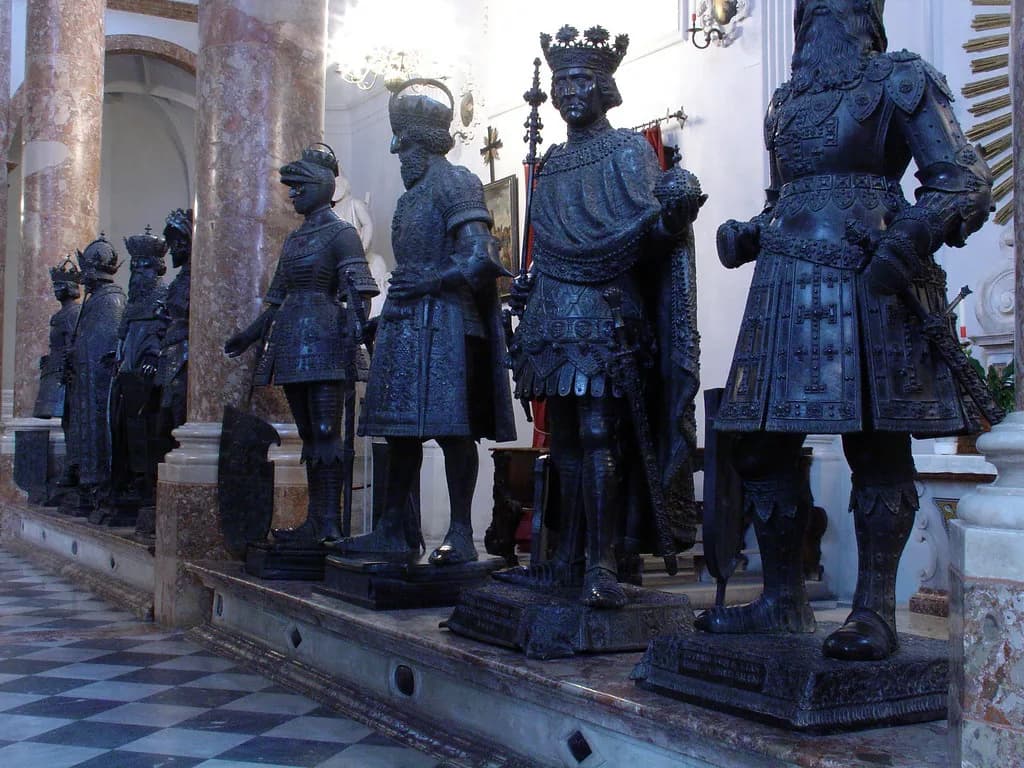
The bronze figures stand taller than life around the tomb, and they are the reason locals call the Hofkirche the Schwarz-Mander-Kirche, or Black Men Church. They depict Maximilian's family and models: his two wives, Maria von Burgund and Bianca Maria Sforza, along with figures such as the crusader Gottfried von Bouillon and nobles from other princely houses whose lineage underscored Habsburg claims. The nickname is loose, because several of the figures are women.
Give the figures real time rather than treating them as decoration. Each one is a separate portrait in bronze, and the group as a whole is a statement of dynastic ambition as much as a funeral ornament, which is why the church reads as a piece of European court art rather than a parish interior.
Inside: the Ebert-Orgel, the Silberne Kapelle and Andreas Hofer
Beyond the tomb, the Ebert-Orgel is the other headline: a Renaissance organ more than 450 years old and among the oldest playable instruments of its kind anywhere, still used for concerts today. The Silberne Kapelle holds the silver altar and the tombs of Archduke Ferdinand II and his wife Philippine Welser, and since 1823 the church has also held the grave of the Tyrolean freedom fighter Andreas Hofer.
Audioguides are available at the church, which suits independent travelers who want the figure-by-figure background without joining a group. Group tours can be arranged in advance through the Tiroler Landesmuseen, the body that administers the church.
Opening hours and tickets
The church is open year-round Monday to Saturday from 9:00 to 17:00, while Sundays and public holidays run 12:30 to 17:00. That afternoon-only Sunday window is the detail most likely to upset a schedule, so put the Hofkirche on a weekday morning if your trip allows it.
Admission is run by the Tiroler Landesmuseen, which publishes current rates and any combination offers on its own site. Confirm the price there before you go, and ask at the desk whether a combined ticket with the adjoining state museums works out cheaper for your plans.
How long to allow and how to pair it with the Hofburg
Treat the Hofkirche as a focused 60- to 90-minute stop and pair it with the Hofburg Innsbruck immediately next door, where the Giant Hall and the imperial apartments continue the same Habsburg story. Doing both in one block is far more efficient than splitting them across the day, since you never leave the same small quarter.
After the two buildings, walk five minutes into the Altstadt to see the Golden Roof (Goldenes Dachl) in Innsbruck, the ornate late-Gothic oriel that gave the old town its signature image. It is a quick exterior look plus a small museum, which makes it a light third stop rather than a full afternoon.
If you still have energy and clear weather, the Nordkette Cable Car Innsbruck leaves from the Hungerburg funicular near the old town and climbs to alpine viewpoints above the city. Save it for a separate block of several hours, since the mountain stations reward lingering, and the cable car runs on its own seasonal schedule that you should confirm before counting on it.
Nearby sights worth stacking with a visit
A short walk southeast brings you to Dom St. Jakob Innsbruck, the city's baroque cathedral, which pairs naturally with the Hofkirche for a morning of church interiors. The two are different in purpose and mood, and seeing both clarifies what the court church was built to do that a cathedral was not.
For a half-day extension, Ambras Castle Innsbruck sits above the city and holds the Habsburg collections Ferdinand II assembled, including the famous portrait gallery and armory. It needs its own transport or a longer walk uphill, so give it a separate slot rather than squeezing it in after the Hofkirche.
Two more stops fit the same central walk: the Annasäule Innsbruck on Maria-Theresien-Straße, a marble column that marks the old town's main axis, and the Ferdinandeum Innsbruck, the Tyrolean state museum with art and history collections. Neither demands a long visit, which makes them easy add-ons on the way back to the station.
Is the Hofkirche worth an hour of your Innsbruck day?
Yes, if you care about the Habsburg story that runs through Innsbruck: the empty tomb and its 28 bronze figures are unlike anything else in the city, and the church sits so close to the Hofburg and the Altstadt that the detour costs you almost no travel time. Skip it only if your day is already full of interiors and you would rather spend the hours on the Nordkette or Ambras.
Go on a weekday morning if you can, allow 60 to 90 minutes, and check the current admission price through the Tiroler Landesmuseen before setting out. Pair it with the Hofburg next door and you have a compact, coherent half-day in the heart of Innsbruck.
Explore more Innsbruck guides
- Alpenzoo Innsbruck
- Bergisel Ski Jump (Bergisel Schanze)
- Glockenmuseum Innsbruck
- Hofgarten Innsbruck
- Maria-Theresien-Straße
- Swarovski Crystal Worlds (Kristallwelten), Wattens
- Tirol Panorama mit Kaiserjägermuseum
- Tyrolean Folk Art Museum (Tiroler Volkskunstmuseum), Innsbruck
- Innsbruck City Tower (Stadtturm)
Frequently Asked Questions
Is the Hofkirche free to enter?
The Hofkirche is administered by the Tiroler Landesmuseen as a museum church rather than an open parish church you wander into for nothing. Current admission rates and any combination tickets are published by the Tiroler Landesmuseen, so confirm the price there or at the entrance desk before you commit.
Can you attend a concert or Mass in the Hofkirche?
The Ebert-Orgel is still used for concerts, but the church is run as a museum site rather than a regular parish, and concert dates and any service times are not fixed to a predictable weekly pattern. Look at the Tiroler Landesmuseen program for scheduled organ events rather than assuming you can walk in on a given evening.
What is the difference between the Hofkirche and Innsbruck Cathedral?
The Hofkirche is a 16th-century memorial church built for Maximilian I's tomb, with the bronze figures, the Ebert-Orgel and Andreas Hofer's grave as its main draws. Innsbruck Cathedral, Dom St. Jakob, is the city's baroque cathedral and an active place of worship with a different interior and artistic focus. They are separate buildings a short walk apart, and each rewards a visit for different reasons.