
Golden Roof (Goldenes Dachl) in Innsbruck: A Visitor's Guide

The Golden Roof (Goldenes Dachl) is Innsbruck's best-known landmark and the one sight in the old town you can see at no cost and in about five minutes: a late-Gothic balcony projecting above Herzog-Friedrich-Straße, its roof covered in 2,657 gilded bronze tiles. It sits in the pedestrian heart of the city, a short walk from the Hofburg and the Hofkirche, which makes it an easy stop rather than a half-day excursion. This guide covers what the balcony is, how to find it, what the museum inside holds, and the ticket and hour details the operator lists.
What the Golden Roof actually is
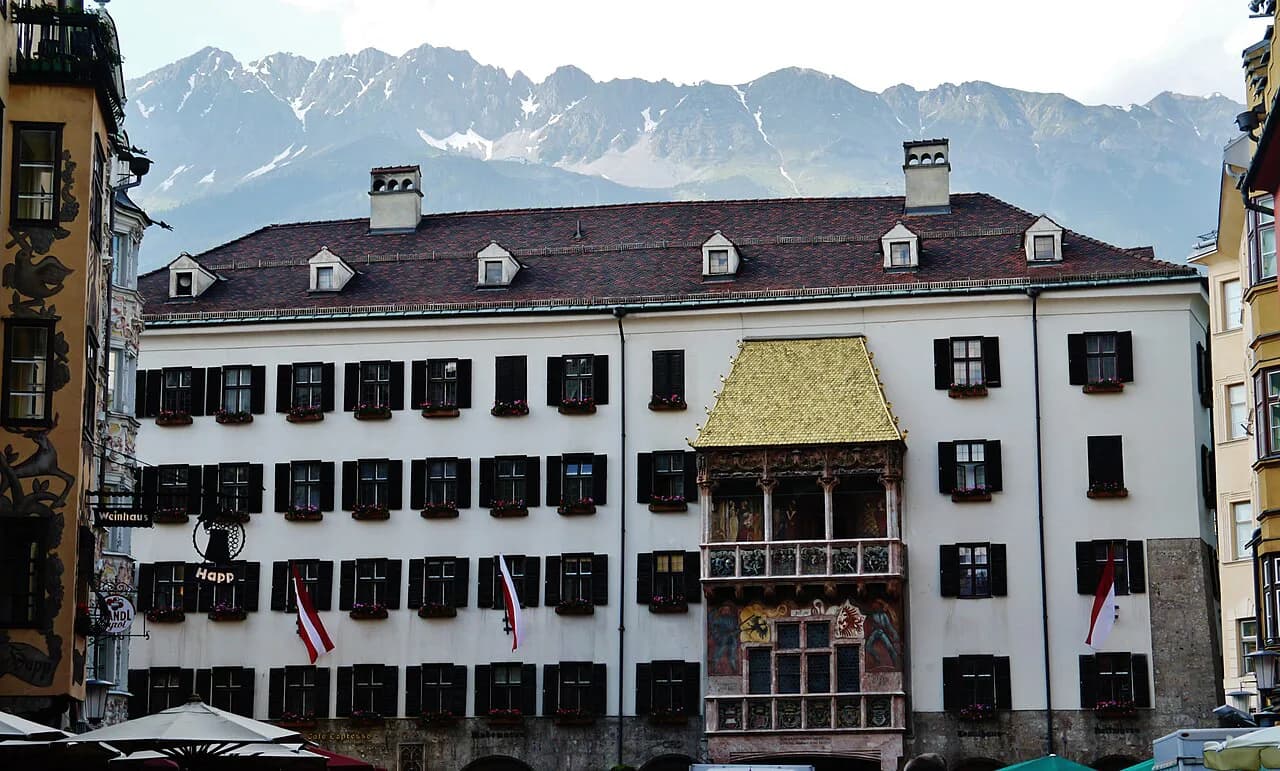
The Golden Roof is a late-Gothic oriel balcony that Emperor Maximilian I built around 1500, and its roof carries 2,657 gilded bronze tiles, with a few pure-gold ones among them. The structure is Innsbruck's most famous landmark and the visual anchor of the historic district. The balcony itself served as a viewing box from which the emperor could watch tournaments, festivals and other events in the square below.
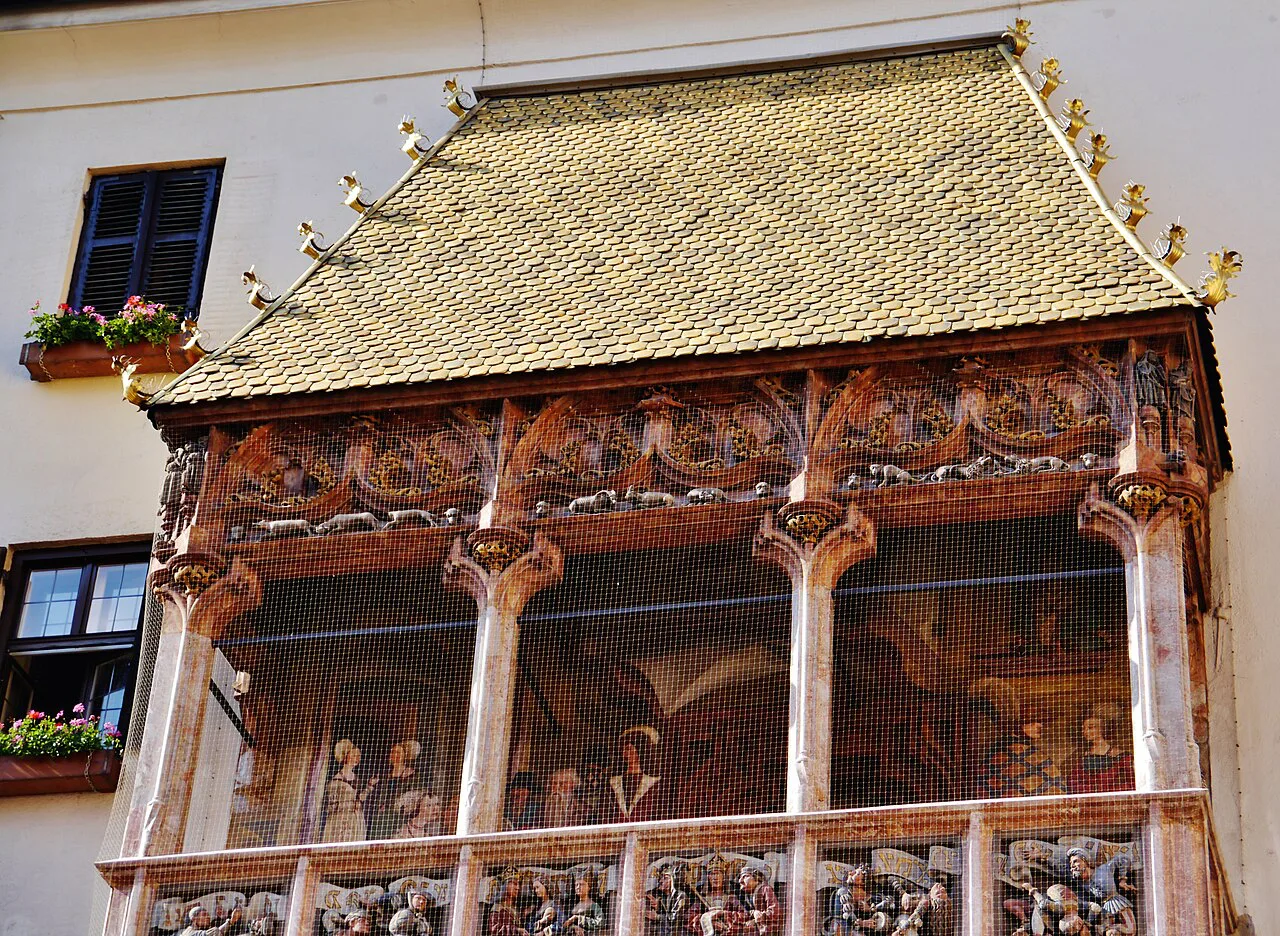
The balcony is 16 meters wide and the roof 3.7 meters high, with reliefs along the underside of the roof edge showing Maximilian I alongside his two wives, Mary of Burgundy and Bianca Maria Sforza, and Morris dancers. The commission doubled as a statement: Maximilian built it partly to counter talk about his financial difficulties, which makes the gold both decoration and argument. Knowing this changes how you read the facade — it is political theater in gilded form, not a church ornament.

Where it stands and how to find it
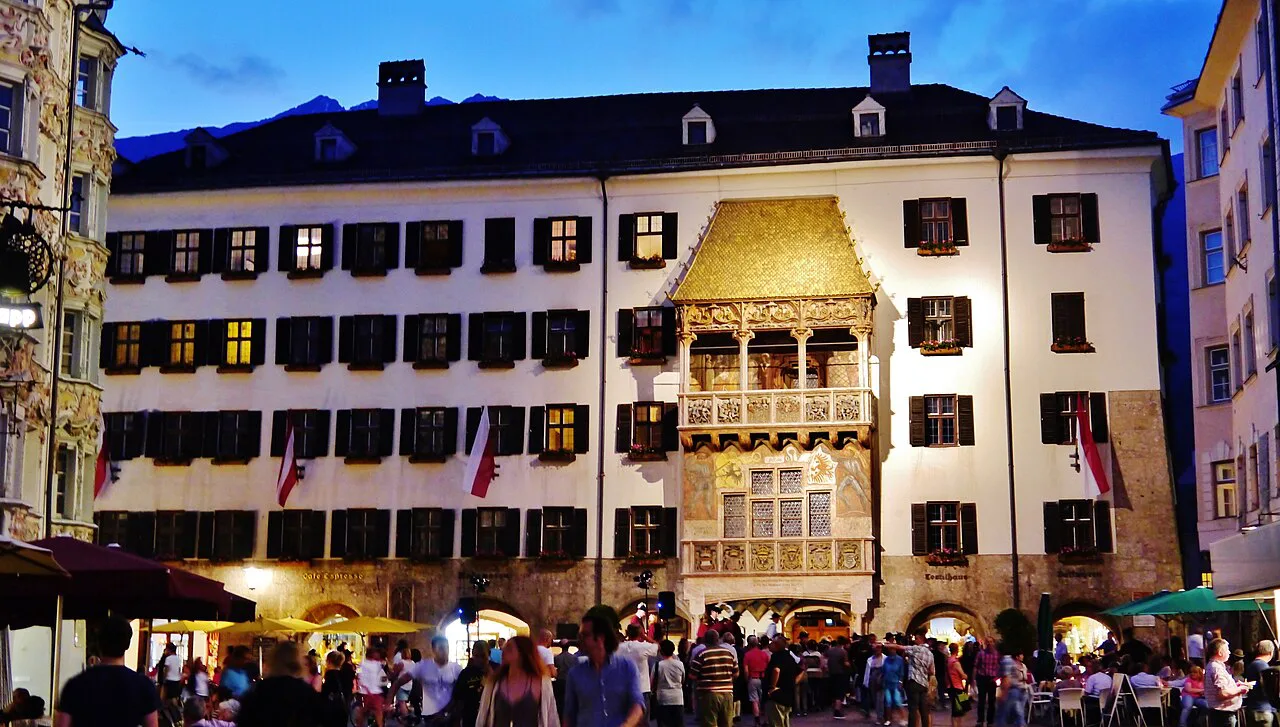
The address is Herzog-Friedrich-Straße 15, 6020 Innsbruck, in the middle of the pedestrian old town. In practice you do not need to navigate: the street runs from the Maria-Theresien-Strasse side into the old town, and the balcony appears overhead long before you reach the number. Look up at the level of the second or third floor rather than at street level, where the souvenir shops draw the eye first.
Because it stands in the pedestrian zone, the Golden Roof is a natural first stop for a walk through the center of Innsbruck. Pair it with the other main sights — laid out in these Innsbruck Attractions — so that you cross the old town once rather than backtracking. The balcony has no gate and no ticket line at street level, so you can slot it in between two indoor visits.

What you see from the street
From the street the whole landmark is free: the projecting balcony, the glittering roof and the reliefs beneath the eaves are all visible from the pavement. Allow a few minutes to look properly and read the figures, then move on. The gilded tiles are the point — the roof is the architectural element "the Golden Roof" refers to, not the modern museum under it.
The tiles are gilded bronze, most of them gilded by fire, with only a handful in pure gold. The visible tiles are twentieth-century replicas: the originals were replaced during the 20th century, and six of them now sit inside the museum. That trade-off is worth knowing before you judge the outside as either fake or authentic — you are looking at a faithful reconstruction of a 1500 roof, and the surviving originals are a few steps away.
The Golden Roof Museum
The museum occupies the rooms behind the balcony and takes Emperor Maximilian I as its subject, with texts on his life and rotating exhibitions. It was fully rebuilt for the 500th anniversary of his death and reopened in February 2019. If your interest is Habsburg pageantry rather than the object, this is where the story is told; if you only want the photograph, the street is enough. The Golden Roof Museum pairs naturally with the nearby Hofkirche Innsbruck, the court church a few minutes away in the same old-town cluster.
The museum's second draw is the collection of original roof tiles saved from the 20th-century replacement, which lets you see the actual gilding up close. The rooms are compact, so budget your time around the exhibits rather than expecting a large palace museum. Guided tours of the museum are offered, and the front desk can tell you when the next one starts on the day you arrive.
Tickets
Adult admission to the Golden Roof Museum is listed at €5.00, and children enter free. A combined ticket covering the Golden Roof and the City Museum costs €6 for adults, with children again free. That combo is the better buy if the Innsbruck City Museum is already on your list; if it is not, the single ticket is the cheaper route.
These figures come from a single published listing without an effective date, so treat them as a guide rather than a guarantee and confirm the current rate at the ticket desk. The balcony outside remains free regardless of what the museum charges. If you are building a day of paid sights, the Hofburg Innsbruck and Ambras Castle (Schloss Ambras) in Innsbruck are the larger indoor stops and carry their own admission.
Opening seasons and hours
Hours vary by season. From May to September the museum is listed as open Monday to Saturday, 10:00 to 17:00; from October to April it opens Tuesday to Sunday, 10:00 to 17:00. In November the museum is listed as closed. That November closure is the one line worth checking twice before a late-autumn trip, because the balcony outside stays visible while the museum behind it does not.
The pattern matters for planning: in summer you lose Monday, in winter you lose Monday anyway and gain a Sunday. If your Innsbruck day falls on a shoulder-season Monday, plan the Golden Roof from the street and put the museum on a different day. Confirm the season dates against the operator's own published hours before you rely on them.
How much time to allow
Two different visits are possible here. The balcony from the street takes a few minutes and costs nothing; the museum inside takes a short visit of its own, and most travelers can absorb the compact rooms in well under an hour. Decide which you want before you arrive, because standing in the square does not prepare you for the exhibit space and vice versa.
A sensible split is five to ten minutes at street level and a museum stop of roughly 30 to 45 minutes, longer if a temporary exhibition is running or you take a guided tour with fixed start times. Add time for the crowd on the street in high season, when the narrow lane in front of the balcony fills with groups. Leave the longer block of your day for the Hofburg Innsbruck, whose Giant Hall and state apartments are a full visit rather than a stop.
What's nearby in the old town
The old town around Herzog-Friedrich-Straße stacks several sights within a few minutes of each other. The Hofkirche Innsbruck, the Hofburg Innsbruck and the Golden Roof form a tight triangle, and the Annasäule Innsbruck stands on the broad Maria-Theresien-Strasse a short walk away. A single loop through the center covers the baroque square, the imperial palace and the golden balcony without a tram.
For a different register, the Ferdinandeum in Innsbruck holds the Tyrolean state collections, and the Dom St. Jakob is the city's main church, both in the same central district. If you want altitude, the Nordkette Cable Car leaves from the edge of the old town and climbs steeply above the rooftops. And if you prefer to stay indoors, the Bell Museum covers bell casting a short distance from the center.
Ticket first or street first?
See the Golden Roof from the street before you decide about the museum. The balcony is free, takes minutes, and gives you the measure of the thing; the museum adds the Maximilian story and six original tiles for a modest ticket. If the City Museum is also on your list, the combined ticket is the efficient purchase.
Fit it into a single old-town loop with the Hofkirche and the Hofburg, and check the seasonal hours and the November closure against the operator's published schedule before a winter or shoulder-season day. Everything else in the center can be arranged around those few minutes at street level.
Explore more Innsbruck guides
Frequently Asked Questions
Is the Golden Roof in Innsbruck real gold?
The roof is covered in fire-gilded copper shingles, not solid gold; only a few tiles are pure gold. The tiles visible today are 20th-century replicas, and six of the originals are displayed in the Golden Roof Museum.
What is Innsbruck known for?
Innsbruck is known above all for its old town and the Golden Roof, a late-Gothic balcony built under Emperor Maximilian I around 1500. The city is also the base for the imperial sights around Herzog-Friedrich-Straße, including the Hofburg and the Hofkirche.