Friesach, Austria: Carinthia's Medieval Town of Walls and Castles
Friesach in Carinthia keeps medieval walls, a water-filled town moat, castle hills and a castle built by hand with medieval methods. Here is how to see it.
On this page
Friesach rewards a half day, and a full day if you want to watch the Burgbau and climb both castle hills. The town has kept its medieval appearance more completely than almost anywhere else in Carinthia: a defensive ring of walls, towers and a moat that still carries water, with castle hills rising above a compact historic center. This guide explains the layout, names the sights worth your time, and shows how the town fits a route through Carinthia by train or car.
What Friesach is and why its medieval townscape stands out
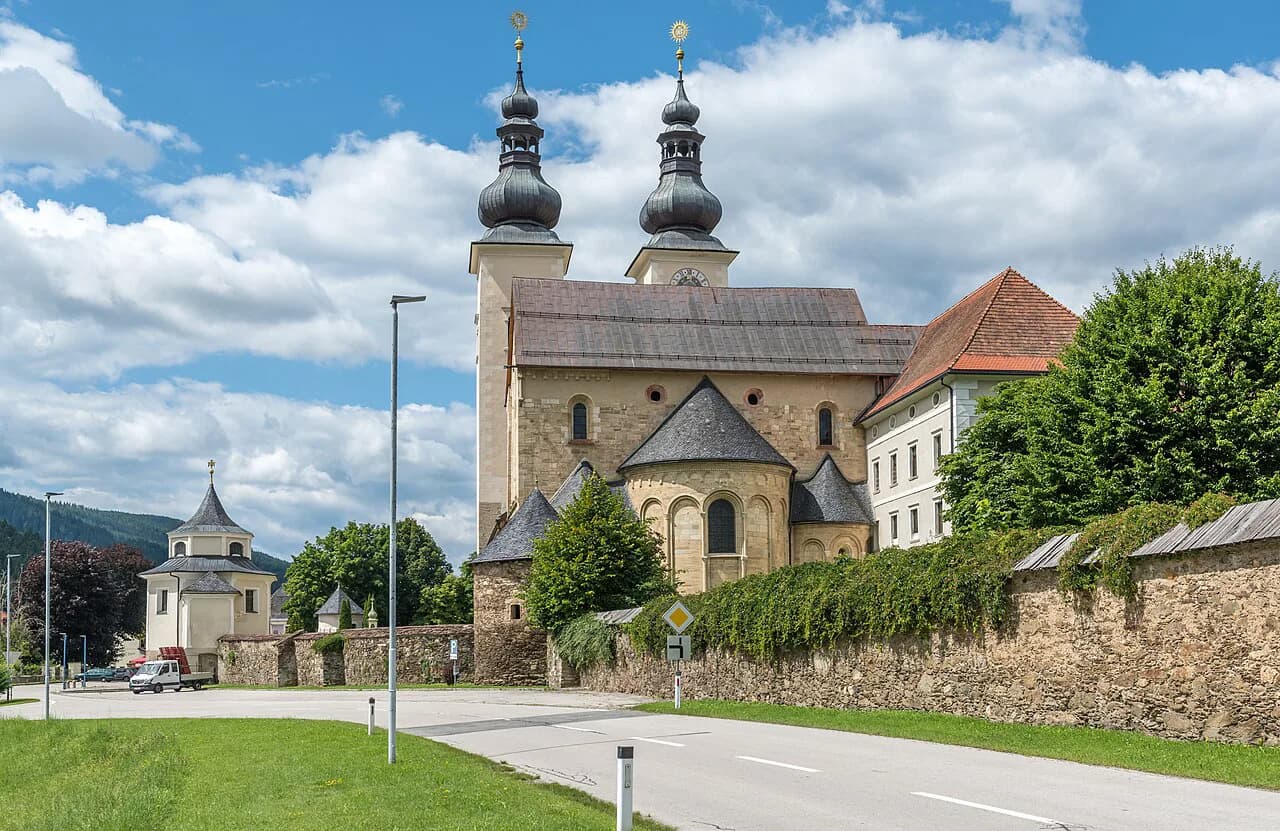
Friesach was once a residence of the Prince-Archbishops of Salzburg, and that Salzburg connection shaped the town's churches, monasteries and fortifications. Its medieval silhouette has survived largely intact because the castles and ruins on the Petersberg, Virgilienberg and the other hills still frame the historic center from above, and the town is promoted as a Burgenstadt, a town of castles.
The result is a town where the medieval set pieces are not gathered in one place. The secular sights, the churches and the museums sit in the lanes of the center, while the castles and ruins stand on separate hills around it, so any visit involves walking up and down. Plan for that shape rather than expecting a single walled circuit you can stroll in an hour.
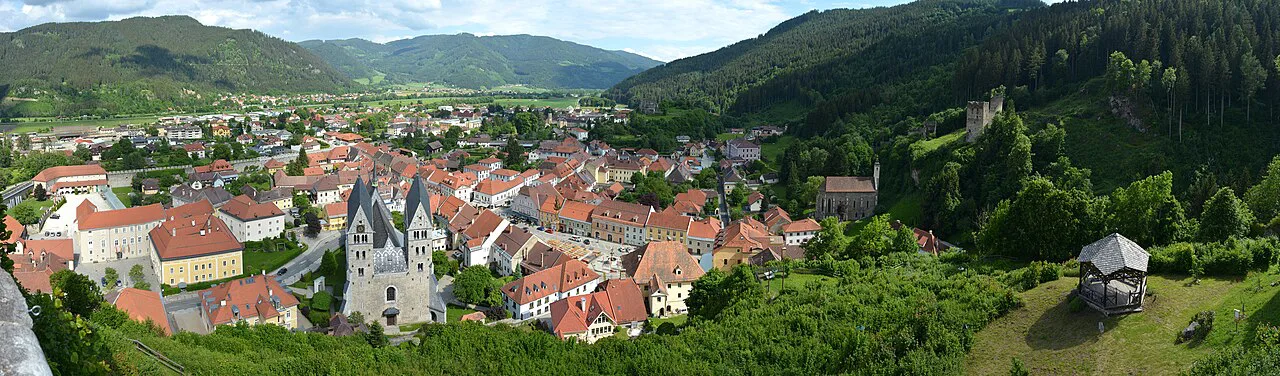
The old center and main square: lanes, squares and churches to walk through
The historic center is the natural starting point: winding lanes and small squares, several churches and former monasteries, all packed into a compact area you can cross on foot. Walk without a fixed route first, then pick the churches and museum you actually want to enter, because the town's appeal lies in the streetscape as much as in any single sight.
Friesach sits in Mittelkärnten, the region the local tourism board describes as Carinthia's historic, cultural and culinary center, with the Metnitztal, Gurktal and the country around St. Georgen am Längsee close by. That makes the town a sensible stop on a wider Carinthia loop rather than a standalone destination, and it pairs naturally with a Klagenfurt base or a lake stay on the Wörthersee (check the Wörthersee guide and the Klagenfurt guide for the lake and city ends of the loop).
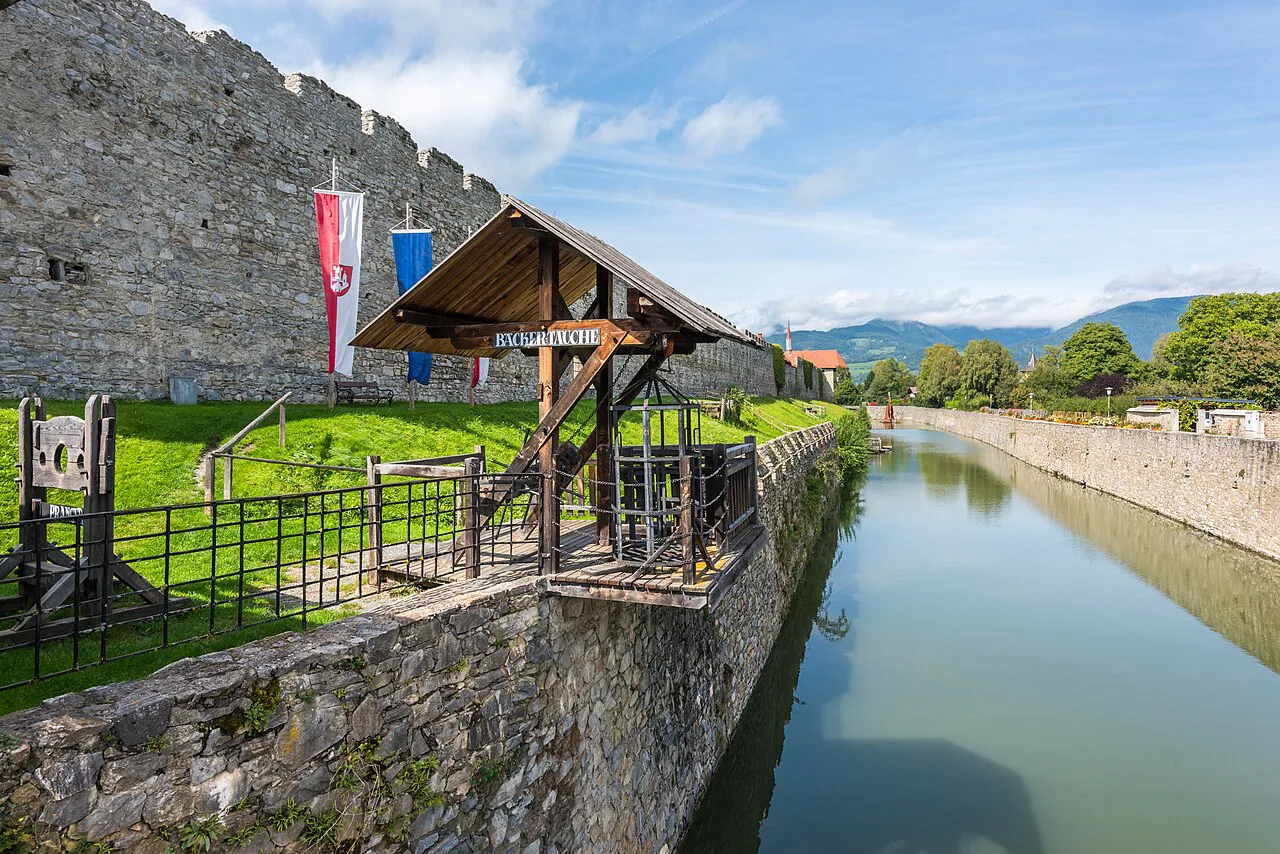
The water-filled town moat, walls and towers that ring the center
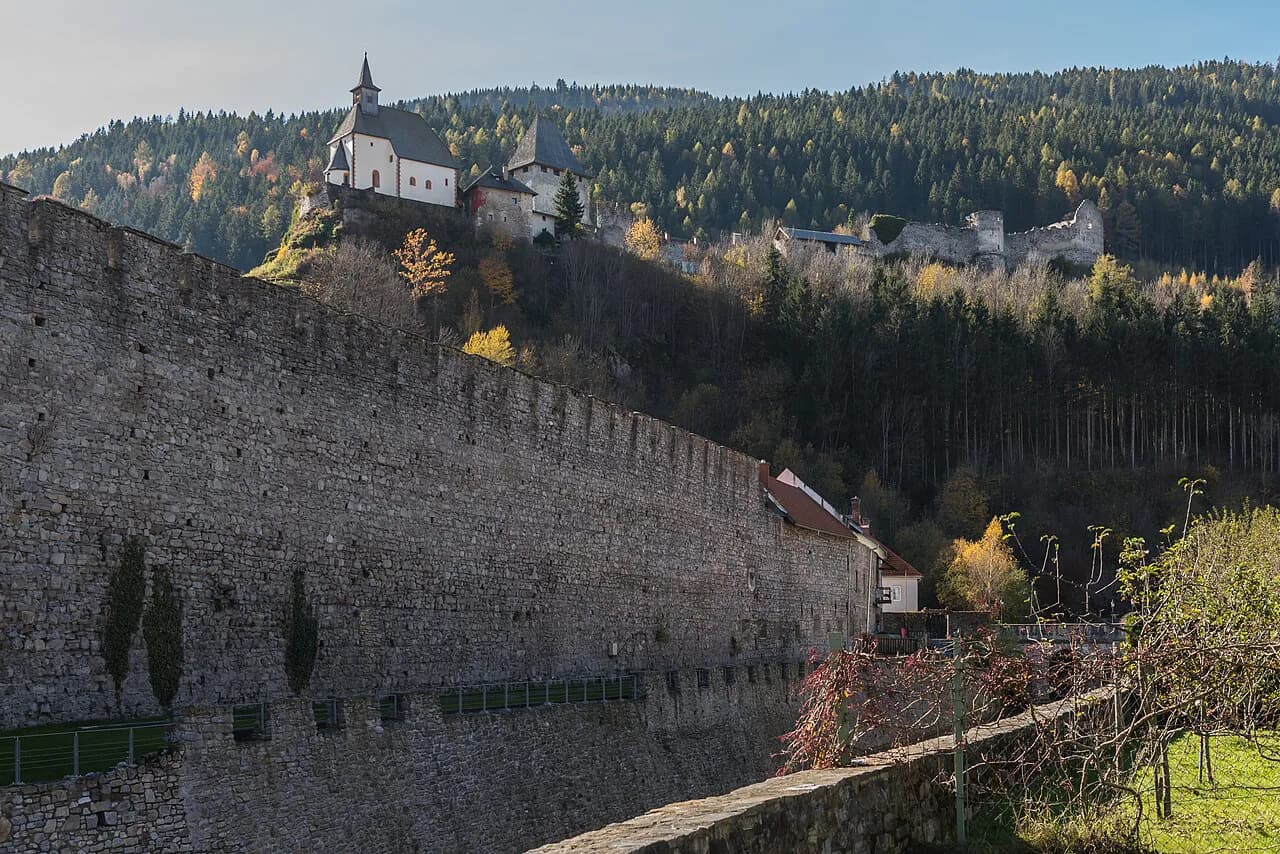
The town's defensive ring is the feature that sets Friesach apart: a system of walls, fortified towers and a town moat that still carries water, described by the regional tourism board as one of the last water-bearing town moats in Europe. Walk around the center and you can trace the circuit, and it is perhaps best taken as a loop rather than viewed from a single point; the moat, walls and towers together explain why the town's silhouette reads as medieval from a distance.
Allow time to walk the outside of the ring rather than only the lanes inside it. The stretch along the moat gives you the clearest sense of how the fortifications enclosed the town, and the towers give you the vantage points. Comfortable shoes matter here: the ground is uneven and the walking adds up over a day.
Petersberg and Virgilienberg: the castles and ruins above town
The castles and ruins on the Petersberg, Virgilienberg and the other hills above the center produce the outline you see from the approach roads, and they are the reason the town calls itself a Burgenstadt. The climb is the trade-off: the reward is the view back over the walls and roofs, and the effort is a steady uphill walk from the center.
If you want a structured way to see the castle hills rather than improvising, the Burgenwanderweg is the town's own castle trail linking the fortified sites around the center. It suits travelers who would rather follow a marked route than guess at paths, and it turns the hills into a single walk instead of several separate detours.
Friesach also hosts the Friesacher Burghofspiele, an annual theater season staged on the Petersberg, and every two years the Spectaculum zu Friesach brings tournaments and historical festivities into town. Check the town's event calendar for the current season's program rather than planning a trip around a fixed date.
Stadtmuseum Friesach in the Kapellenturm: the Friesacher Pfennig and medieval weapons
The Stadtmuseum Friesach occupies the Kapellenturm on the Petersberg, spread over six floors. Its core exhibits are the Friesacher Pfennig, the medieval coin minted in the town that served as an important currency of the Middle Ages, alongside medieval weapons and other finds. It is the one indoor stop that explains the town's commercial and military past, so put it early in your visit if the weather is uncertain.
The museum's opening times and admission are set by the operator, and the town publishes them separately from the general sightseeing information; confirm the current schedule before you climb the hill specifically for it.
The Burgbau Friesach: a castle under construction with medieval methods
The Burgbau Friesach is the reason to give the town more than a quick pass. South of the center, a new castle is being raised using medieval techniques, without electricity or machines, as a long-running research project in experimental archaeology; it draws visitors of every age and turns a construction site into the main attraction. Watching stone, timber and muscle do the work is a different experience from touring a finished castle.
The site is an active build, so what you can see changes as the work progresses. It sits outside the compact center, which means adding a walk or a short drive to your day; budget for it explicitly rather than treating it as a five-minute add-on, since the visit is the point of the stop for many travelers.
Tours and access run on the project's own schedule, and the town's pages separate the Burgbau from the museums; check the current visiting arrangements on the day you plan to go.
Chocolate at the Craigher Schokoladen-Manufaktur in Friesach
The Craigher chocolate manufactory sits in the middle of Friesach and runs as an experience workshop where you can see how the family's chocolate is made rather than just buy it. It is a low-effort stop in the center, useful when you want something indoors between the castle hills and the moat walk, and it works well for travelers with children or a sweet tooth.
The manufactory also runs as an experience workshop, and its visiting hours follow the business's own schedule; confirm before making it the anchor of your afternoon.
Other stops: the Automuseum in St. Salvator and the Fürstenhof grain store exhibition
Two further sights sit at the edges of a Friesach day. The Automuseum in St. Salvator displays an unusual collection of cars assembled by Gerhard Porsche and is a separate destination outside the town itself, so it needs its own time slot and transport. In town, the Getreidespeicher im Friesacher Fürstenhof holds an exhibition on Carinthia's wildlife and the connections between people, forest and animals, presented in a way that suits a mixed-age group.
Because both are run independently, their seasons and hours differ from the town's main sights; confirm current opening before you build either into the plan, especially the Automuseum, which is the longer detour.
How much time Friesach needs and a short walking order for the center
A workable order is the old center first, then the Stadtmuseum in the Kapellenturm, then the castle hills, with the moat and walls last as a loop back toward where you started. Give the Burgbau its own block of time, because it is outside the center and is the most distinctive thing in town; a half day covers the center and one hill, and a full day covers the Burgbau and both castle hills without rushing.
Friesach's sights are close together on the map but separated by height, so the honest constraint is climbing rather than distance. Travelers with limited mobility should pick the center and the museums, and treat the hilltop castles and the Burgbau as optional.
Getting to Friesach and fitting it into a Carinthia route by train or car
Friesach lies in northern Carinthia within the Mittelkärnten region, and its position on the rail corridor toward Klagenfurt makes it reachable without a car. Check ÖBB timetables for train connections and Postbus timetables for the last stretch, and use the operator's own journey planner for times rather than relying on memory or rough estimates.
By car the town is a straightforward stop on a route between Klagenfurt and the north, which makes it easy to pair with Gurk, St. Veit an der Glan or the lake towns on the Wörthersee in a single loop. A car also makes the Automuseum in St. Salvator practical, since it is a separate destination outside the town itself.
A Klagenfurt base works well, since the city is the region's main transport hub and Friesach sits within driving or a short train ride of it. From there you can add lakes or abbeys on other days instead of trying to compress everything into one outing.
Is the Burgbau worth the detour to Friesach?
Yes, if you want a Carinthian town that feels genuinely medieval rather than reconstructed for show. The moat, the walls and the castle hills give Friesach a shape you can read on foot, and the Burgbau adds something no finished castle can: the process of building one. Travelers who only want a square and a cafe will find it quiet, and that is the honest trade-off.
Build the day around the center and one castle hill, add the Burgbau, and leave the Automuseum for travelers with their own car. Confirm current opening arrangements for the museums and the Burgbau before you go, then let the town's slow pace set the rest of the schedule.
Explore more Klagenfurt guides
Sources
Notes for your next Austrian town break
Optional updates when we add or revise town guides.
You might also like
Continue reading
More guides you'll find useful