
Piaristenkirche Krems: What to See Inside Krems's Oldest Church
Piaristenkirche Krems deserves 20 to 30 minutes of your Krems walking day. It is the city's oldest church, first documented in 1014, and it holds one of Austria's oddest tower tops: the Frauenbergturm carries the Krems town coat of arms instead of a cross. This guide covers where the church stands, how to reach it on foot, what to look at in which order, and how it fits between the Kunstmeile and the Steiner Landstraße.
What the Piaristenkirche is and why it stands out
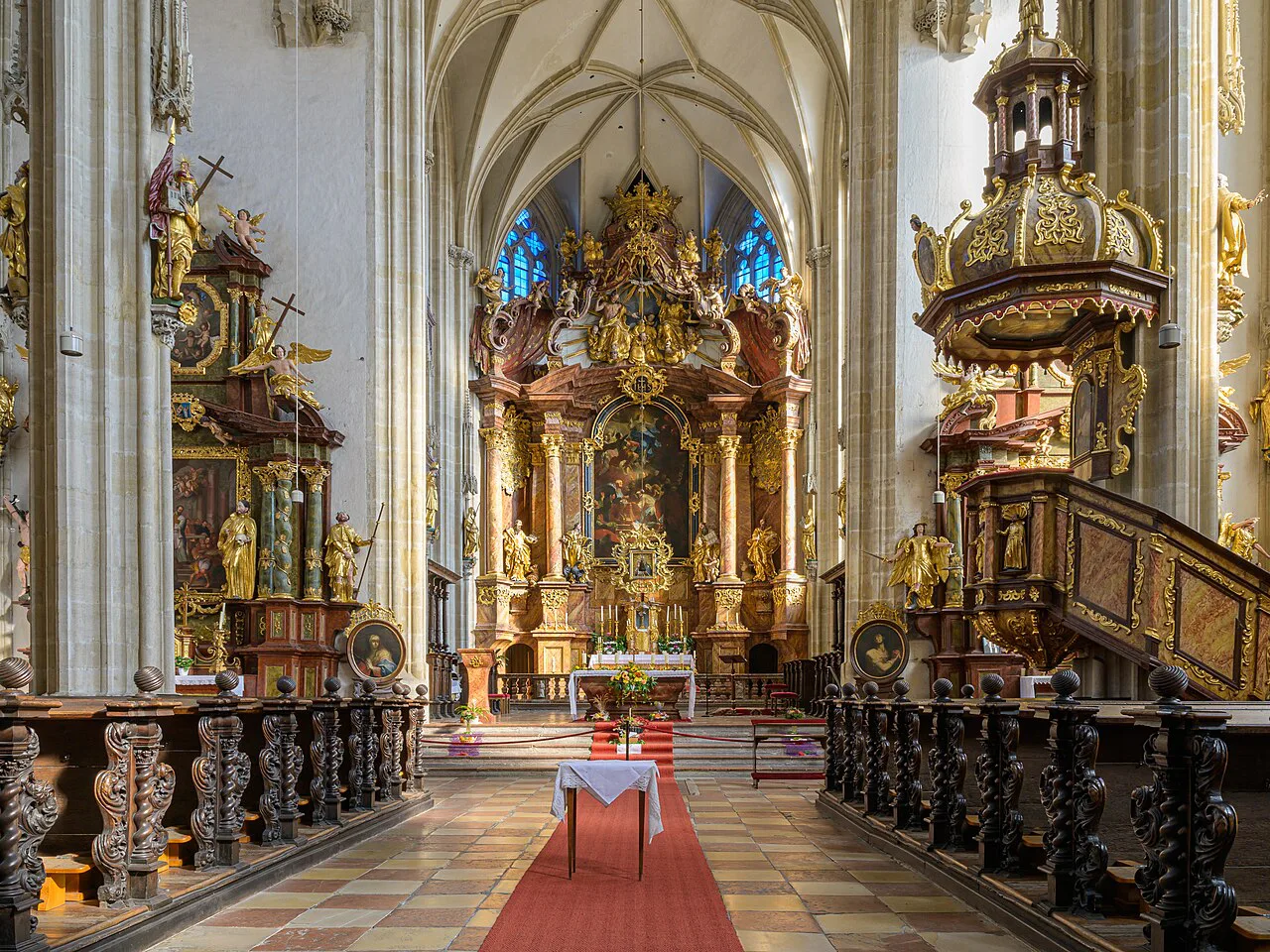
The Piaristenkirche is a former Jesuit church that passed to the Piarist order, and its fabric is a layered record of the town's changing owners. The building began as a Romanesque structure, was rebuilt as a Gothic hall church, and then had its interior refitted in baroque style. That mix is the reason to step in: you read four centuries of Krems in one nave.
Most visitors treat it as a quick look on the way to somewhere else, and that is fair. Set your expectations at one compact interior and one exterior detail worth a photograph, then move on.

Where it sits in Krems and how to reach it on foot
The church stands on Piaristengasse in the historic center of Krems, on the Stein side of town and a short walk from the Danube. From the Kunstmeile museum quarter it is a few minutes on foot through the old streets; from the riverbank promenade, head uphill into the center and follow Piaristengasse.
Krems is the regional rail hub for the Wachau, and the station sits across the tracks from the old center rather than in it. The church is also a natural stop on a loop that takes in the Steiner Tor and continues along the Steiner Landstraße toward Stein.

The Frauenbergturm: a tower without a cross
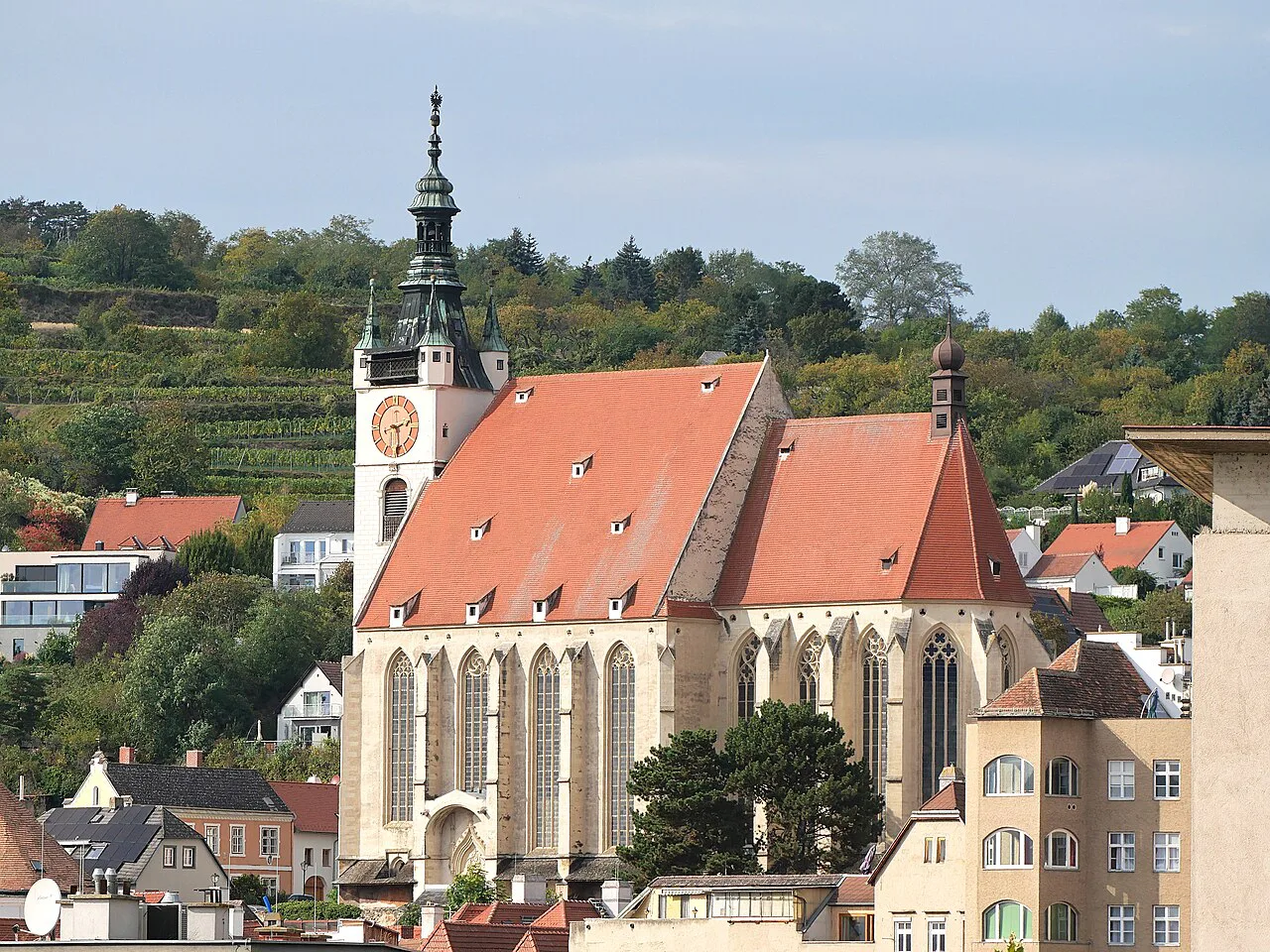
Look up first. The Frauenbergturm, whose origins reach back to the early 13th century, was raised in the 15th century and given corner turrets, and it served the town as a watchtower rather than purely as a church tower. Its weather vane carries the Krems city coat of arms in place of a cross, a detail the source calls unique among Austrian church towers.
Photograph it from across the street or from the square below, where the whole tower fits in the frame. The coat of arms is high up, so you need a clear line of sight rather than a telephoto lens.
Inside: the late-Gothic hall nave and the diamond-net vault
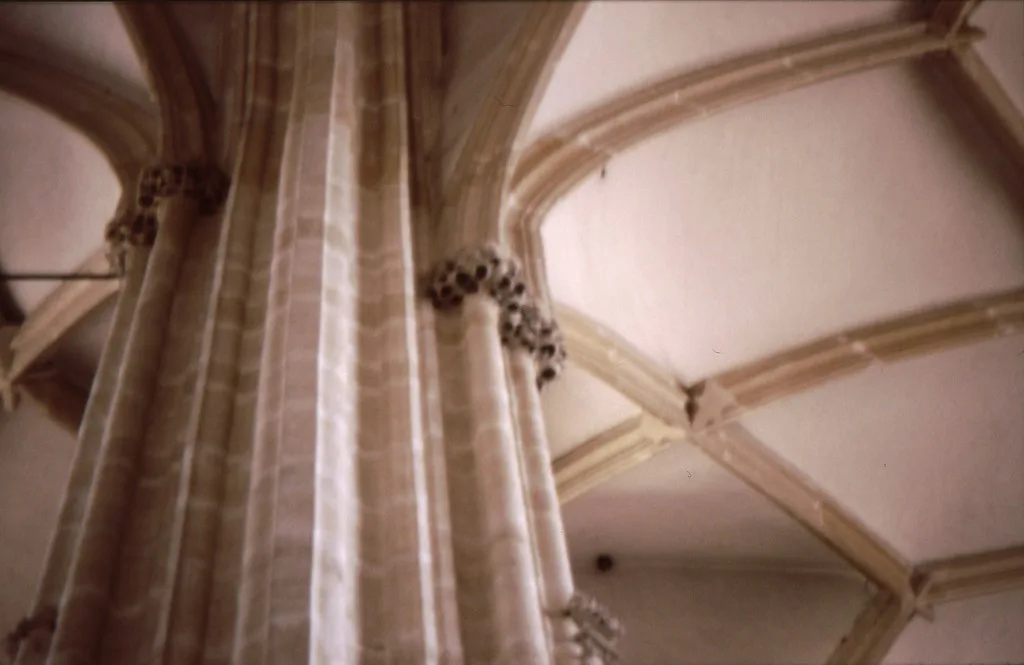
The nave you walk into is a three-aisled late-Gothic hall, built from the mid-15th century under Laurenz Spenning, the master builder associated with St. Stephen's Cathedral in Vienna. The choir carries a diamond-net vault completed in 1457, and the nave was consecrated in 1508. Stand at the rear of the nave and look up: the rib patterns are the church's best architectural feature.
Rib vaults and heavy Gothic walls mean the interior is dim even on a bright day, so give your eyes a minute to adjust before reading the altars. Morning light is generally better for the windows than late afternoon.
How the Jesuits and then the Piarists reworked it
The Jesuits took over the church in 1616, founded a monastery and a school beside it, and refitted the interior in baroque style. When the Jesuit order was suppressed, the Piarists arrived in 1776 and continued the teaching tradition on the same site. Keep that sequence in mind: the Gothic shell is original, but most of the furnishings you see are later insertions.
The Kremser Schmidt altarpieces to find
Martin Johann Schmidt, known as Kremser Schmidt, is the painter whose work defines the baroque layer of the church. In the choir, the high altarpiece shows the Assumption of the Virgin, painted in 1756. In the nave, the right side altar is dedicated to Saint Joseph Calasanz, founder of the Piarists, and further altars along the nave walls carry images of Saint Joseph and Saint Aloysius.
Work through them in order: choir first, then the Calasanz altar, then the nave walls on your way out. Because the paintings sit above eye level, step back toward the center aisle to see them properly instead of peering from directly beneath.
The Franz Xaver chapel fresco
Near the entrance, a fresco marks the doorway to the Franz Xaver chapel. The Jesuits added it in 1640. It is easy to miss on the way in, so turn around after you enter and look back at the entrance wall.
The crypt and its charnel house
A crypt beneath the church holds a charnel house, the storage space for bones moved from the churchyard. Access is not guaranteed on a casual visit. Ask at the parish office in Krems, which handles the church's affairs, whether the crypt can be seen during your stay.
How long to allow and how to slot it into a walk
Budget 20 to 30 minutes for the church itself, or 45 if you are photographing the tower and reading the altarpieces slowly. That fits neatly between the Kunstmeile and the walk toward Stein. A sensible order is the Kunsthalle first, the Piaristenkirche second, then the Steiner Landstraße down to the Steiner Tor.
If you are heading further afield afterward, Stift Göttweig (Göttweig Abbey) sits across the Danube near Furth and makes a natural half-day extension by bus or car. The abbey is a Benedictine foundation with a baroque interior on a hill above the valley, and it pairs well with a morning in Krems.
Sunday Mass and what it means for a visit
The Piaristenkirche is an active parish church, so services take precedence over sightseeing. The city's religion listing gives Sunday and holiday Mass there at 11:00 a.m., with English-language services on request. Plan your interior visit for the morning before that, or for the afternoon after it, and expect the doors to be busy around service time.
If you want to attend Mass rather than sightsee, arrive a little early and sit toward the rear so latecomers can find seats. The Piarist church is one of several Catholic parishes in Krems, and the same city listing covers the others if you are comparing service times.
Nearby: St. Veit and the Steiner Landstraße
St. Veit, the parish church whose roots go back to the town's earliest years, stands at Pfarrplatz a short walk away and is the other essential church stop in Krems. Together with the Piaristenkirche it gives you the Gothic and the baroque ends of the town's ecclesiastical story in one loop.
From there, the Steiner Landstraße runs toward Stein past burgher houses and shops, and the Steiner Tor marks the old town gate at the Krems end. Walk it in one direction and take the riverside path back for a different view of the Danube.
What to confirm before you go
Door times follow parish life rather than a visitor schedule. Confirm the day's opening and any service times through the city's religion listing before you build your walk around it. That one check is the difference between a quick look inside and a locked door.
Where the Piaristenkirche fits in your Krems day
Treat the Piaristenkirche as a 20- to 30-minute stop with one unmissable exterior detail and a handful of baroque paintings worth finding by position. Pair it with St. Veit, the Steiner Landstraße, and the gate at the end of the street, and you have a compact, walkable old-town loop. Check the parish's service and opening details the day before, then go early.