
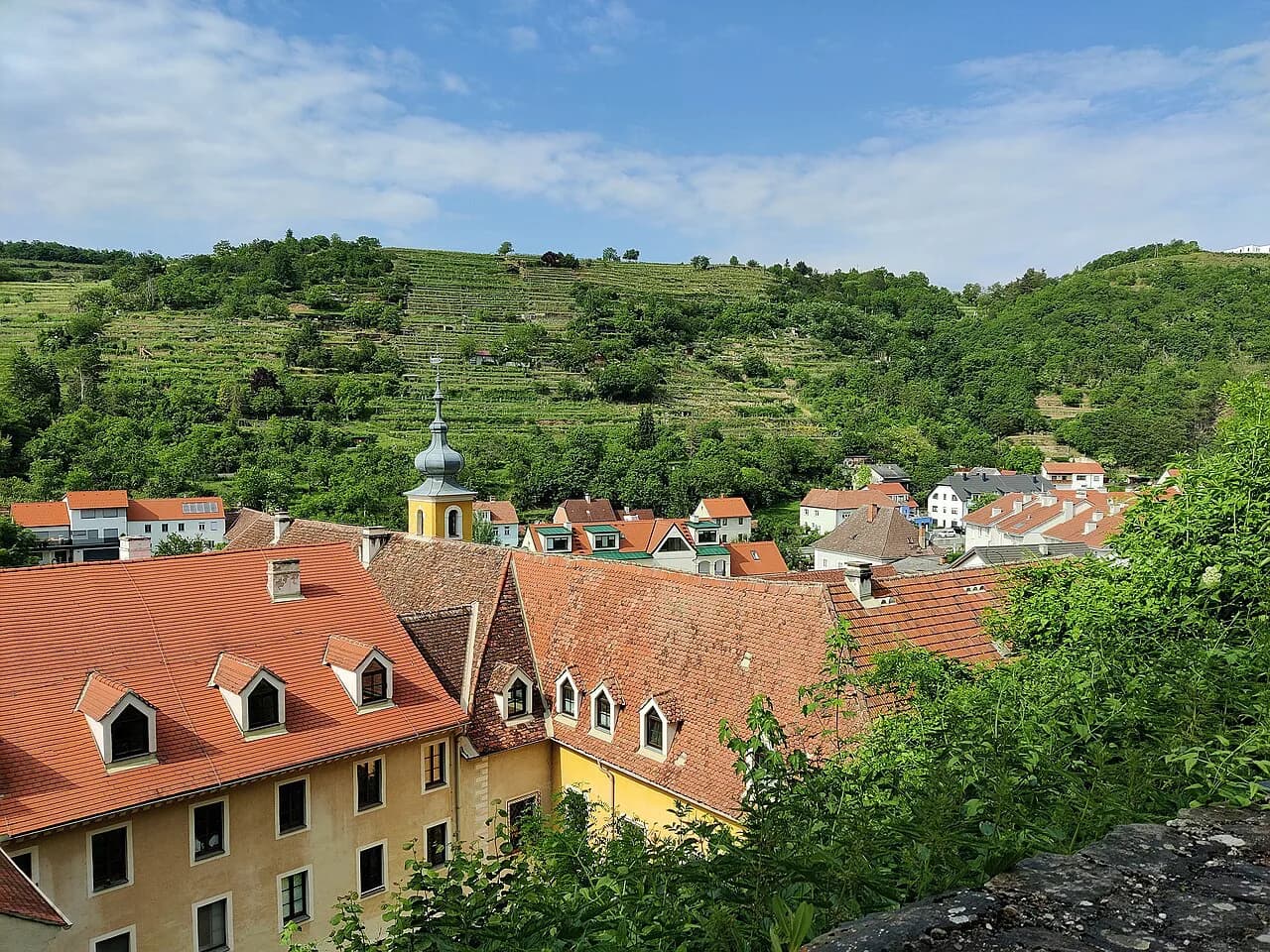
Pfarrkirche St. Veit in Krems: Visiting the Dom der Wachau

Pfarrkirche St. Veit is Krems's main parish church and the building locals call the Dom der Wachau, the cathedral of the Wachau. It is a working Catholic parish on Pfarrplatz in the old town, open to the public during the day, and worth 30 to 45 minutes if you look at the furnishings rather than just the nave. This guide covers what stands where, which artworks to hunt down, and how the church slots into a walk through Krems.
Why Krems calls it the Dom der Wachau
The nickname is about size and standing rather than a bishop's seat. St. Veit is the largest parish church in the Diocese of St. Pölten, according to the parish itself, and it anchors the old town the way a cathedral anchors a cathedral square. The parish celebrated its 1,000th anniversary in 2014, which gives you a sense of how long this site has been in use.
The documented story starts with a donation by Emperor Henry II in 1014, and the church appears under the patronage of St. Vitus from 1178. Treat the building you see as the third or fourth version on the site rather than a medieval survivor, because almost nothing of the Romanesque structure remains above ground.

Where the church stands on Pfarrplatz
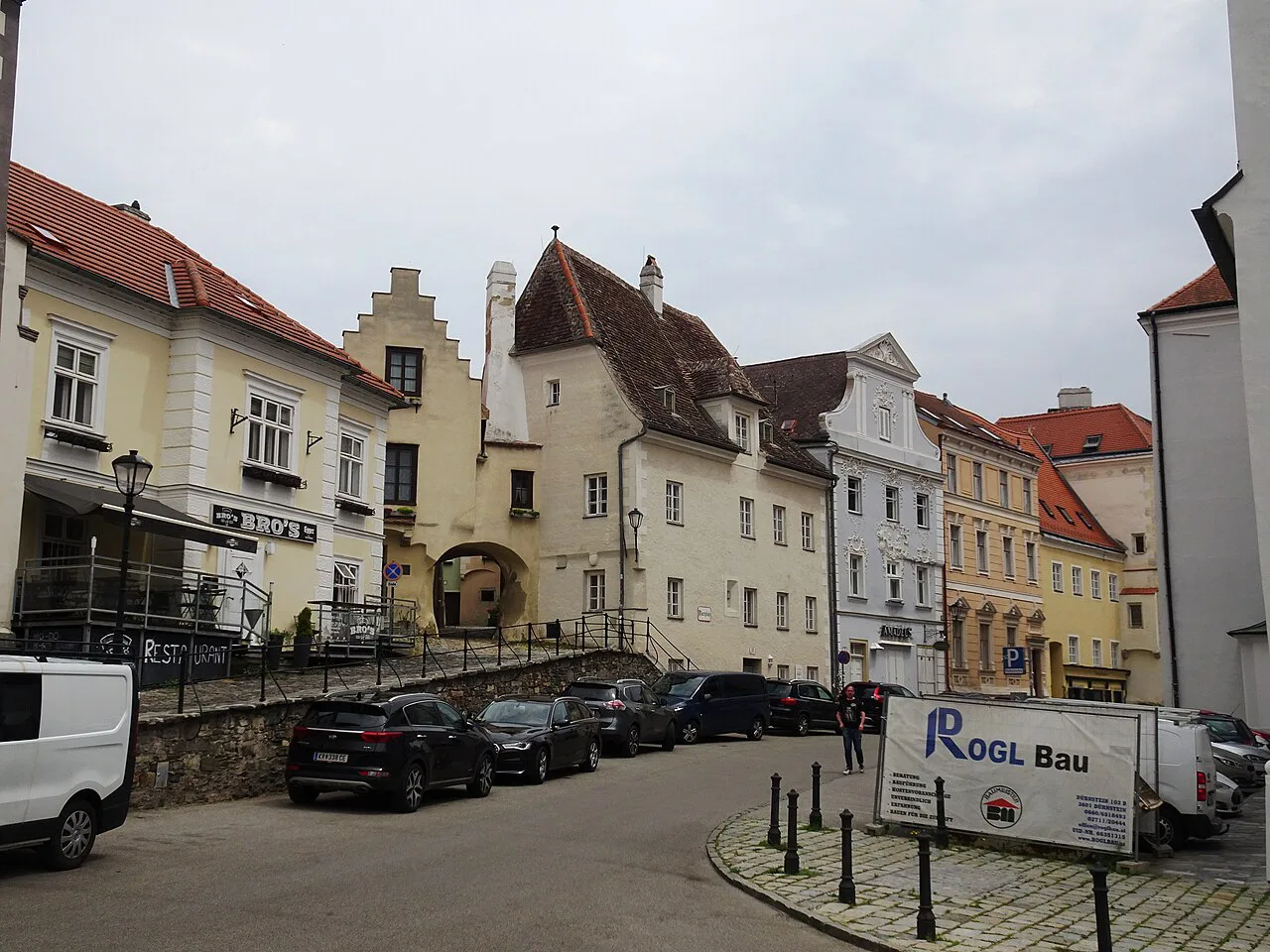
St. Veit sits on Pfarrplatz in the Krems old town, a short walk from the pedestrian core and within easy reach of the Danube-side streets. The parish office is at Pfarrplatz 5, so that address is the one to use if you are navigating by map or asking directions.
Because it is inside the historic center, the church works best as one stop on a Krems old-town loop rather than a separate excursion. Pair it with the lanes around the Steiner Tor in Krems and the museum quarter across the river in Stein an der Donau, and you have a full half day without any transport except your feet.

Getting there from the station, by boat or by bus
Krems an der Donau has train connections on the Danube line, and the station sits on the edge of the old town. From the platform, head south toward the historic center and follow signs for the Altstadt; the church tower base and the square in front of it come into view once you are inside the pedestrian zone.
In season, Danube cruise boats call at Krems and Stein, which puts the church within a short walk of the landing stages. Bus services in the Wachau run along the valley, and the local network drops you close to the center rather than at the church door. Confirm sailing dates and bus departure times on the operator's own timetable before you build a day around them, since both are seasonal.
A plain exterior, an 18th-century interior
The mismatch is the thing to prepare for. From outside, St. Veit reads as a severe early Baroque box, rebuilt between 1616 and 1630 to plans by the Milanese architect Cypriano Biasino after the medieval church was judged unsafe. The only medieval survivor is the lower section of the tower, which dates to the early 13th century.
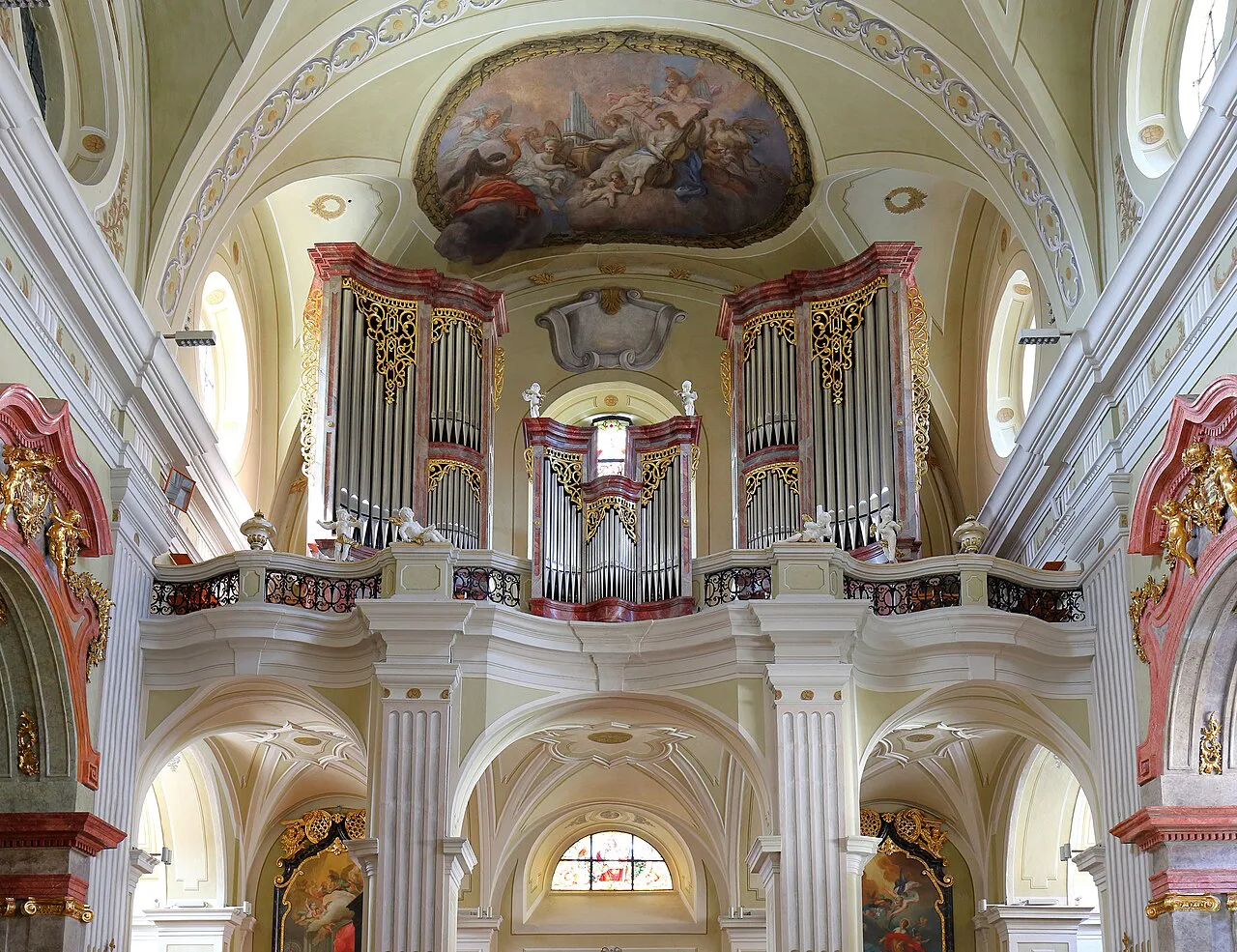
Step inside and the date jumps forward a century: the furnishings and painted decoration belong to the 1700s. That contrast between a reserved shell and a rich interior is what makes the church more interesting than its façade suggests.
The Götz furnishings: high altar, choir stalls and pulpit
The Passau sculptor and architect Joseph Matthias Götz supplied the high altar, the choir stalls and the pulpit in 1733, and together they set the tone of the interior. Look at the pulpit as a piece of carved architecture rather than furniture, and note how the choir stalls hold the liturgical center of the church.
Give these three pieces your time instead of photographing every side chapel. If you see only one thing inside St. Veit, make it the high altar ensemble, which shows how a modest parish could still buy first-rate sculpture in the 1730s.
Frescoes by the Kremser Schmidt and the 1734 altarpiece
The ceiling frescoes were painted by Martin Johann Schmidt, known as the Kremser Schmidt, in 1787, and they are the reason to look up as you walk the nave. The high altarpiece above Götz's altar is earlier, painted in 1734 by Johann Georg Schmidt, the so-called Wiener Schmidt, a contemporary of the fresco painter with no family connection to him.
Kremser Schmidt is the painter most associated with this stretch of the Danube, so seeing his work in the church is a useful primer before you meet him again in local collections. The pairing of the two Schmidts on one axis, ceiling above altarpiece, is the kind of detail most visitors walk past.
The black marble side altar and the Maria Bründl statuette
In the left transept stands a side altar of black marble that came from the Bründlkapelle of the Kapuzinerkloster Und, transferred here in 1796 when that monastery was dissolved. With it came a small Bohemian statuette of the Virgin Mary from around 1420, the Maria Bründl image of grace that had been the focus of Marian devotion at Und.
This is the oldest object on view and the one with the most complicated history, since it arrived as a rescued piece of a suppressed monastery. Find the left transept first if your time is short.
The Anna Maria chapel and its 14th-century sculpture
On the north-east side of the church, a small chapel was created in 1739 to house a group of figures showing Anna Maria reading and teaching. The central stone sculpture is earlier, from the first half of the 14th century, and is described as an important document of the late Gothic period in the artistic development of Krems.
It is easy to miss because it sits off the main axis and looks modest next to the baroque altars. Walk the outer edge of the interior before you leave so you do not skip it.
How long to allow and how to combine the visit
Budget 30 to 45 minutes inside if you want to find the Götz pulpit, the two Schmidt paintings and the Und altar. A brisk 15-minute look at the nave is possible, but you will leave without the pieces that make the church distinctive.
The church fits naturally into a walk that takes in the old town squares, the Gozzoburg, and then the Kunstmeile across the river. Build the church into the middle of that loop rather than at the end, so you are not rushed by closing time elsewhere.
If you have a car, the wider Wachau is close: Stift Göttweig sits on its hill above Furth bei Göttweig within a short drive of Krems, and makes a natural baroque pairing with St. Veit. Both are working religious sites, so the same courtesy about services applies at each.
Visiting around services
The church is open to the public during the day and the tourism listing gives no admission charge. Sunday Mass is listed at 08:00, 10:00 and 19:00, which means the late morning is the least convenient window for sightseeing on a Sunday.
Weekday Masses appear on the parish schedule at 18:30 on Tuesday and Thursday and 07:45 on Friday and Saturday, so an early morning or a mid-afternoon visit avoids the pews filling up. The parish office on Pfarrplatz 5 keeps separate hours and is not the same thing as visitor opening times. Check the parish site for the current schedule before you plan a Sunday around the church.
Access and what to confirm before you go
The Danube tourism entry lists the church as reachable by public transport, but it gives no detail on step-free access, ramps or an accessible entrance. If mobility is a factor, call the parish office at the number published on its site before you travel rather than assuming a side door is open.
Treat St. Veit as a self-guided stop; the parish site publishes no guided-tour offer. Bring the artwork names from this guide and you will read the interior far better than by wandering.
Making St. Veit part of your Krems day
St. Veit rewards a slow 45 minutes more than a quick photo stop, mainly because its best pieces sit off the central aisle. Go on a weekday morning, look for Götz's pulpit, both Schmidt paintings and the black marble altar, and save the Anna chapel for last.
If you are staying in the region, the church pairs neatly with the museums of the Kunstmeile and with a Wachau drive to Göttweig. Plan around Sunday Mass times and the day stays simple.
Explore more Krems guides
Frequently Asked Questions
Is the Dom der Wachau the same church as Pfarrkirche St. Veit?
Yes. Dom der Wachau is the popular nickname for Pfarrkirche St. Veit in Krems, used because it is the largest parish church in the Diocese of St. Pölten. The dedication is to St. Vitus, who appears as the church's patron from 1178.
Do you need tickets for Pfarrkirche St. Veit in Krems?
The church is a working parish church open to the public during the day, and the Danube tourism listing gives no admission charge. Visitors walk in; the parish site publishes no guided-tour offer to book.
Can you attend Mass at St. Veit in Krems as a visitor?
Yes, visitors are welcome at services. Sunday Mass is listed at 08:00, 10:00 and 19:00, with weekday Masses on Tuesday and Thursday evenings and Friday and Saturday mornings. Check the parish site for the current schedule before you go.