
Hallstatt Ossuary: The Painted Skulls in St. Michael's Chapel
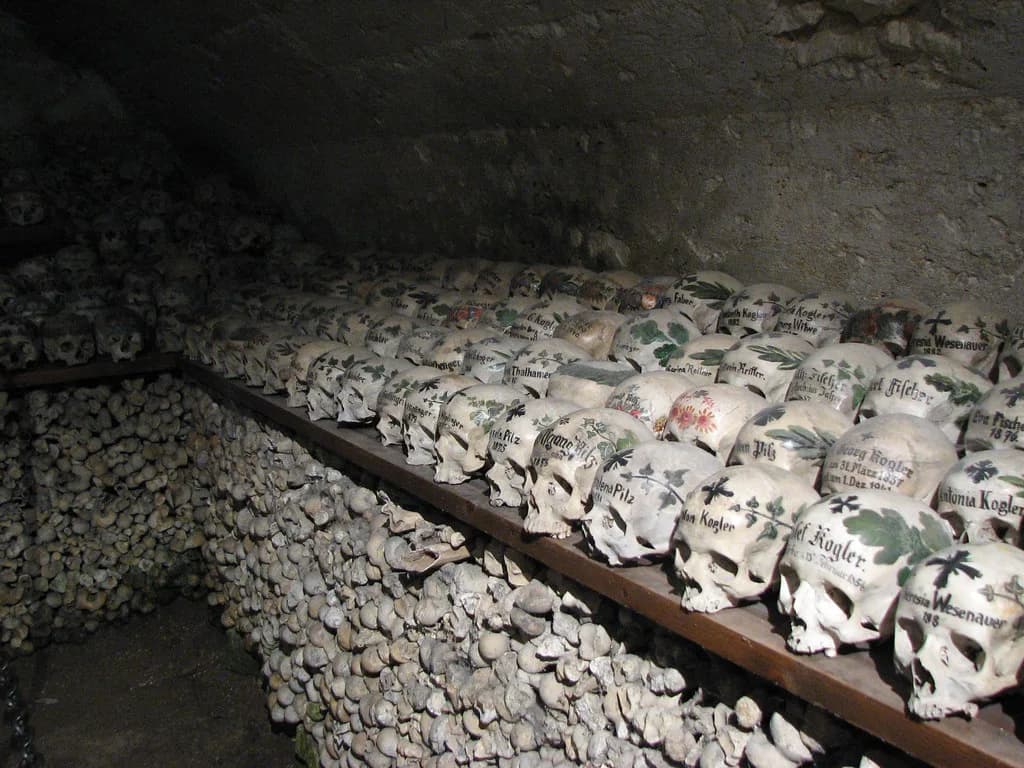
The Hallstatt Ossuary is a compact charnel house inside St. Michael's Chapel, a Romanesque building beside the Catholic parish church on the hillside above the village center, and it holds more than 600 artistically painted skulls. The visit takes minutes rather than hours, but the climb and the setting are the point: you reach it past a working mountain cemetery with Lake Hallstatt below. This guide covers where the Beinhaus sits, how to get up, what to look for among the skulls and how the chapel fits into a walk through Hallstatt.
What the Hallstatt Ossuary is
A charnel house, or Beinhaus, is where bones removed from reused graves are kept, and Hallstatt's version sits in St. Michael's Chapel next to the Catholic parish church. The chapel dates to the 12th century, and the collection of painted skulls is the reason most travelers make the climb. Hallstatt's is the largest surviving collection of its kind, which is why a room this small draws visitors from across the world.
The setting matters as much as the objects. The chapel stands beside the cemetery, on rocky ground above the rooftops, and the two are visited together rather than separately. Treat the interior as a consecrated space with human remains rather than a museum case, and keep voices low and movement calm.

Where the ossuary sits above the village center
The Beinhaus is in the center of Hallstatt, but not at street level: you climb to it by a long flight of steps or by the Kirchenweg, a steeper path up to the church. The steps are the direct route; the Kirchenweg takes longer, gains height more gradually in places, and is the route to choose if you would rather walk a path than a staircase. The chapel and cemetery sit on the slope, so the last stretch is uphill whichever way you come.
Above the village, the cemetery occupies the terraced ground around the parish church, with the chapel immediately beside it. Allow a few minutes at the top simply to orient yourself, because several passages thread between the graves and walls and the entrance is not obvious on the first pass. Look for the small chapel building next to the church rather than a separate ticket hall.

Getting there on foot
Most travelers arrive in Hallstatt by boat or train and walk up from the landing, which puts the whole village within a short walk before the climb begins. From the ferry landing, the shore is close and the uphill lanes to the church start almost immediately behind the waterfront houses; the climb itself is the slow part, not the distance. Boats connect the landing with the rail side of the lake, where Hallstätter See separates the station from the town.
By car, parking sits in several lots outside the historic core, and every one of them leaves a steep walk up through the village to the church. Driving into the lanes themselves is not an option, so plan the climb as part of the arrival rather than something you do after dropping bags at the door. The village is compact enough that the walk from the lots is short in distance and demanding in gradient.
Opening hours and admission
The ossuary is a small chapel charnel house rather than a large museum, and access is controlled by the parish, so opening times can vary by season and around church services. Published visitor information from the village lists no fixed hours or ticket price for the Beinhaus, so check the day's access at the chapel entrance or through the parish before you climb.
If the door is shut when you arrive, the cemetery and the parish church next door remain the reason for the climb and are visited on the same circuit. The climb is short enough that a second attempt later in the day costs little.
What you see inside
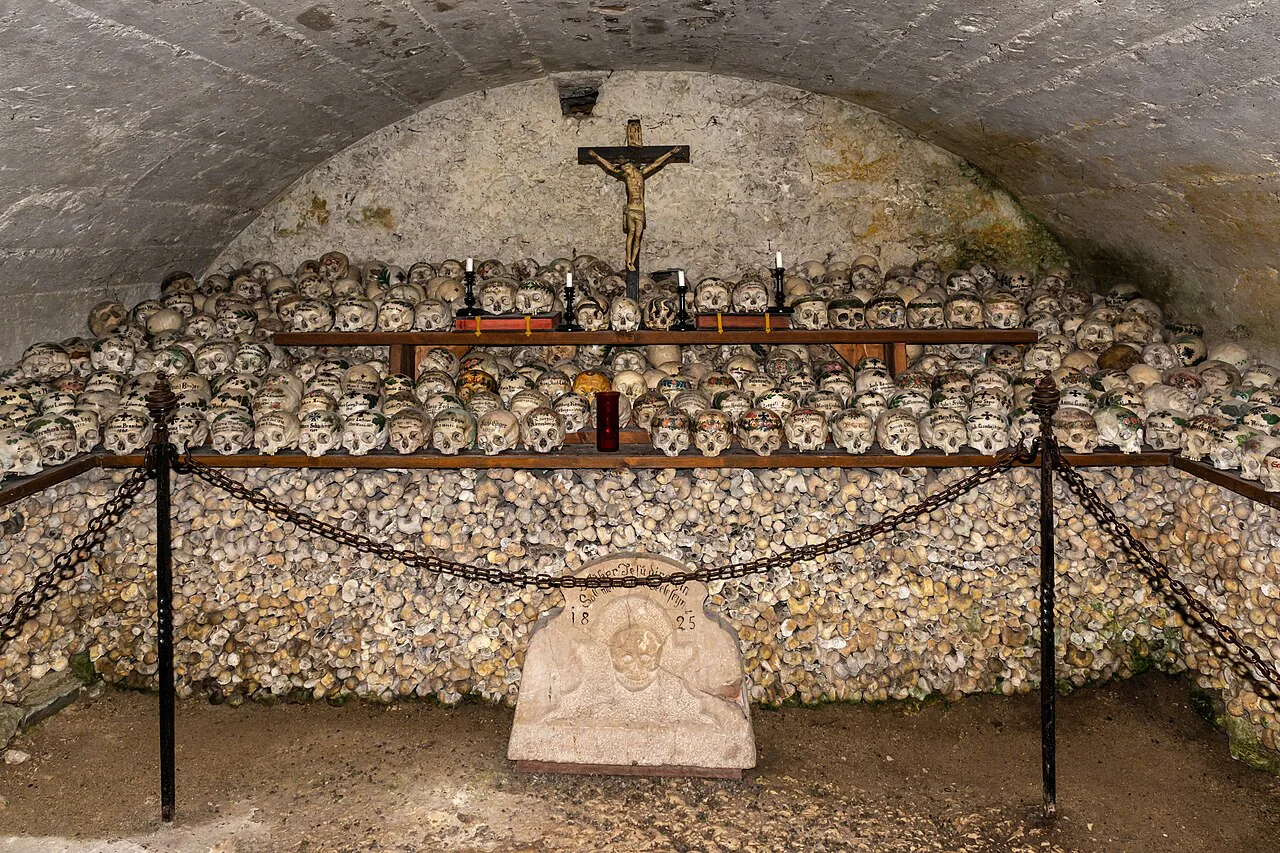
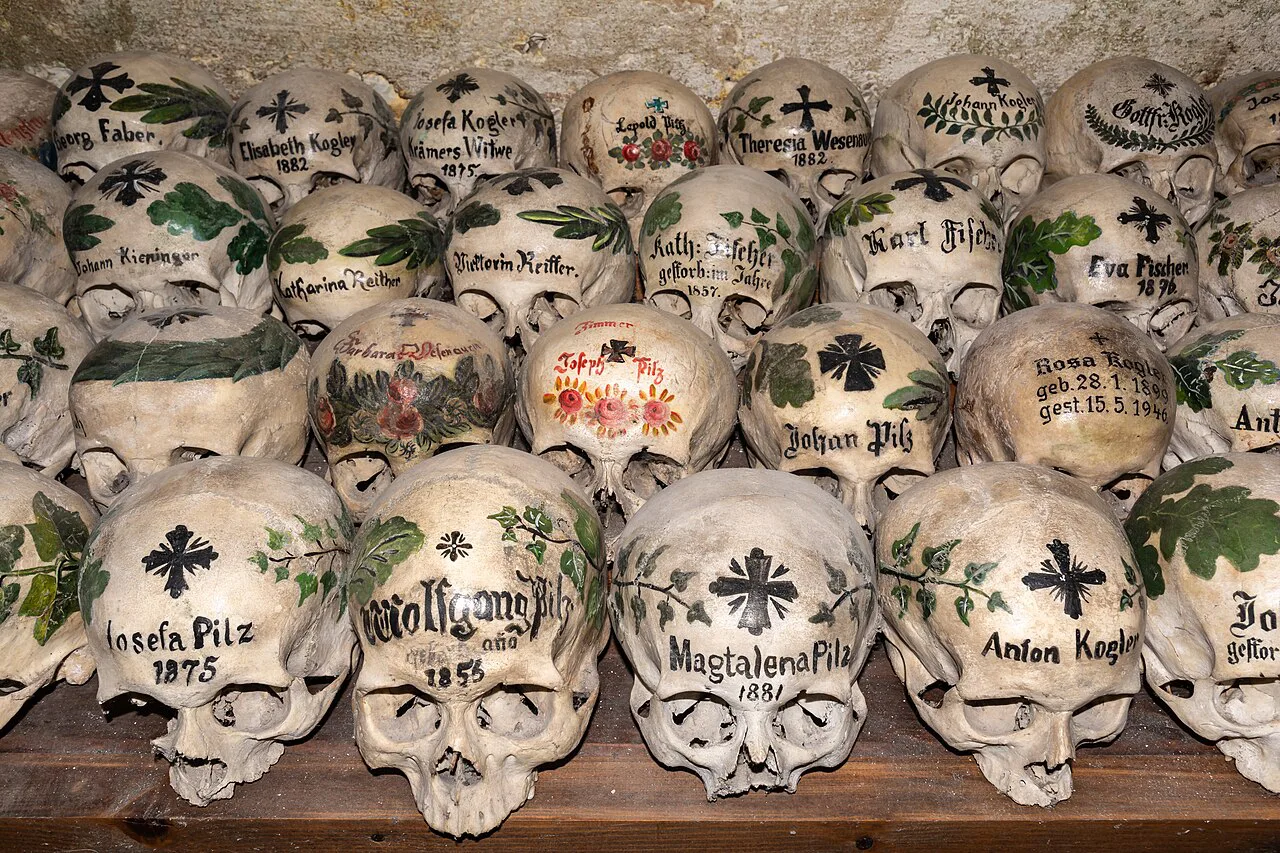
Skulls line shelves along the walls of the lower chamber, most of them painted, and the decoration is the record: names, initials and dates were painted on so a family member's identity survived the move from grave to ossuary. Look for family groups placed together, which makes the shelves read as a village register rather than a single artwork. Many skulls were decorated at the end of the 18th century, a few as late as the 20th.
The painting styles run in a rough sequence that you can read on the shelves. The oldest skulls carry wreaths, and the darker the wreath the older the skull; later examples show thin wreaths with colored crosses that have contoured edges, then flower ornament on the forehead, then green leaves at the temples, usually with a black cross on the forehead. The most recent paintings, from the early 19th century, pair thin ivy branches on either side with Latin script and comparatively narrow crosses.
Why the skulls are here
Space in the churchyard was limited on the slope, so graves were reused, and when a grave was taken over for a new burial the previous occupant's skull and bones were moved into the charnel house in a second funeral. Painting the skull preserved the link to a name and a family, which is why the collection functions as a genealogy as much as a burial site. The custom belonged to the eastern Alpine region, including the Innviertel, Upper Austria, Salzburg, Tyrol and Bavaria, and Hallstatt is where the largest group survives.
The room holds far fewer people than the parish registers record: investigations in the mid-20th century documented just over 2,100 skulls, painted and unpainted, against roughly 30,000 entries in the church death registry before 1900. That gap is worth holding in mind while you look, because the shelves are a fragment of the village's dead rather than a complete archive. The most recent interments date from the closing years of the 20th century.
St. Michael's Chapel itself
The chapel has two parts: the charnel house at ground level beside the cemetery and a Gothic upper story whose stained-glass windows show St. Michael with the Balance of Life. The baroque Michael altar in the eastern section was donated by the salt merchant Eysl in 1612, and the baroque pulpit on the northern wall was moved here from the parish church in 1905. The rear altar came from the former hospital chapel in the Lahn district of Hallstatt.
How much time to allow
Budget a short interior visit, then give the church and cemetery the larger share of your time on the hill. The climb, the cemetery paths and a slow look at the shelves together fill under an hour at an unhurried pace, and the view down over the roofs rewards a few extra minutes. Pair the visit with the market square on the way back down rather than trying to add a second major sight to the same hour.
Combine the chapel with the Catholic parish church, which shares the same grounds, and with the rooftop walk over the village that the local visitor site suggests as a roughly half-hour stroll from the church hill. The cemetery sits between them, so the three belong to one climb and one loop.
Etiquette and practical notes
The chamber is small and enclosed, and visitors move through it shoulder to shoulder in high season, so anyone uneasy in tight spaces with human remains should decide before starting the climb. Keep the visit quiet, since this is an active cemetery chapel rather than a display hall. Follow any photography rules posted at the entrance rather than assume a camera is welcome.
Sunday services and church functions can affect access to the buildings on the hill, so plan the climb around the quieter parts of the day when the village itself is less crowded. Early morning and late afternoon thin the lanes considerably.
Nearby in Hallstatt
Below the chapel, the market square and the lanes down to the water make an easy continuation of the walk, and the Hallstatt Museum covers the salt-mining history behind the village's fortunes. The Hallstatt Salt Mine and the Salzbergbahn funicular sit higher up the mountain, and the Hallstatt Skywalk overlooks the lake from the ridge.
The Lutheran Church stands lower in the village and is worth a short stop on the way back to the landing, and the waterfall at the head of the valley gives the village its background sound. Beyond Hallstatt, the Dachstein Salzkammergut area covers the surrounding lakes and mountains.
Should you make the climb?
Make the climb if you want the village's history in one small room: painted skulls, a Romanesque chapel and a cemetery that is still in use, all a short walk uphill from the waterfront. Skip it if steps are a problem, if a cramped space with human remains is not for you, or if your schedule leaves no room for the church and cemetery that make the visit complete.
Explore more Hallstatt guides
Frequently Asked Questions
How many skulls are in the Hallstatt ossuary?
More than 600 skulls in the collection are painted, out of a larger group of painted and unpainted remains. Records from investigations in the mid-20th century documented just over 2,100 skulls in total, a fraction of the roughly 30,000 burials entered in the church death registry before 1900.
Was Frozen based on Hallstatt?
Nothing in the village's own visitor material or the parish records makes that claim. Hallstatt is known for its salt mine, its lakeside setting and the painted skulls in St. Michael's Chapel; treat the film comparison as internet lore rather than local history.
Can I visit the ossuary and the salt mine on the same day?
Yes, if you start early. The ossuary is a short interior visit on the church hill, and the salt mine sits higher on the mountain with its own funicular and tour times, so the two fit into one day when you leave time for the climbs and check the mine's tour schedule before setting out.