
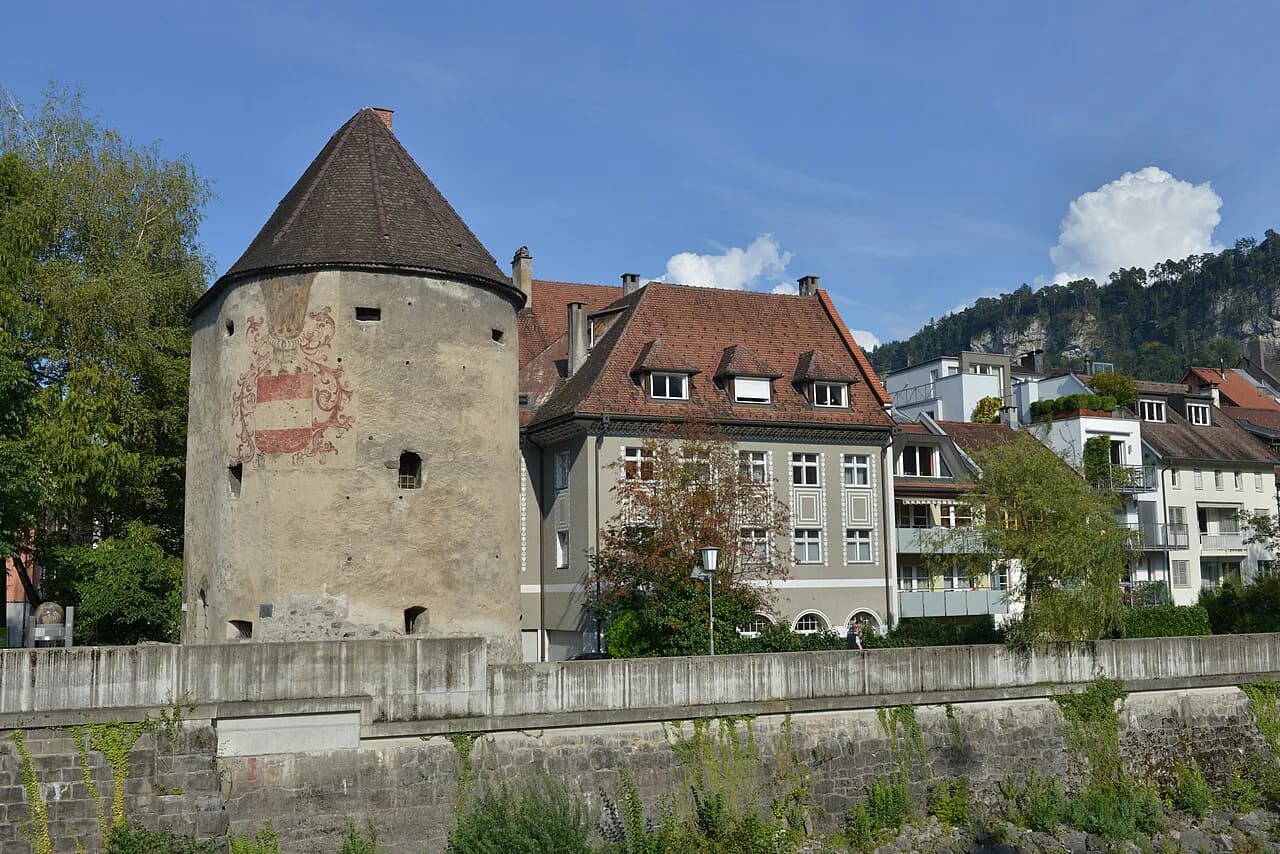
Wasserturm Feldkirch: The Water Tower on the Old Town Wall

The Wasserturm is a defensive tower built into Feldkirch's medieval town wall on the Ill, and it is an exterior sight rather than a museum. You come for the river-side wall position and the fresco on its west face, then fold it into a loop that takes in the old town's other towers and gates.
This guide covers where the tower stands, what to look for on the stonework, how to reach it on foot and how long to budget. It also sets out why the interior stays out of reach and which nearby sights pair naturally with the wall walk.
A wall tower built for defense on the Ill
Feldkirch's old town was ringed by a town wall, a moat and a set of defensive towers and gates until the first half of the 19th century. Five towers and four town gates along that ring protected the core, and several of them still stand on a walk through the Altstadt. The Wasserturm was built before 1482 as part of the wall, with a passage to the Ill that let the town use the river's water; there are reports that boats also worked the lower Ill from there.

The river connection is the reason for the name, and it is worth holding on to while you look at the tower. What you see now is a masonry tower sitting on the wall line, not a building that reaches down to the water.
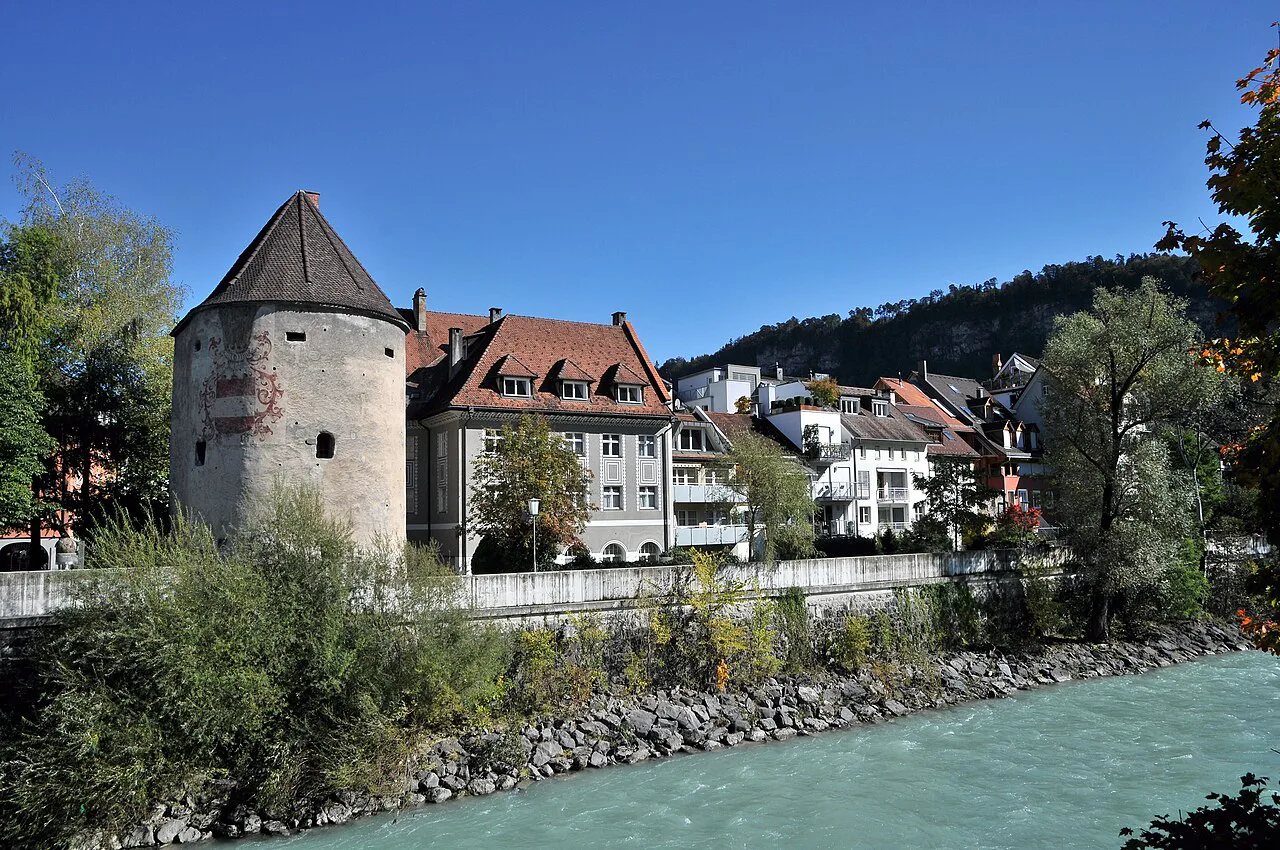

Where it stands: Montfortgasse, above the Ill
The tower stands at Montfortgasse 17, on the stretch of town wall that runs along the Ill, a short walk from the lanes of the Altstadt. The address is the useful reference for a map app, because the tower is part of a wall line rather than a freestanding monument with its own forecourt.

Approach from the old town side and you meet the tower at eye level with the wall; approach from the river side and the wall line reads more clearly as a boundary. Either way, plan the stop as a point on a walking route rather than a destination you arrive at by vehicle.
How to reach it on foot
Feldkirch's Altstadt is compact, and the tower is reached on foot from the pedestrian lanes in minutes rather than stages. From the rail station, walk into the old town first and then follow the wall line toward the Ill; the tower sits on that edge, so it works as the hinge between the lanes and the riverbank.
Keep the walk simple: the tower is one piece of the old fortification, and the other towers and gates are spread along the same ring. A single loop through the center hits several of them, and the Katzenturm, the round eight-story tower built under Emperor Maximilian I between 1491 and 1507, is the most conspicuous of the group.
What to look for on the outside
The tower reads as a four-story structure projecting beyond the line of the town wall. That overhang is the detail to look for when you compare it with the flatter stretches of wall on either side.
On the west side, a fresco shows an Austrian coat of arms with peacock feathers as a helm crest, and the year 1518 marks the town's tie to Austria. Treat 1518 as the date carried on the painting, not the date the tower went up. Shot marks in the masonry are also visible, a reminder that the wall was tested in earnest.
The fresco rewards a slow look rather than a snapshot: step back toward the riverbank to take in the whole west face, then move closer for the crest. Flat light in the middle of the day can make the paint harder to read, so early or late hours are better for seeing the details.
A clubhouse, not a museum
The tower has had a second life. For more than 47 years it housed the Feldkircher Pfadfinder, the local scouts, until they moved to a new home in Nofels; since 1996 it has served as club premises for the Grosshammerzunft Feldkirch, the Faschingsgilde Spältabürger and the Fotoclub Kontakt. A guild fountain, the Zunftbrunnen, was set up on the square in front of it in 1999.
That history sets expectations: you view the Wasserturm from outside, and there is no visitor entrance to plan around. Give the tower itself a few minutes, then spend your time on the wall line and the fresco.
Walking the wall circuit: towers and gates in one loop
The Wasserturm makes most sense as one stop on a circuit. The Pulverturm, built in 1460 and the oldest of the four wall towers, once stored powder and now hosts art and culture; the Mühletor, also called the Sautor, sits at the southeast end of the suburb; and the Churer Tor, the Salz or salt gate, was the exit toward Chur and the Swiss trade.
Two more names round out the set: the Diebsturm, built before 1500 and once the tower in the suburb, and the compact exhibition on the four town gates, titled Entrance to Feldkirch, which is under the Churer Tor. Pick the gates and towers that fall on your line through the center instead of chasing every one.
The circuit is a wander, not a hike, and the stops sit close together in the old town. Allow half a day to see the wall pieces at an unhurried pace alongside a church or a museum, and a single hour if the towers are your only goal.
How much time to allow
For the Wasserturm alone, plan a short stop of a few minutes: the exterior, the fresco and the view along the wall. The tower is small, and the reward is in the setting rather than in a sequence of rooms.
For the full tower-and-gate walk, budget two to three hours in the Altstadt, including the lanes between stops. Add time if you take in the Churer Tor exhibition or stop for coffee, and keep the pace loose enough to read the masonry details as you go.
Nearby: Schattenburg and the rest of the Altstadt
The Schattenburg Castle in Feldkirch sits above the town and is the natural counterpart to the wall walk: the towers and gates guarded the streets, and the castle watched over them from the hill. It is a separate visit with its own hours and admission, so check those before you build it into the day.
The Altstadt itself fills the time between stops. The Palais Liechtenstein in Feldkirch is one of the town's later buildings and gives a contrast to the medieval stonework, while the Feldkirch Cathedral (Dom St. Nikolaus) anchors the center on the church side.
If you are traveling with children and want something beyond the old town, the Wildpark Feldkirch on the Ardetzenberg is a short trip from the center and a change of scene from walls and gates. It is a separate attraction with its own visitor details, so confirm them before setting out.

Practical notes for the visit
There is no ticket to buy for the Wasserturm and no published opening hours for its interior, because the building serves as club premises. Check the town's own visitor pages for any temporary access or guided-tour arrangements before you go.
Wear shoes that handle cobbles and the odd stretch of uneven pavement along the wall. The tower is outdoors and unroofed, so a wet day turns the fresco and stone into a quick look rather than a long one.
Should the Wasserturm be on your Feldkirch walk?
Yes, as a stop on a wall-and-gate loop rather than a sight in its own right. The tower gives you the river-side wall position, the 1518 fresco and the clubhouse history in a few minutes, and the Katzenturm and the gates fill out the rest of the walk.
Build the day around the Altstadt on foot, add Schattenburg if you want the view back over the wall, and keep the Wildpark for a separate outing with children. That order keeps the walking short and the sightseeing varied. For the wider set of Feldkirch sights, see Feldkirch Attractions: 8 Visitor Guides.