
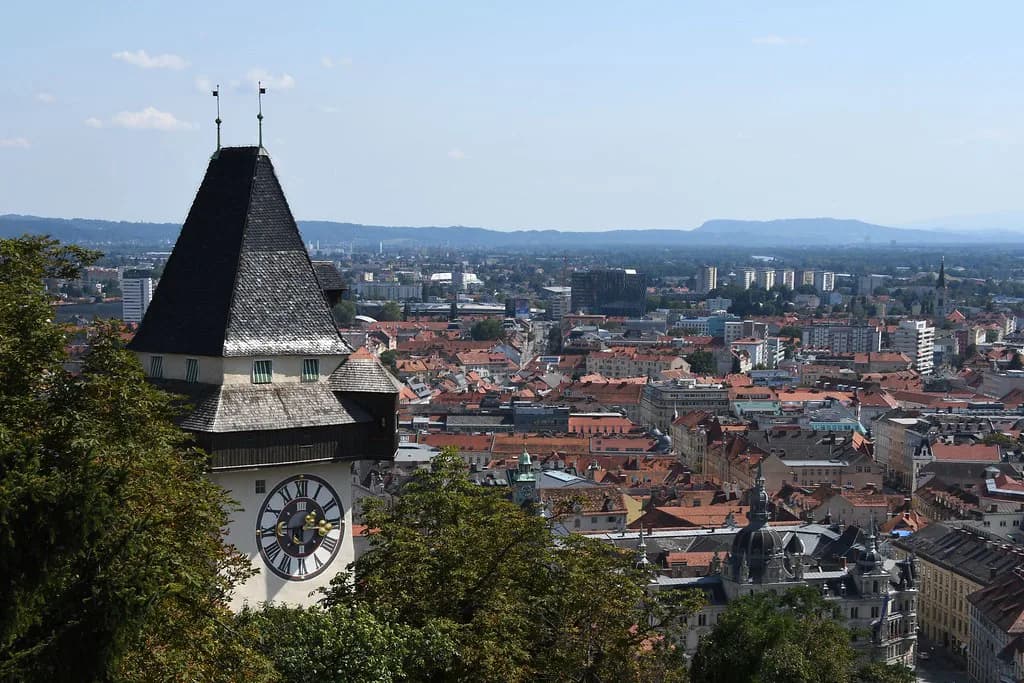
Uhrturm Graz: How to Reach Graz's Clock Tower and What to See
The Uhrturm is the clock tower that crowns the Schlossberg, the hill rising directly above Graz's old town, and it is the city's best-known landmark. You reach it on foot, by tram plus a short climb, or with the Schlossbergbahn funicular, and a visit fits easily into a half day above the center. This guide covers where the tower stands, the four ways up, the inverted hands on its clock face, the neighboring Glockenturm, and what else lies below the hill.
What the Uhrturm Graz is
The Uhrturm is a clock tower perched on Castle Hill, known in German as the Schlossberg, overlooking the rooftops of Graz and standing as the enduring symbol of the Styrian capital. The hill rises 123 meters above the Hauptplatz, so the tower is visible from much of the center and works as a compass point while you walk the old town. Its great clock faces are what most travelers come to see up close.
The tower sits at the southern end of the Schlossberg, on a hill that borders the Mur and touches the historic Altstadt directly. That position means you can combine the climb with a walk through the old town rather than treating the tower as a separate excursion. The historic center below belongs to the UNESCO World Heritage list.

The inverted hands on the clock face
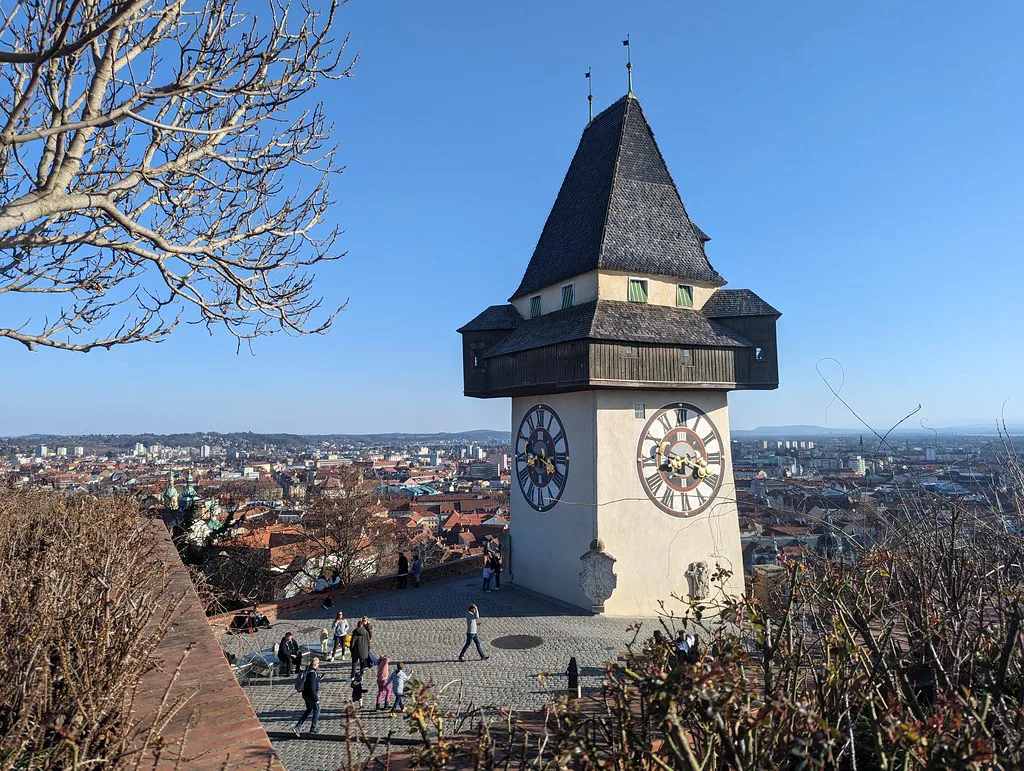
The hands on the big dials confuse plenty of visitors, because the long hand marks the hour rather than the minutes. The clockwork was built by Michael Sylvester Funck in 1712 and still runs today, though it has been driven electrically since the middle of the twentieth century. Reading the face correctly is part of the fun of standing beneath it.
Because the long hand marks the hour, a glance from the Altstadt can look wrong until you know the convention. Guides on the hill explain the swapped hands as part of their tours, which is useful if you want the story rather than just the photo. Look at the dials from below first, then again up close, and the logic becomes obvious.
Getting there on foot
Several paths lead up from the center, including the Schlossbergstiege, the landmark staircase, plus a steeper route through the castle park that rewards the effort with a wide view over the city. Walking up costs nothing and takes only a few minutes from the edge of the Altstadt, though the grade is real and the stairs add up. If you are short on time or energy, the funicular and the glass lift are the quicker options.
Getting there by tram
Tram lines 1, 3 and 7 stop at Jakominiplatz, a central hub a few minutes from the hill, and all seven tram lines in the city pass through it, so almost any tram brings you close. Lines 4 and 5 run to the Schlossbergbahn stop, where you can take the stairs or ride the funicular up. From either stop the tower is a short walk, which makes public transport the simplest arrival.
If you arrive by train, Graz Hauptbahnhof connects to the center by tram, and from there the same routes lead to Jakominiplatz. Allow a little buffer for changing lines rather than counting on a single seat ride. Timetables and current service patterns are published by the operator, so confirm your connection before setting out.
Schlossbergbahn, glass lift and the car-free hill
The Schlossbergbahn funicular and a glass lift both climb the hill, giving you the view without the stairs. The Schlossberg is a completely car-free zone: the road up is closed to general traffic and there is no parking at the tower or anywhere near it, so there is no drive-up option at all. That calm is exactly why the top feels quiet compared with the streets below.
Driving in and parking
If you come by car, the A2 Südautobahn brings you in from the west at Graz-West or from the east at Graz-Ost, while the A9 Pyhrnautobahn offers Graz-Nord from the north and Graz-West from the south; follow signs for the center from any of them. Parking in the inner city is scarce and the garage tariffs are the expensive part of a car day, so leave the vehicle on the edge and switch to tram or foot. Distances inside the center are short enough that the car mostly sits still once you arrive.
The alternative that avoids the search for a space is to park outside the Altstadt and ride in, since the tram network reaches Jakominiplatz from every line. Expect to pay city garage rates rather than a flat sightseeing fee, and check the current tariff boards on arrival. For most visitors the car stays parked for the whole Graz stay.
What you see at the top
At the summit the tower itself is the draw, with its massive dials and the old clockwork inside, which guides explain on the hill's tours. Beyond the masonry, the terrace opens onto the famous roofscape of the old town, a spread of red tiles and courtyards that is the classic Graz photograph. Give yourself a few minutes simply to look before heading back down.
The castle that once stood here is gone, and the hill is remembered as one of the strongest fortifications of its era, one that even Napoleon failed to take. What the people of Graz kept were the Uhrturm and the Glockenturm, the two structures that define the skyline today. That history explains why the hill feels like a park with monuments rather than a ruined fortress.
Glockenturm and the Liesl bell
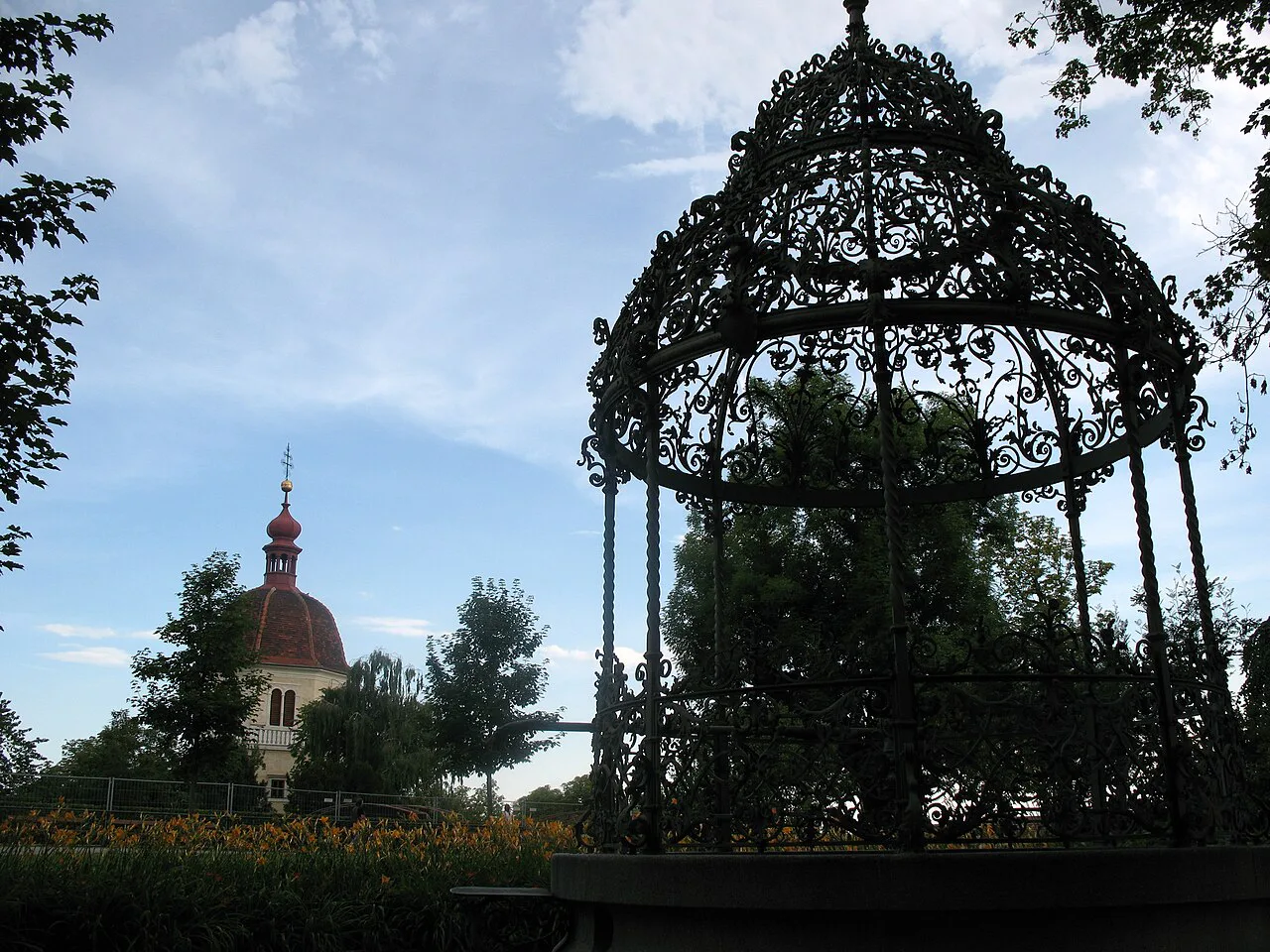
A short walk from the clock tower stands the Glockenturm, the bell tower housing the Liesl, the third-largest bell in Styria. It is the natural second stop on the hill and turns a quick photo into a proper circuit of the summit. Combine the two rather than treating the Uhrturm in isolation.
Guided tours on the Schlossberg
Guided walks on the Schlossberg cover the Uhrturm, the Glockenturm and the story of the inverted hands, and can be booked in English as well as German. Tours run at set times rather than continuously, so the departure schedule is the detail to confirm before you go. Check current tour times and any ticket prices through Graz Tourismus when you plan the day.
How much time to allow
Budget roughly an hour for the tower and the Glockenturm if you take the funicular up, and closer to two hours if you climb the stairs and linger over the view. The funicular buys you time at the top but costs a ticket, while the stairs are free and slower; either way the summit itself needs no more than half an hour unless you join a tour. Add the walk down through the old town to finish at the Hauptplatz.
What is nearby below the hill
At the foot of the Schlossberg lies the Altstadt with the Hauptplatz, and the Mur runs alongside the hill, so the riverbank is a natural place to end the descent. Across the water, the Kunsthaus Graz in the Lend district is the modern counterpoint to the medieval center, and the Murinsel Graz floats in the Mur as an easy stop on a river walk. Together they make a compact loop from the hill back into town.
The Graz Cathedral and the surrounding streets sit within the same old-town grid, so a single afternoon can cover the hill and the main squares without any transport. More Graz Attractions, from palaces to parks, are worth a separate look if you are staying longer. Schloss Eggenberg lies further out and needs its own slot in the plan.
Which way up the Schlossberg should you take?
Take the Schlossbergbahn or the glass lift if you want the view with minimum effort, and the Schlossbergstiege stairs if you want the climb to be part of the visit; both land you at the same tower. Either way, plan the Glockenturm into the same loop and finish with a walk down into the Altstadt and along the Mur. Check current opening times and tour departures before you set out, then let the hill set the pace of the day.