
Stadtpark Graz: A Visitor's Guide to the City's Central Park

Stadtpark Graz is the largest park in the city, entry is free, and it sits directly against the UNESCO-listed historic center, so a visit costs you time rather than money. Allow 45 minutes to an hour for the chestnut avenues and a bench, longer if you are traveling with children. This guide covers where the park sits, how to walk in from the old town, what the tree collection actually contains, and which nearby sights pair with it.
Where Stadtpark Graz sits
The park occupies the green band that runs along the edge of the old town, on ground that was once the glacis outside the city walls. From above, it reads as a green island set into the roofscape of the UNESCO World Heritage historic center, which is the clearest way to picture its position before you arrive. Practically, this means you can step out of the dense old town streets and into open ground within a couple of minutes.
The official address for navigation is Stadtpark 1, 8010 Graz, which is what you should enter if you are routing by phone or car rather than walking from the center. The park itself has no gate to find and no ticket window to queue at, so the address matters mainly for taxi drivers and mapping apps.

How to get there from the old town
On foot is the sensible approach. Come out of the Altstadt on the eastern side and the park begins where the built-up blocks end, with the Dammallee running through it as the main spine. Because the park is inside the city rather than on its fringe, it works as a pause in a walking day rather than a separate excursion that needs its own transport planning.
Public transport in Graz is dense around the center, and the park's edge is served by the tram and bus network that crosses the old town ring. Buy your ticket at the machine or app on the day. If you are driving, leave the car and walk; the center is compact and parking is the bigger cost.
What to see: the Dammallee and the chestnut avenues
The park holds around 2,000 trees, and the white-flowering horse chestnut is the dominant species with 830 of them. A further 150 different kinds, species and varieties grow here, which makes a slow lap more interesting than the headline count suggests. The backbone of the layout is the Dammallee with its four sub-sections, plus the avenues that cross the park; both are planted with white-flowering horse chestnut.
Plan your walk around those lines rather than wandering at random. Start on the Dammallee, follow one cross avenue to the far side, and come back on another; in May and June the chestnuts are in flower and the avenues are the reason to be here. The rest of the year the structure still gives the walk shape, and you get the same green corridor without the blossom.
The park's origin is civic rather than aristocratic: in 1868, Graz residents and the mayor at the time, Moritz Ritter von Franck, pushed for a Stadtpark on the green areas before the old city walls. That origin explains the layout. The park is linear and public, tied to the streets and neighborhoods around it rather than walled off as a palace garden.

The playground, benches and cafés
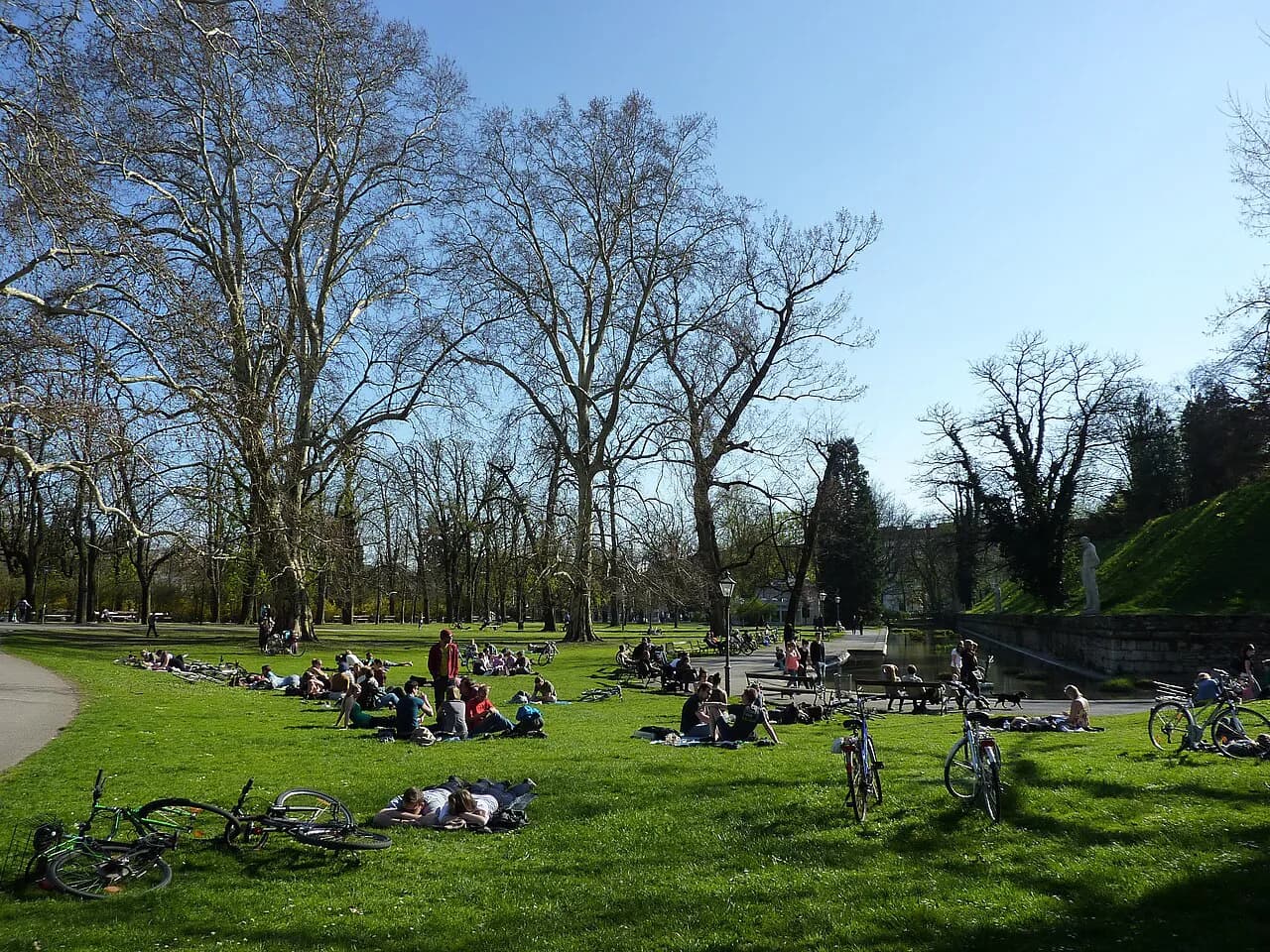
This is a living city park, not a monument. Children head for the large playground, while adults settle under the chestnut trees and on the benches, and in the late afternoon and early evening locals meet at the cafés at the park's edges for a drink after work. Squirrels are tame enough to approach if you have nuts, which is a reliable way to keep younger travelers occupied.
Treat the park as a stop with a table at the end of it rather than a sight to be ticked off. The cafés along the perimeter are where the park becomes useful on a hot afternoon; you get shade, a seat and a drink without leaving the green space.
Free entry and what it means for your day
Entry to Stadtpark Graz is free, so there is no ticket stop, no queue and no reason to save the park for a day when you have budget left. That changes how you slot it in: it can be a short crossing between two paying sights, or a long bench afternoon, with no wasted money either way.
Graz Tourismus lists the Stadtpark under its parks and gardens rather than its ticketed sights, and the tourist information office on Herrengasse 16 in the center is the place to pick up a city map before you walk over. Nothing about the park requires advance booking.
How long to allow, and when to go
Budget 45 minutes to an hour for the Dammallee and one or two cross avenues, with a stop on a bench. With children, allow more, because the playground holds them far longer than the trees will. The park is at its best in late afternoon and early evening, when the light comes through the chestnuts and the after-work crowd arrives at the cafés; midday in high summer is hot and shade-dependent.
Nearby sights to pair with the park
The Schlossberg rises above the old town just west of the park, and the Schlossberg lift saves the climb if you would rather spend your legs on the park. From the top you get the classic view over the red roofs of the center. The Schlossberg is the natural half-day partner for a Stadtpark morning, and the wider list in Graz Attractions: 7 Visitor Guides helps you order the rest.
On the other side of the river, the Kunsthaus Graz in the Lend district is the city's contemporary art museum and an easy add-on if you want a contrast to the park's nineteenth-century landscaping. The Murinsel on the Mur sits close to it and makes a short stop on the same bank. Together they give you a modern counterpoint to the chestnut avenues.
If you are building a broader sightseeing list, Schloss Eggenberg sits out on the western edge of the city and needs a separate trip, while the cathedral and the Uhrturm fit into the same old-town walk as the park. The park works best as the green connective tissue between those stops rather than as a destination on its own.
Should the park be on your Graz list?
Yes, as a free, low-commitment stop rather than a headline sight. The park earns its place through the Dammallee, the chestnut avenues and the fact that it costs nothing, and it fits naturally between the old town and the river. If your day is tight, cross it on foot on your way to the Schlossberg or the Kunsthaus and you will still get the essence of it.
Explore more Graz guides
Frequently Asked Questions
Do you need tickets for Stadtpark Graz?
No. Entry to the park is free, and there is no ticket window or booking step. You can walk in from the old town at any point along its edge.
How many trees are in Stadtpark Graz?
Around 2,000 trees grow in the park. The white-flowering horse chestnut dominates with 830 specimens, and roughly 150 other kinds and varieties are also present.
What is the Dammallee?
The Dammallee is the main axis through Stadtpark Graz, made up of four sub-sections and planted with white-flowering horse chestnuts. The cross avenues follow the same planting, so the park reads as a grid of tree-lined walks.