
Kalvarienberg Bad Ischl: The Baroque Hill Church and Its Chapels

The Kalvarienberg in Bad Ischl is a small baroque hill church above the town, built between 1704 and 1706, with a sloping facade of nine terracotta figures and a Holy Sepulchre chapel plus four Stations of the Cross chapels on the slope around it. Allow roughly an hour for the church and the chapels together, and longer if you want to sit with the view. This guide covers where the hill sits, how to reach it by car or rail, what to look for outside and inside, and how the outdoor chapels shape a visit.
Two things justify the walk more than anything else. The facade figures show the trial and condemnation of Jesus in three groups and are large enough to read from below, and the ceiling fresco of 1779 puts God the Father, the Holy Spirit and angels carrying the instruments of the Passion above the nave. Both reward looking up before you go in.
What the Kalvarienberg actually is
The Kalvarienberg is not a single building but a small ensemble on a hill: the baroque church, a chapel of the Holy Sepulchre beside it, and four Stations of the Cross chapels scattered on the slope. Church and chapels are listed as protected monuments, which is why the group reads as one designed landscape rather than a random cluster.
It was the second Calvary site in the Salzkammergut, following the one at Traunkirchen from 1696. The Ischl church was built from 1704 to 1706, and the crucifixion group was carried up from the town parish church of St. Nikolaus in a procession on 14 September 1706, which is why the hill has been a devotional route from the center since the start.
The church belongs to the Diocese of Linz and is a sacred building rather than a museum, so treat it as a place of worship that happens to be full of art. Plan the outdoor chapels first and treat the interior as something you enter when it is open.

Where the hill sits in Bad Ischl
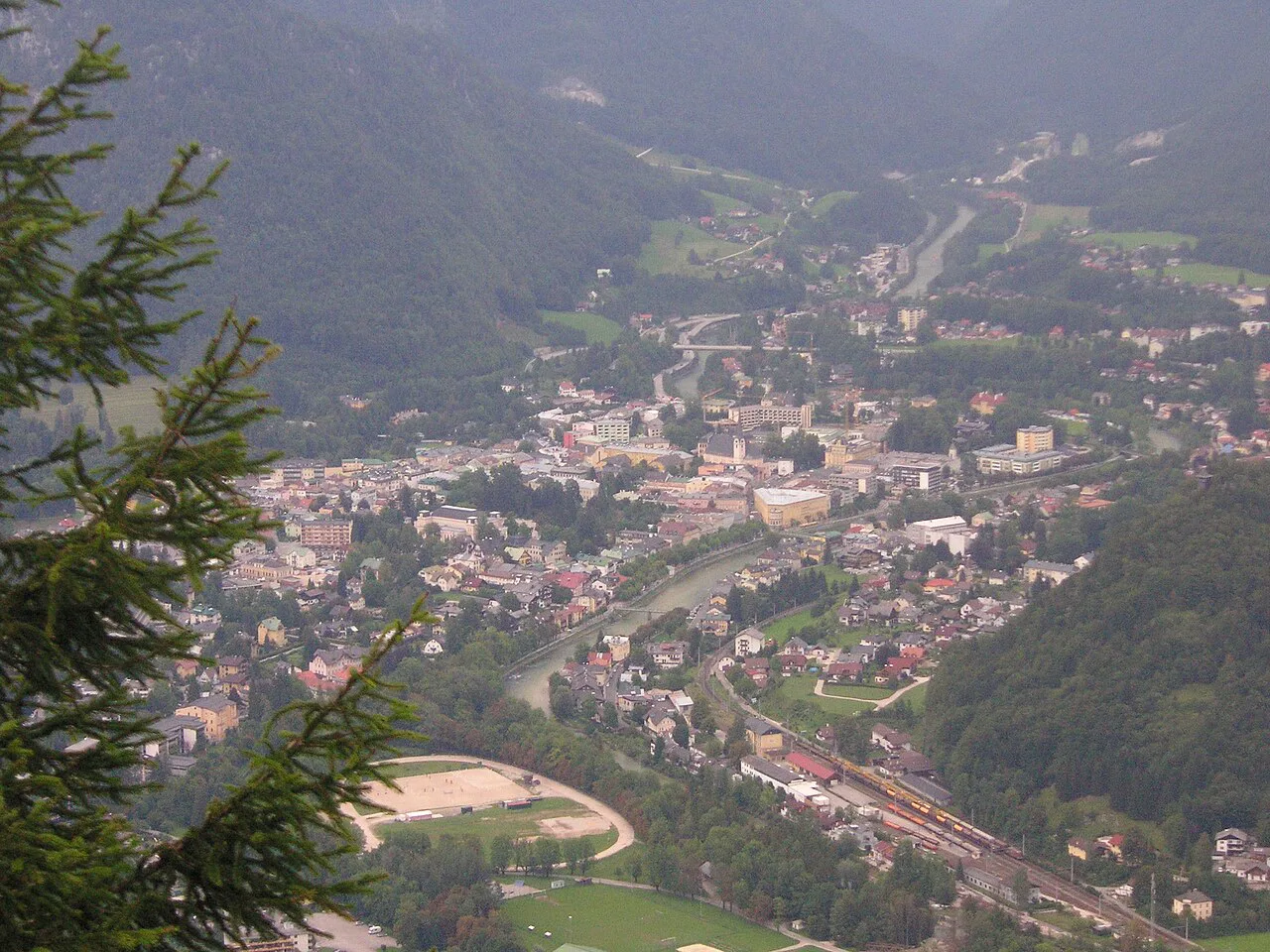
The Kalvarienberg stands in the Ahorn district of Bad Ischl, on rising ground above the town center. That position matters for planning: you are walking uphill away from the dense Kaiser-era core, so the church works best as a first or last stop of a town day rather than something to squeeze between two central sights.
The address given for the site is Kalvarienberg, 4820 Bad Ischl. Use that for a navigation app rather than a street number, because the church sits on open ground above the built streets.
How to get there by car or by train
By car, the published route from Salzburg runs on the B158 toward Bad Ischl. From Vienna, the route given is the A1 to Regau, then the B145 to Bad Ischl. These are road descriptions, not timings, so build your own estimate from your starting point and check road conditions on the day.
By rail, the chain is Linz or Salzburg to Attnang-Puchheim, then a connection to Bad Ischl; from Graz the listed chain runs Stainach-Irdning to Bad Ischl. The route description carries no timetable, so check current departures with ÖBB before you travel.
From Bad Ischl station the hill is a walk through town and up, with no shuttle mentioned for the site. If the climb is the part you want to avoid, budget for the uphill leg on foot and keep the chapels as an optional extension rather than a fixed circuit.
Look up first: the terracotta facade figures
The reason to stop in front of the church rather than walk straight in is the facade. When the building was enlarged in 1779, three flat niches were cut into the front wall to hold three terracotta groups of three figures each, showing the trial and condemnation of Jesus, with the Ecce-homo scene in the middle. The statues are nearly life-size and visible from a distance.
Look closely at the group on the right: the court servants wear Turkish costume, which points to the figures being made during the period of the Turkish wars. Who carved them is not recorded, and the original polychrome paint was replaced in the nineteenth century; a 1964 restoration gave them the dark red base tone you see now.
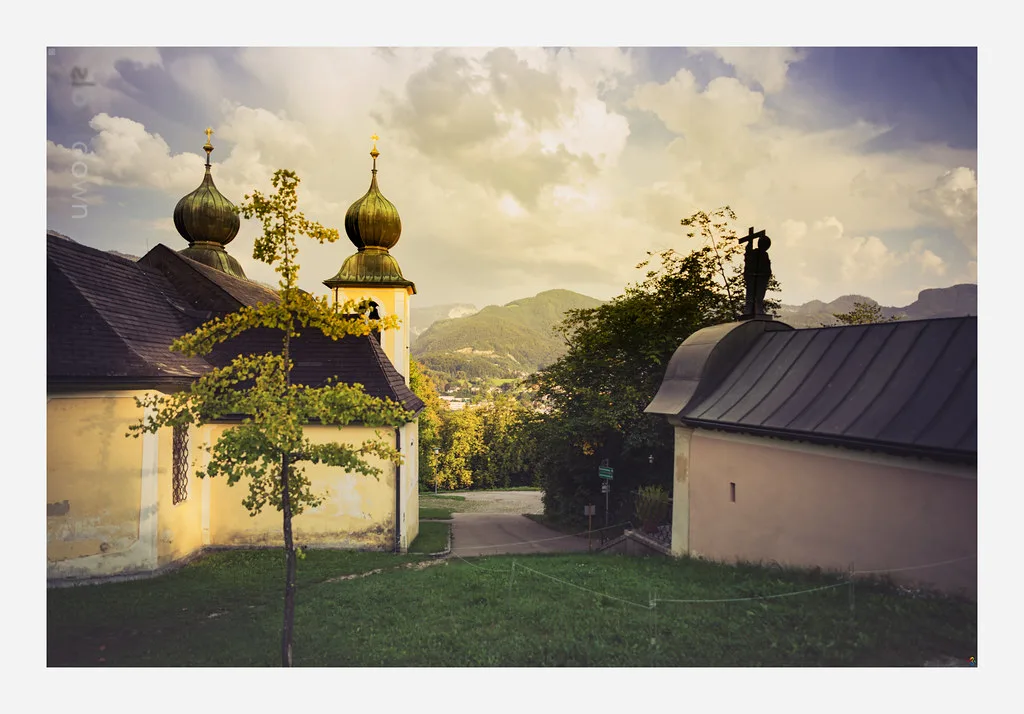
The 1779 project also rebuilt the front as you find it, adding two towers, a sacristy and an apse behind the main altar for the crucifixion group. Knowing that date explains why the west front feels broader and more symmetrical than a small 1706 hill church would.
Inside: the 1779 fresco and the crucifixion group
The nave and chancel are barrel-vaulted, which focuses attention upward onto the ceiling fresco of 1779. It shows God the Father on the globe, the Holy Spirit as a dove, and the cross of Christ, with angels around them carrying the instruments of the Passion: the scourge, the sponge and Veronica's veil. Much of it was painted over in 1893 and carefully restored in 1960 and 1961.
The main altar holds the crucifixion group carried up the hill in 1706: Jesus, the two thieves, Mary, John, Mary Magdalene kneeling at the foot of the cross, and two riders, one holding a lance. The expanded group is first documented in a prayer book of 1761. The sculptor is not certain; the Mondsee carver Johann Georg Kammerdorfer, who owned a house in Bad Ischl from 1704 to 1707 and worked in the circle of Meinrad Guggenbichler, is a conjecture rather than an attribution.
Nearer the entrance, the church has a modern note: a baptismal font made in 2010 from regional materials only. It sits beside much older fittings, including a Marian votive altar on the right wall inscribed In Großer Bedrängnis, so a ten-minute look inside covers both ends of the building's history.
The chapels on the slope
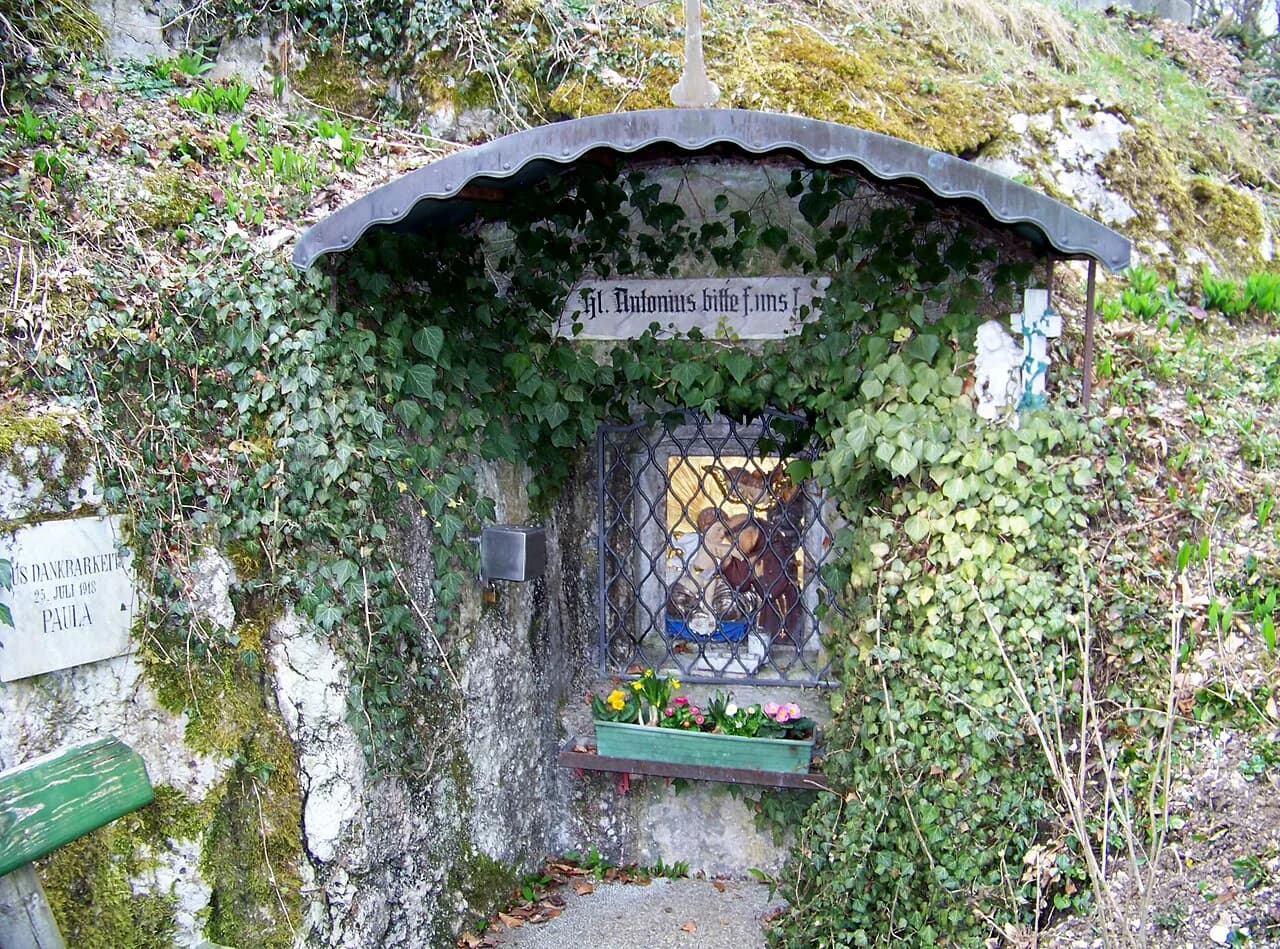
Outside, the Holy Sepulchre chapel stands near the church, and four Stations of the Cross chapels are spread across the hillside. Together they turn a single building into a short devotional walk, and they are the part of the site you can count on seeing whatever the church's opening state.
Plan the chapels as the flexible half of the visit. They are outdoors on sloping ground, so wet weather or tired legs are the moment to look at the facade and the interior and leave the circuit for another time rather than push through it.
How long to allow
For the church interior and facade, twenty to thirty minutes is enough for most visitors: the building is small and the highlights are concentrated in the front niches, the ceiling and the altar. Add the chapel circuit on the slope and an hour in total is a realistic figure, including the uphill approach from the center.
If you only have a short window, prioritize the facade figures and the fresco, since both are the elements you cannot see elsewhere in town. Skip the outer chapels rather than rushing the interior, and remember that the visit is partly a climb, so build in time to stand and breathe at the top.
Nearby in Bad Ischl
The hill fits naturally into a Bad Ischl day rather than a separate trip. The Kaiservilla Bad Ischl, the summer residence tied to Franz Joseph I, sits on the other side of town and pairs well with a morning on the Kalvarienberg, while the Lehár Villa in Bad Ischl covers the composer's world for anyone following the town's music history.
In the center, the Pfarrkirche Bad Ischl is where the crucifixion figures started their procession in 1706, so seeing both ends of that route makes the hill more legible. The Stadtmuseum Bad Ischl and the Kurpark Bad Ischl are easy additions if you want to stay on level ground after the climb.
For the full set of town sights and how they connect, start with Bad Ischl Attractions: 9 Visitor Guides before you fix an order.
Who the hill suits
The Kalvarienberg suits travelers who want a quiet, art-dense half hour away from the bustle of the Kaiser town, and it rewards anyone willing to look at baroque sculpture closely. It suits less well anyone who wants guaranteed opening hours, a ticket desk or a level, indoor experience, because the strongest parts are a small interior and an outdoor slope.
Go for the facade and the fresco, accept that the chapels depend on weather and legs, and check the parish's own information before making the climb the centerpiece of a day.
Is the Kalvarienberg worth the climb?
Yes, if you go for the two things that make it distinctive: the nine terracotta figures on the facade and the 1779 ceiling fresco inside. An hour covering the church, the Holy Sepulchre chapel and the Stations of the Cross chapels is the right shape, and it slots easily into a day built around the Kaiservilla and the center.
Treat the outdoor chapels as the flexible part and the interior as the part to catch while it is open, and confirm access with the parish before setting out.
Explore more Bad Ischl guides
Frequently Asked Questions
Do I need a ticket for the Kalvarienbergkirche in Bad Ischl?
No ticket price or booking rule is published for the church or the chapels. Check with the parish before you go, and treat the outdoor chapels as the part you can see without arranging anything in advance.
How do I reach the Kalvarienberg without a car?
Take the train to Bad Ischl via Attnang-Puchheim from Linz or Salzburg, then walk up through town toward the Ahorn district. Confirm current connections with ÖBB, since the route has no fixed published timetable.
How steep is the walk to the church?
The church sits on rising ground above the center in the Ahorn district, so expect an uphill approach on foot. No path conditions or accessibility details are published, so judge the climb on the day.