
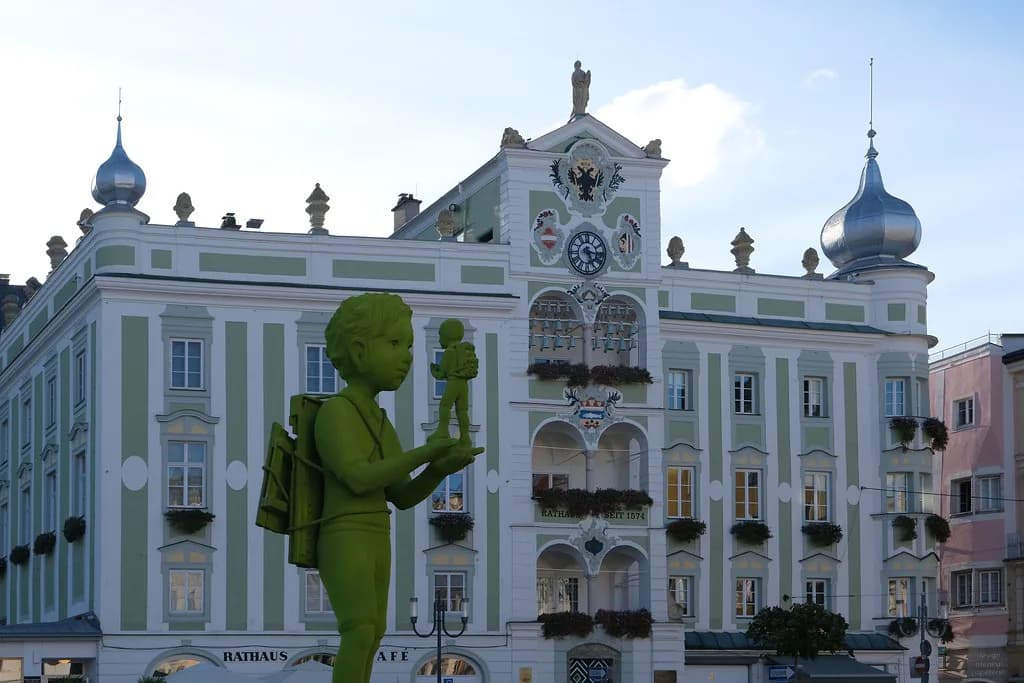
Rathaus Gmunden: The Renaissance Town Hall on Rathausplatz
Rathaus Gmunden is the Renaissance town hall at Rathausplatz 1 in the center of Gmunden, and the square in front of it is the town's main public space. The building itself takes a short look, but the ceramic carillon in its loggia rewards anyone who times a visit around the playing hours. This guide covers the facade details worth finding, the carillon schedule, the tram and bus routes that stop at the door, and the sights within a short walk.
What Rathaus Gmunden is and why it anchors the square
The name of the square goes back to the town hall, which has stood at this spot since the 16th century at its core. Before that, the open ground ran from the Trauntor to the Christophstor and carried several names over the centuries, including Unterer Markt, Seeplatz and the still-common Stadtplatz. In Gmunden's salt-trading years it was called Salzlände, because the salt ships landed here. The square officially took the name Rathausplatz in 1890.
Today the town hall works as the civic anchor of a square that doubles as market ground and event space, so the same address looks very different on a market morning and on a quiet afternoon. The building is also the administrative seat of the municipality, which means the ground floor sees everyday civic traffic rather than museum visitors. Plan the stop as an outdoor visit first and treat any step inside as a bonus.
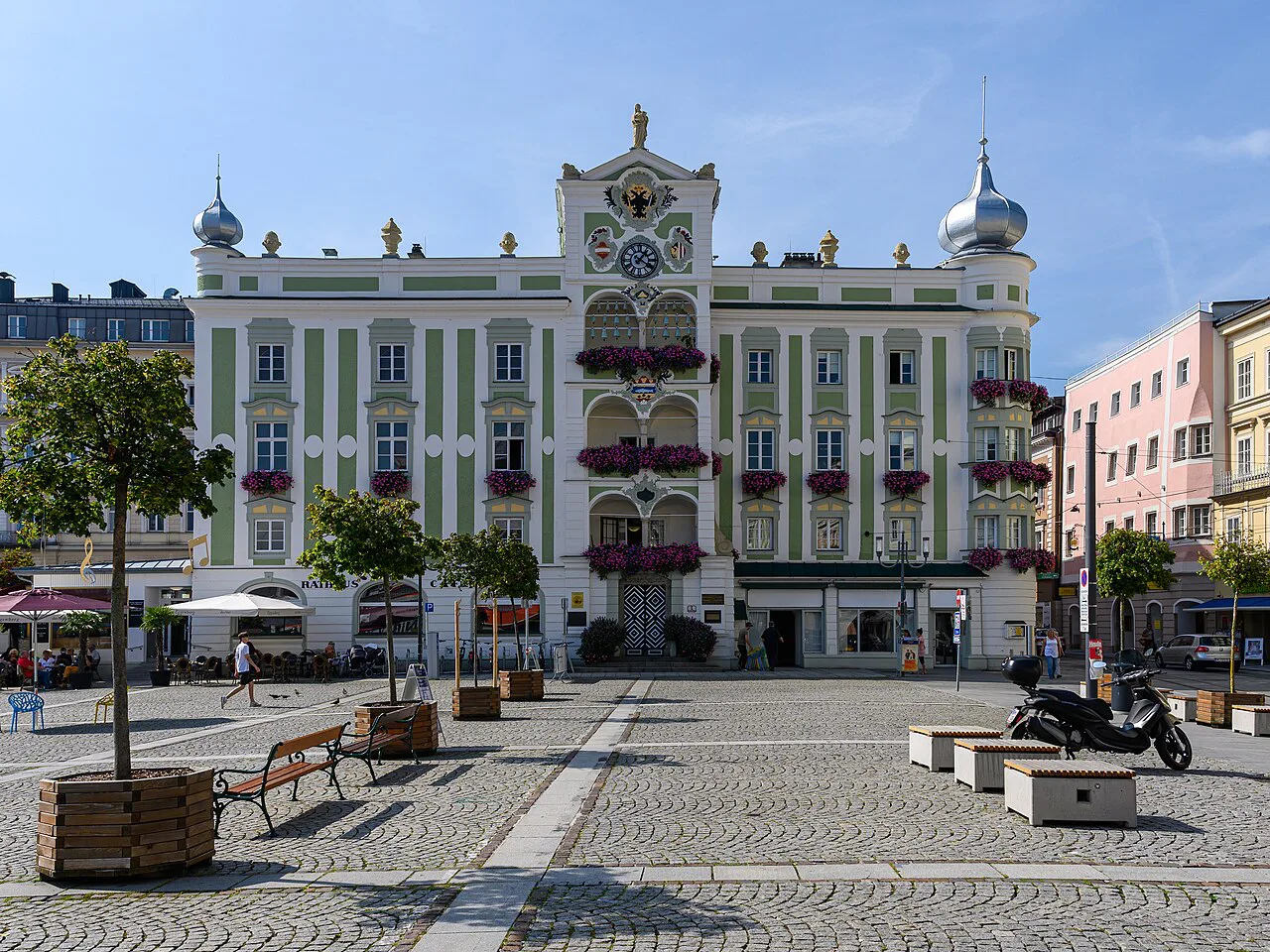

Where the town hall sits in Gmunden
The address is Rathausplatz 1, 4810 Gmunden, in the old center a short level walk from the Traunsee lakefront. The square opens toward the water with the Traunstein and Grünberg rising behind the rooftops, so the facade is framed by lake and mountain at the same time. Use the lake promenade as your orientation point and walk inland to reach the square.
Several routes converge here on foot, including the long-distance cycling paths that pass the Rathausplatz and the Traunbrücke roughly 200 meters away. If you are coming from the lake boats or the promenade, the town hall is a two-minute detour rather than a separate trip.
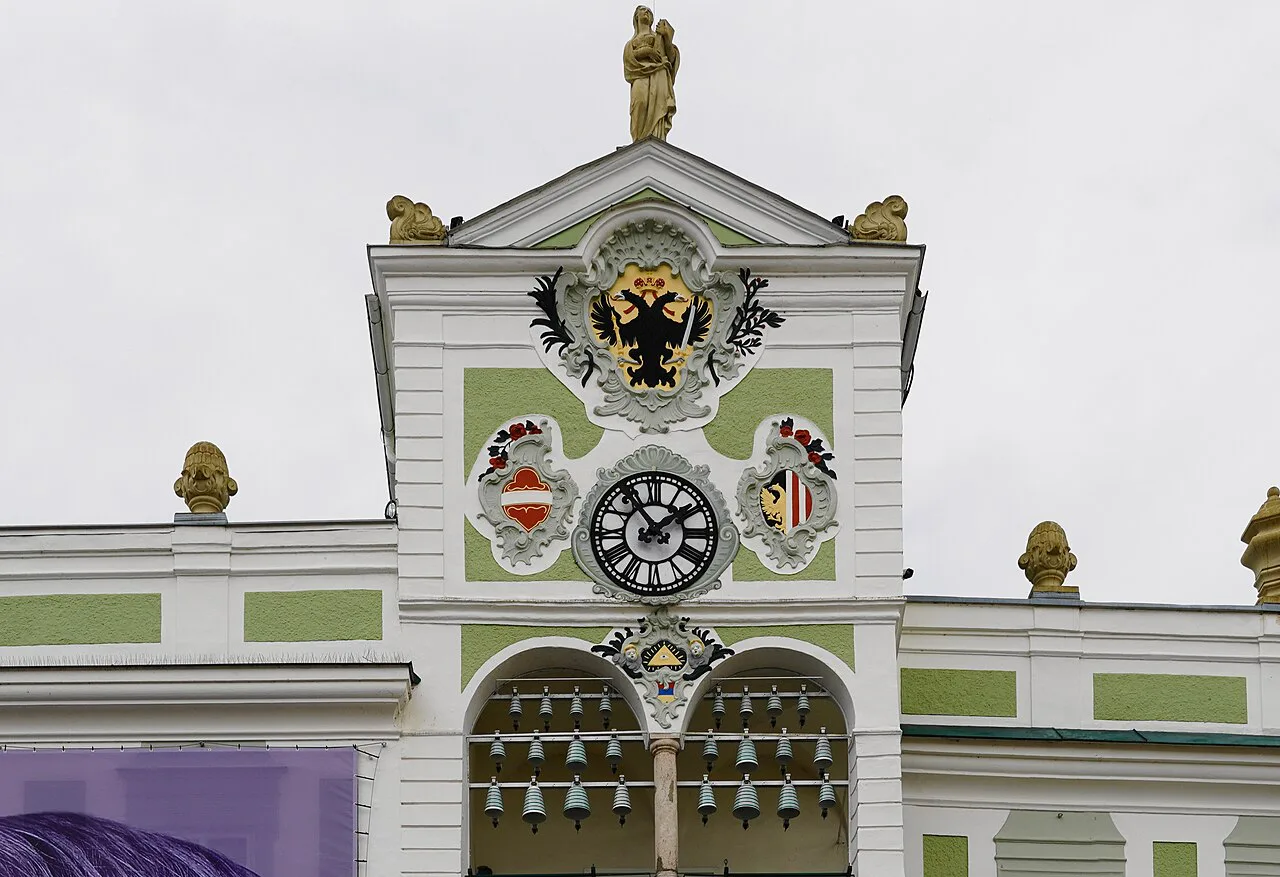

The building: what to look for on the facade
The core of the current building dates from the 16th century, though the exact year of construction is not recorded. The central block suggests Italian builders were at work or at least shaped the design, and the whole is a Renaissance structure. Look up rather than straight ahead: the ornament is concentrated around the clock and under the loggia.
Above the town hall clock sits a colored depiction of the Austrian double eagle, flanked by the Austrian Bindenschild and the coat of arms of the province of Oberösterreich, with the Eye of God beneath them. These painted elements are easy to miss at street level because the arcade draws the eye first. Step back toward the middle of the square for the full composition.
The ceramic carillon in the loggia
A ceramic carillon hangs in the loggia, and it is the reason to plan this stop around a time rather than pass through at random. In summer the bells play at 10, 12, 13, 14, 15, 16, 17 and 19 o'clock. During Advent the sequence changes to 10, 12, 14, 16, 17 and 18, and in the rest of the year it runs at 10, 12, 14, 16 and 19.
There is no playing between January 6 and the start of spring, so a winter visit will not include the carillon. Arrive a few minutes early and stand in the square facing the loggia; the sound is the point, and the facade is the backdrop.
Getting there by train, tram and bus
The simplest rail route runs on the Salzkammergutbahn (line 170) to Gmunden Bahnhof, with connections at Attnang-Puchheim to main-line trains on the Westbahn corridor. From Gmunden Bahnhof, the Traunseetram (line 161) operated by Stern & Hafferl runs to the Gmunden Rathausplatz stop, which sits right beside the square. The same tram also connects from Vorchdorf Eggenberg and from the Park & Ride at Gmunden Engelhof.
By bus, OÖVV lines 507, 505 and 533 plus the local city bus lines stop at Gmunden Rathausplatz. Check current departure times with ÖBB and the Upper Austrian transport operators before you set out, since frequencies vary by season and day.
Arriving by car
Drivers reach Gmunden from the A1 Westautobahn at the Regau exit, then follow the B145 into the center; the same road brings you in from Bad Ischl. The nearest garage is roughly 200 meters from the square, and the old town has short-stay parking zones during the day. Use marked spaces only and expect to walk the last few minutes.
Parking rules and any charges are posted locally at the garage and on the street signs, so read them on arrival rather than assuming a rate.
How long to allow
Budget 20 to 30 minutes for the square and the facade, timed so you are standing in front of the loggia when the carillon starts. Add a further 45 to 60 minutes if you continue into the old center on foot, which brings the visit to a comfortable half day with a coffee stop.
There is no published ticket or guided-tour schedule for the town hall interior, so treat the visit as an outdoor one and ask at the municipal office on the spot if you want to know about access. The building is a working civic address rather than a museum.
What else happens on Rathausplatz
The square hosts a weekly market on Tuesdays and the annual Österreichischer Töpfermarkt, the Austrian potters' market that gives Gmunden its reputation as a ceramics town. It is also the setting for seasonal events from the Fête de la Musique to the Mondscheinbummel and traditional occasions such as the Glöcklerlauf. A Tuesday morning therefore feels busier and more market-like than a mid-afternoon in the same week.
Since summer 2025 the permanent sculpture La Communication by Kim Simonsson has stood in the center of the square, more than four meters tall and facing the K-Hof Museum, in dialogue with its counterpart above the fountain. It gives the open space a fixed focal point between the market days.
Nearby on foot
The Kammerhofmuseum Gmunden (K-Hof) is close enough to pair with the town hall, and its collections cover the town's salt and ceramic history. Schloss Ort Gmunden, on its island in the Traunsee, is a slightly longer but still walkable extension along the water. Both make sense as a continuation of the same morning rather than separate outings.
The Pfarrkirche Gmunden (Stadtpfarrkirche Gmunden) stands within the same old-center circuit, so a loop from the square can take in the church, the museum and the lakeside without any transport. Build the order around the carillon time and fill the rest on foot.
Should the town hall be your first stop in Gmunden?
Yes, if you arrive in the morning: the square orients you toward the lake, the Traunstein and the old center, and the carillon gives the stop a fixed time. If your schedule misses the playing hours entirely, the facade and the market square still justify a short pass-through on the way to the lakefront or a nearby guide such as Schloss Ort.
Build the visit around the listed playing times, check the tram and bus times before you travel, and keep the rest of the morning flexible for the market or the museum next door.