
Klagenfurt Cathedral: What to See Inside Dom zu Klagenfurt

Klagenfurt Cathedral rewards about 25 minutes, not a half day: its draw is one compact interior with three stacked galleries, rich 18th-century stucco and ceiling paintings, a pulpit dated 1726 and Daniel Gran's high altar painting. Plan it as a single stop inside the old city rather than the anchor of a Klagenfurt day. This guide covers what the church is, how it fits a walk through the center, which furnishings are worth looking up for, and what sits in the house next door.
What Klagenfurt Cathedral is and where it sits
The Dom zu Klagenfurt is the city's cathedral, standing in the heart of the Carinthian capital rather than on a suburban edge. That position puts it inside the same compact core as the city's squares and arcaded lanes, which is why it works best folded into a walk rather than treated as a separate excursion. The church has served since 1787 as the seat of the Prince-Bishop of Gurk, who resides in Klagenfurt, so it carries a bishop's role as well as a parish one.
For orientation, treat the cathedral as one entry on a short list of downtown sights and plan the rest of the center around it; the wider set of options is laid out in Klagenfurt Attractions: 5 Visitor Guides. Because the church sits in the old town, the sensible approach is on foot from wherever you park or arrive.

How to get there and how it fits a center walk
Arrive in the old city and walk: the cathedral is a downtown landmark, and the easy approach from the main station is on foot or by city transport into the center. Plans that reach Klagenfurt by train should treat Hauptbahnhof as the arrival point and continue from there.
A practical loop uses the cathedral as a midpoint between the city's civic buildings and its market square, so you see the church while already moving through the center rather than doubling back. Build the walk around one church interior, one market pause and the adjoining museum, and the old city fits comfortably into a half day without rushing.

The building: a late-16th-century church with a later Catholic role
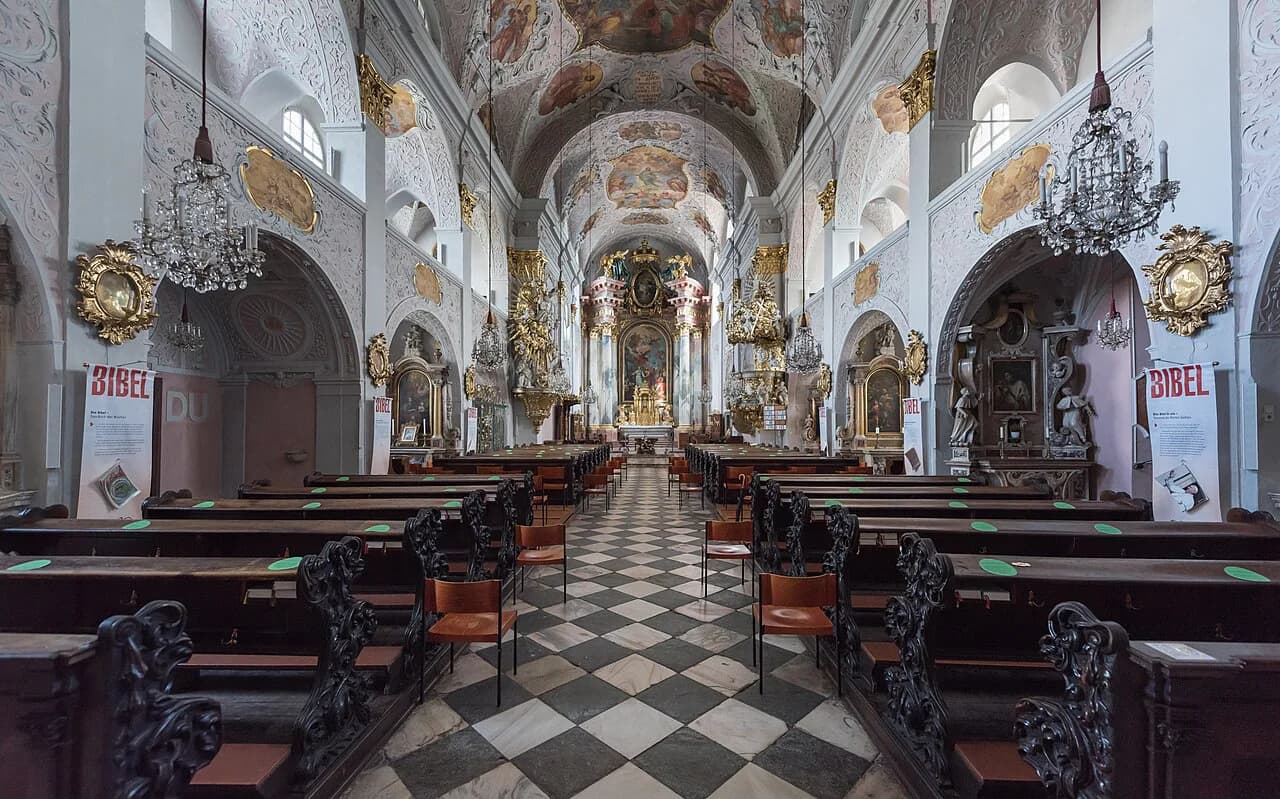
Construction ran from 1578 to 1591, which makes the shell a late-16th-century building rather than the medieval church many visitors expect in an Austrian old town. The interior decoration seen today — the stucco, the wall and ceiling paintings — belongs to the 18th century, a later layer over the galleried shell. That two-stage story explains the mismatch between the restrained, galleried structure and the exuberant finishes inside.
In 1787 the church became the cathedral of the Prince-Bishop of Gurk, and it has held that function since. Look at the building with both phases in mind: the columned structure belongs to the 1500s, while the painted and stuccoed surfaces belong to the 1700s.
Inside: galleries, stucco and painted ceilings
The interior is defined by three large galleries, a stacked arrangement of columned balconies that gives the nave its unusual vertical character. Above and around them sit rich stucco decoration and wall and ceiling paintings from the 18th century. On a short visit, step to the center of the nave and look up first: the ceiling cycle and the cornices are what set this church apart from a plainer parish interior.
Allow time to read the galleries as architecture, not just decoration; their columns and balustrades frame the paintings instead of competing with them. If you photograph the ceiling, the nave center gives the cleanest sightline and avoids the distortion you get from the side aisles.
The 1726 pulpit and Daniel Gran's high altar
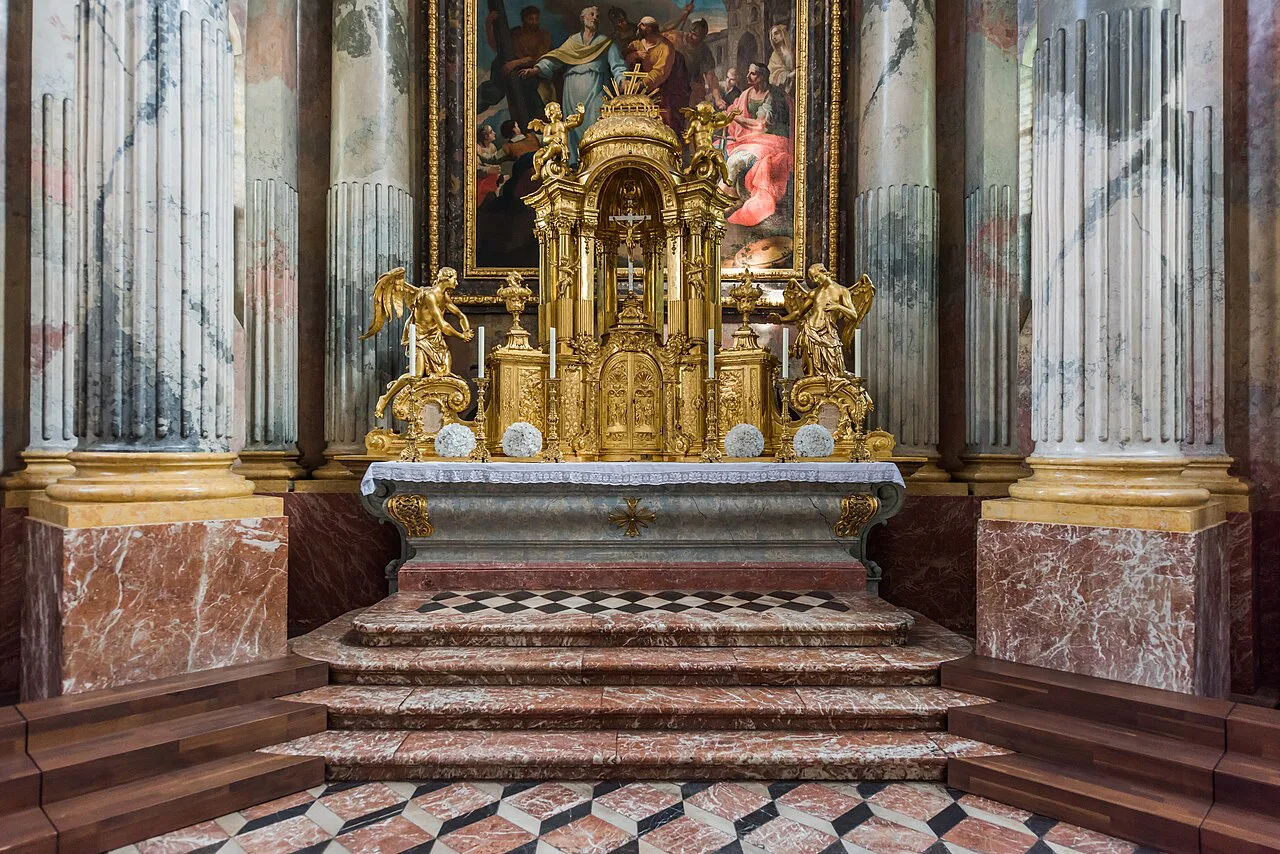
Two furnishings deserve a deliberate stop. The pulpit dates to 1726 and is among the interior's most impressive pieces of church furniture, while the high altar carries an 18th-century painting by Daniel Gran. Find both before you leave the nave, since a hurried pass through the church tends to catch the galleries and miss the furnishings.
Treat the altar painting as the reason to linger at the high altar rather than treating the church as a single wide shot. The pulpit is easiest to study from the nave floor, where you can take in its full height without standing directly beneath it.
Side chapels and their marble detailing
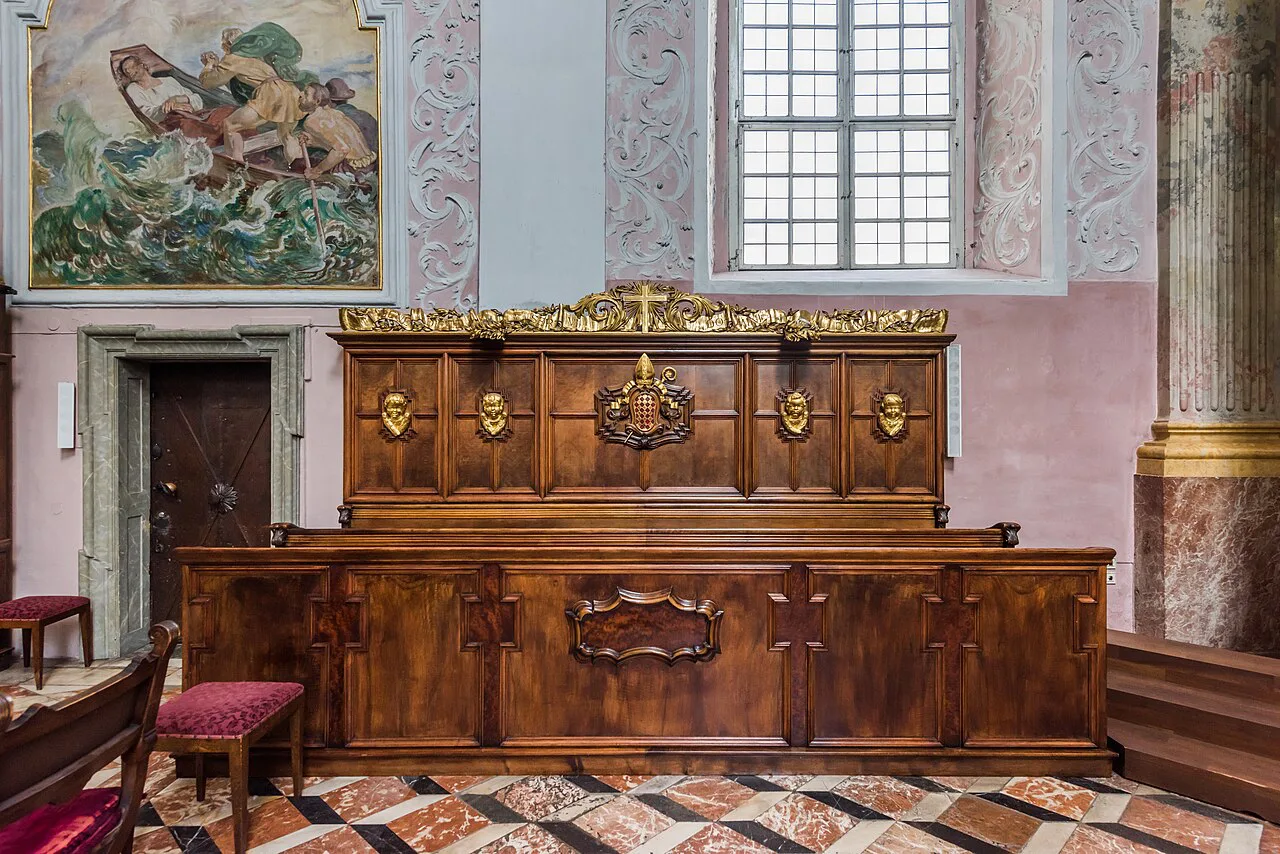
The side chapels add a quieter layer to the visit, and their marble detailing is a specific feature worth seeking out rather than a general impression of grandeur. Walk the perimeter after seeing the high altar, since the chapels sit off the main axis and are easily bypassed if you enter and exit through the same point.
This is where a visit stretches beyond the quick look most travelers give a city church: the chapels reward slow inspection more than the nave does. If your time is tight, spend it on the chapels and the high altar rather than on repeating views of the galleries from every angle.
The Gurk Diocesan Museum next door
The house beside the cathedral holds the Gurk Diocesan Museum, and this is the part of the site most short visits skip. Its displays cover church vestments, religious art, altarpieces and stained glass, which makes it the natural extension if you want context for what the cathedral's furnishings mean. Treat it as a separate museum with its own displays rather than a side room of the church.
The museum's standout object is the Magdalenenscheibe, a stained-glass panel dated 1170 that is thought to be the oldest stained glass in Austria. Keep that hedge when you describe it: the claim is that it is thought to be the oldest, not settled fact. If you only have time for one painted or glazed object beyond the cathedral, make it this panel.
How long to allow and when to go
Give the cathedral itself roughly 20 to 30 minutes: enough for the galleries, the ceiling, the pulpit, the high altar and the side chapels in one pass. Add another 30 to 45 minutes if you go into the Gurk Diocesan Museum next door, which turns the stop into a half-day anchor rather than a quick look. Travelers with only a passing interest should cap it at the church and move on.
Mornings and the quieter stretches of a weekday give the best conditions for looking up at painted ceilings and reading furnishings without a crowd in front of you; midday is when the old city sees the most foot traffic. Check the church's and museum's current opening times locally before you build a schedule around them.
Nearby: Landhaus, New Town Hall and the Benedictine Market
The cathedral's old-city position means the rest of the center is minutes away, and the nearby civic sights round out a single walk. The Landhaus Klagenfurt, the provincial parliament building, is the most architecturally distinctive of them; the wider set of downtown options is laid out in Klagenfurt Attractions: 5 Visitor Guides.
Looping from the cathedral through the old city on foot gives you a continuous stretch of civic architecture and lanes without doubling back. Allow at least an hour for that circuit beyond the cathedral, more if you stop to eat or shop along the way.
If you want a second, very different attraction in Klagenfurt on the same day, Minimundus, the miniature park, is the usual choice and pairs naturally with a center walk. Travelers extending along the water can add a Wörthersee boat trip on a separate afternoon rather than cramming it in with the cathedral.
Should Klagenfurt Cathedral be on your list?
Yes, for the interior rather than for scale: the three galleries, the 18th-century stucco and ceiling paintings, the 1726 pulpit and Daniel Gran's high altar give a 25-minute stop real substance, and the side chapels repay a slower walk. The Gurk Diocesan Museum next door, with the Magdalenenscheibe, is the reason to set aside a full half day. Skip the cathedral only if you have already decided to spend the morning elsewhere in the old city.